How Do You Think Through PfMP Questions? Augment Consultancy’s Five-Step Framework


TL;DR
Learn a five-step PfMP decision framework to answer situational questions, reject distractors, and improve mock-exam reasoning.
The current PMI’s 170-question exam gives candidates 240 minutes to make portfolio-level decisions under pressure. That is why experience alone can feel unreliable when every answer seems partly reasonable.
To answer PfMP situational questions, first identify the organization’s strategic objective, then confirm the portfolio manager’s authority and the governance trigger. Compare portfolio-wide value, risk, resources, and stakeholder effects before selecting the next authorized action. Reject answers that optimize one component, bypass governance, confuse delivery with investment selection, or act before analysis.
We built this guide to show how to answer PfMP situational questions with a repeatable method, recognize tempting distractors, and review mock-exam mistakes without relying on rumored passing scores.
Why Do Experienced Leaders Second-Guess PfMP Questions?
Experienced project and program leaders are used to solving problems quickly. A schedule slips, a team needs help, a budget is tight, and action feels responsible. PfMP questions often ask you to pause that instinct because the portfolio manager’s job is not to rescue every component. It is to help the organization choose, balance, authorize, and govern the right mix of work.
That shift is the heart of how to answer PfMP situational questions. Instead of asking, “How do I fix this component?” ask, “What is the strategic consequence, who has the decision right, and what should happen next?” Understanding strategic portfolio work helps you separate genuine portfolio responsibilities from senior delivery responsibilities.
PMI frames the role around aligning projects, programs, and operations with organizational strategy while balancing demands and directing resources toward priorities. That means the strongest answer is usually not the fastest action. It is the most defensible portfolio action, which is the central discipline behind how to answer PfMP situational questions.
How Do You Use the Five-Step PfMP Decision Flow?
The five-step flow prevents a familiar mistake: choosing an answer because it sounds decisive before identifying what decision is actually being tested. Candidates learning how to answer PfMP situational questions need a sequence that works even when the scenario feels unfamiliar.
-
Identify The Strategic Objective: Look for the business priority, investment theme, regulatory need, benefit, or strategic change behind the scenario. A component can be on schedule and still be strategically misaligned.
-
Confirm The Role And Decision Level: Determine whether the scenario belongs to a project manager, program manager, portfolio manager, sponsor, or governance body. This is the fastest way to eliminate answers that solve the wrong problem.
-
Locate The Constraint And Trigger: Find the event that requires a decision, such as a funding conflict, changed strategy, value gap, aggregate risk, stakeholder disagreement, or review gate.
-
Compare Portfolio-Wide Effects: Evaluate alignment first, then value, risk, resource capacity, dependencies, and communication consequences. Do not let one attractive component override the health of the whole portfolio.
-
Choose The Next Authorized Action: Select the answer that analyzes, recommends, facilitates, communicates, or escalates through the proper governance route. Our PfMP training playbook uses this same distinction between a sound recommendation and an unauthorized decision.
Learning how to answer PfMP situational questions becomes easier when you annotate each item with five short labels: objective, role, trigger, comparison, and next action. Each label keeps you from treating the answer choices as isolated actions rather than parts of a governance decision.
How Do Project, Program, and Portfolio Answers Differ?
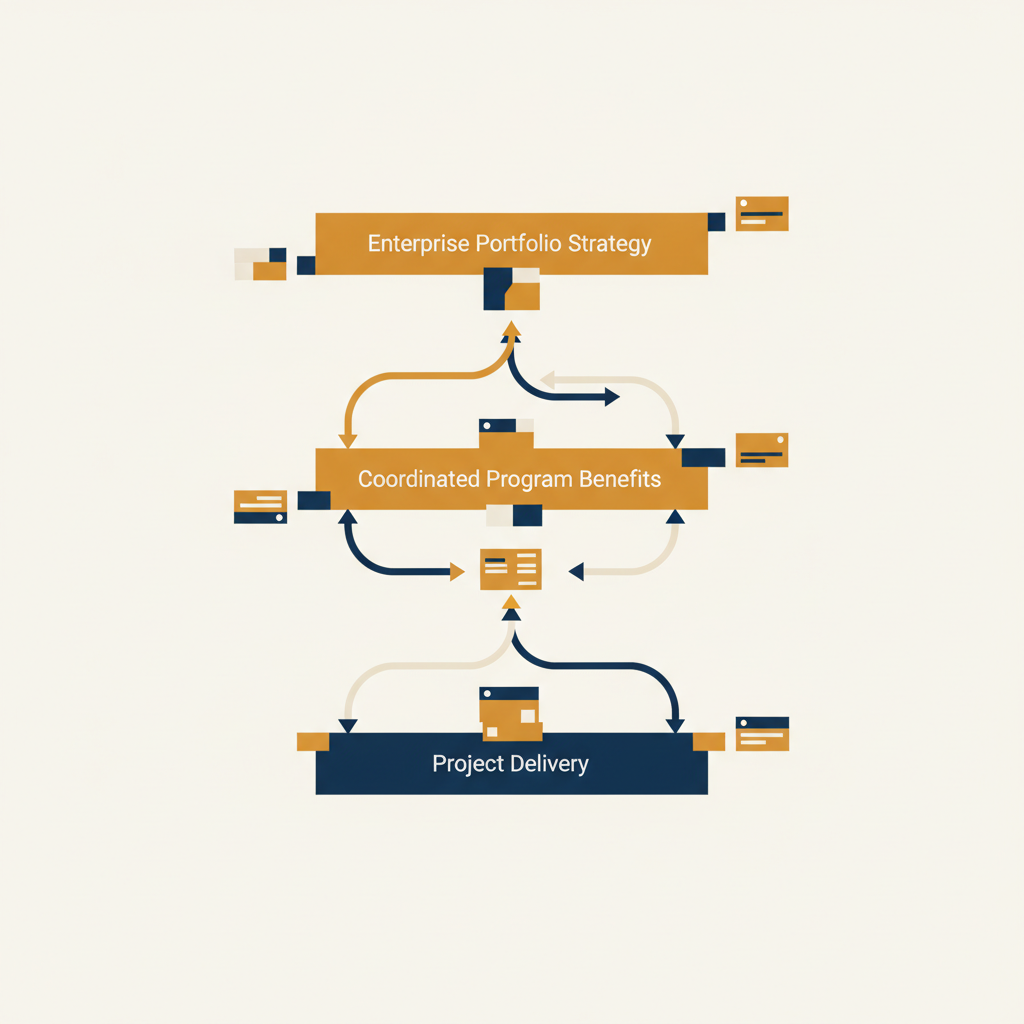
The most attractive wrong answer often comes from the level below portfolio management. Project answers focus on delivery. Program answers coordinate related work and benefits. Portfolio answers consider investment selection, strategic alignment, balance, and governance across the organization.
PMI defines portfolio management as centralized management used to identify, prioritize, authorize, manage, and control work in support of strategic objectives. Its portfolio definition also makes clear that portfolio components do not need to be directly related, which is why local delivery logic is often insufficient.
| Decision Level | Primary Question | Strongest Success Lens | Common Wrong Turn |
|---|---|---|---|
| Project | Can this work deliver its agreed output? | Scope, schedule, cost, quality | Fixing execution when the question asks about investment |
| Program | Are related components delivering coordinated benefits? | Dependencies, benefits, integrated delivery | Treating related work as the whole enterprise portfolio |
| Portfolio | Is the organization doing the right work? | Alignment, value, risk, capacity, governance | Optimizing one successful component at the expense of the mix |
When you are working out how to answer PfMP situational questions, use this table as a quick diagnostic. If an option tells you to manage a team, repair a schedule, or directly correct a component, it may be project or program logic disguised as a portfolio answer. That role check is often the quickest route to how to answer PfMP situational questions correctly. For more practice distinguishing governance responsibilities, see our portfolio governance coverage.
What Should You Prioritize When Several Answers Sound Right?
A good PfMP answer does not ignore value, risk, resources, or stakeholders. It puts them in the right order. Strategic alignment comes first because a component that no longer supports organizational direction may not deserve continued investment, even if its delivery metrics look good. When you are deciding how to answer PfMP situational questions, start by testing alignment before comparing any other benefit.
Next, respect authority and governance. The portfolio manager may analyze the situation, prepare options, recommend a scenario, or facilitate a decision. A governance body or sponsor may authorize a material investment change. After that, compare portfolio value, aggregate risk, capacity, dependencies, and communication needs.
This hierarchy explains how to answer PfMP situational questions when two options both look sensible. Prefer the one that protects strategy and follows the decision process before making an irreversible commitment. A reliable approach to how to answer PfMP situational questions is to ask whether the action is both strategically sound and authorized at that point in the scenario.
Which Distractors Should You Eliminate First?
Distractors are not random. They are built to reward habits that work in operational leadership but fail when the scenario requires portfolio judgment. The fastest way to improve PfMP decision-making logic is to name the pattern that pulled you toward a wrong answer. That is why how to answer PfMP situational questions depends on eliminating bad logic before selecting the best option.
| Distractor Pattern | Clue In The Option | Why It Tempts | Elimination Rule |
|---|---|---|---|
| Premature Action | “Immediately terminate” or “reallocate now” | It feels decisive and efficient | Analyze the strategic and portfolio effect before irreversible action |
| Unauthorized Escalation | “Go directly to the chief executive” | It feels senior and urgent | Use the established governance route unless the scenario requires an exception |
| Local Optimization | “Protect the highest-performing project” | Strong delivery metrics feel persuasive | Compare the whole portfolio, not one component |
| Role Confusion | “Manage the team” or “repair the schedule” | It matches familiar delivery work | Confirm whether the portfolio manager owns the decision |
| Absolute Wording | “Always,” “never,” or “fund all equally” | Certainty can sound authoritative | Reject universal claims unsupported by the scenario |
Use the distractor table before you reread every option in detail. It helps candidates learn how to answer PfMP situational questions by eliminating choices that violate authority, skip evidence, or confuse activity with strategy. In practical terms, how to answer PfMP situational questions often means rejecting the answer that feels urgent but has not earned the right to be taken yet.
How Do Original PfMP-Style Scenarios Build Better Judgment?
The six scenarios below are original practice scenarios created for learning, not recalled exam content. Each one teaches a decision pattern that can transfer to new questions without pretending there is a memorized answer bank. Use these examples to practice how to answer PfMP situational questions by explaining both the correct option and the weakness in each distractor.
How Should You Select a New Component?
Situation: A proposed component strongly supports a new growth objective but needs scarce specialists already assigned to lower-priority work.
Options: Approve it immediately, ask the project manager to find extra staff, analyze strategic fit and capacity scenarios, or delay all decisions until the next annual cycle.
Reasoning: The issue is investment selection under a resource constraint. The portfolio manager should compare strategic contribution, capacity, dependencies, and the consequences of changing the current mix.
Answer: Analyze portfolio scenarios and recommend an option through governance.
Lesson: How to answer PfMP situational questions begins with evidence and portfolio-wide comparison, not immediate approval.
How Should You Reprioritize Work After a Strategy Change?
Situation: A revised corporate strategy makes several approved components less relevant, although each is still delivering planned outputs.
Options: Continue all work because delivery remains strong, terminate every affected component, assess strategic impact and prepare reauthorization options, or ask component managers to rewrite the strategy.
Reasoning: Delivery performance does not override strategic alignment. However, the portfolio manager should not terminate work unilaterally without the required review.
Answer: Assess the impact, develop options, and take the recommendation through governance.
Lesson: How to answer PfMP situational questions after a strategy shift means reviewing the investment case before deciding whether to continue or terminate work.
How Should You Resolve a Funding Conflict?
Situation: Two components need the same limited funding. Both have credible value cases, but one advances a higher strategic priority while the other reduces a major compliance exposure.
Options: Fund the component with the largest projected return, split the money equally, compare strategic criteria and risk before recommending a scenario, or let the component managers negotiate privately.
Reasoning: The portfolio manager must make trade-offs visible. A return figure alone may miss regulatory exposure, timing, capacity, and strategic consequences.
Answer: Compare the alternatives against approved prioritization criteria and recommend a governance decision.
Lesson: Portfolio value is broader than one financial measure. Knowing how to answer PfMP situational questions here means using the approved criteria rather than inventing a single winning metric. Candidates comparing study formats can use our training alternatives page before choosing a route.

How Should You Handle Aggregate Portfolio Risk?
Situation: Three components each report a manageable supplier risk. Together, they depend on the same supplier, creating a single point of failure for a strategic objective.
Options: Let each component maintain its own response, calculate and assess the combined exposure, replace all suppliers immediately, or wait for one component to fail before escalating.
Reasoning: The trigger is not a project-level risk alone. The shared dependency creates a portfolio-level exposure that may alter the risk profile of the entire investment mix.
Answer: Assess the aggregate risk and bring the portfolio implication into the proper review and communication process.
Lesson: How to answer PfMP situational questions about risk means looking for correlations, not just isolated risk registers. It also means identifying whether the aggregate exposure changes a portfolio decision.
How Should You Manage a Governance Impasse?
Situation: Stakeholders disagree during a portfolio review meeting about whether a costly component should continue. The portfolio manager has presented current value, risk, and capacity information.
Options: Make the final decision independently, postpone without discussion, facilitate the agreed decision process, or escalate immediately outside the governance structure.
Reasoning: The portfolio manager’s role is often to enable a sound decision, not to bypass the board or avoid the issue.
Answer: Facilitate a structured discussion using the established governance framework.
Lesson: Governance is a decision mechanism, not paperwork added after the decision. This is how to answer PfMP situational questions when disagreement creates a decision trigger.
When Should You Recommend Termination?
Situation: A component has missed benefits targets twice, consumes scarce funding, and no longer aligns with the organization’s highest priority.
Options: Terminate it immediately, continue because funds have already been spent, analyze the value and strategic case before recommending termination, or require the project manager to solve the issue alone.
Reasoning: The evidence points toward a possible termination recommendation, but the correct next step still requires an informed portfolio assessment and authorized decision.
Answer: Analyze the continuing case and recommend termination or reauthorization through governance.
Lesson: A termination decision is strongest when it is strategic, evidence-based, and authorized. Learning how to answer PfMP situational questions means separating a strong recommendation from the authority to execute it. Our practice-test gap guide explains why answer explanations matter more than simply collecting scores.
Why Do You Keep Failing PfMP Mock Exams?
Mock exams are useful only when the review process changes the next decision. If you record a wrong answer as “missed governance,” you have learned very little. If you record that you bypassed a decision gate because an option sounded urgent, you have identified a reusable correction. That review habit strengthens how to answer PfMP situational questions under new wording and different business contexts.
PMI’s handbook states that 150 questions are scored and 20 are unscored pretest questions, while the exam blueprint spans five domains. The PMI handbook does not publish a passing score, so score speculation should not replace disciplined review.
Build a mock-exam review log after every timed set:
- Domain: Record strategic alignment, governance, portfolio performance, portfolio risk management, or communications management.
- Reasoning Pattern: Note premature action, governance bypass, role confusion, local optimization, missed aggregate risk, or weak stakeholder timing.
- Missing Cue: Write the exact phrase in the scenario that should have changed your decision.
- Better Rule: Create one sentence you can apply to a similar question next time.
- Retry Result: Reattempt the item later and explain why each distractor fails.
This is how to answer PfMP situational questions more consistently. A careful error log turns how to answer PfMP situational questions from a vague exam technique into a repeatable decision habit. Our study beyond the Standard resource can help you turn formal concepts into scenario-level reasoning.
How Do You Measure PfMP Readiness Beyond a Mock Score?
Readiness is not one lucky score from a familiar question bank. It is the ability to apply the same decision logic when the context, industry, stakeholders, and answer wording all change. That is the real test of how to answer PfMP situational questions consistently.
Use the rubric below after mixed practice sets. It measures whether you are selecting answers for the right reason, which is more durable than memorizing patterns. It also shows whether your approach to how to answer PfMP situational questions holds up when time pressure rises.
| Reasoning Level | Observable Behavior | Next Practice Move |
|---|---|---|
| Component-First | Chooses delivery fixes or direct interventions | Relearn project, program, and portfolio boundaries |
| Process-Aware | Recognizes governance but misses strategic trade-offs | Annotate objective, role, and trigger before reviewing options |
| Portfolio-Consistent | Compares alignment, value, risk, and capacity | Build speed through timed mixed-domain sets |
| Defensible | Explains why every distractor fails | Practice concise verbal justification under time pressure |
Candidates who reach the final two levels consistently across the five domains are building a reliable PfMP strategic mindset. If you need to compare study formats while protecting a demanding schedule, choose a route that leaves room for regular timed practice.
How Does PfMP Mentoring Build Decision Logic?
Useful mentoring is more than exam tips. We use mentoring to identify whether your errors come from governance assumptions, weak strategic alignment analysis, role confusion, or a tendency to act before you have enough evidence. That is particularly useful when how to answer PfMP situational questions feels less certain than your real-world leadership experience.
That matters especially for senior program managers moving toward portfolio governance. Your delivery experience is valuable, but you need a way to translate it into investment-level reasoning. Our PfMP certification support approach focuses on original scenarios, mock-review patterns, and explanations you can defend, rather than asking you to memorize a preferred option.
When you can explain why an answer is unauthorized, too local, too early, or strategically incomplete, you are no longer guessing. You are applying a portfolio decision model, which is the foundation for how to answer PfMP situational questions with confidence.
How Can Augment Consultancy Help You Build PfMP Decision Logic?
At Augment Consultancy, we do not treat mentoring as a stream of answer keys. We help you expose the reasoning habit behind every choice, whether you are bringing years of program delivery experience or moving into portfolio governance for the first time. Our approach uses original scenarios, focused review conversations, and a mock exam error log so you can explain why one option protects strategic alignment while another only sounds decisive. We also help you distinguish a recommendation from an authorization, recognize when analysis must precede action, and build confidence without relying on rumored pass scores. If your preparation has become a cycle of second-guessing, we can help you turn each missed question into a usable decision rule. You will practice the portfolio logic that makes difficult scenarios clearer under timed conditions. Explore our learning path and begin with Augment Consultancy.
FAQs on How to Answer PfMP Situational Questions
Common questions follow.
Are PfMP Situational Questions Mainly Recall Questions?
Situational questions test applied portfolio judgment, so start with strategy, authority, governance, and portfolio trade-offs instead of recalling a definition or a process list from memory.
How Do I Know Whether an Answer Is Portfolio Level?
Look for investment selection, strategic alignment, portfolio balance, capacity, governance, or aggregate risk. Delivery fixes, team direction, and schedule recovery usually signal lower-level reasoning instead.
What Does “First” or “Next” Mean in a Scenario?
It asks for the immediate authorized step, which is often analysis, assessment, facilitation, or communication before a recommendation, reallocation, termination, or escalation within the established governance process.
Should I Always Escalate a Portfolio Problem?
No. First identify the established governance route and the portfolio manager’s authority. Escalate when required, but do not bypass a capable decision forum without reason.
Why Do Strong Mock Scores Sometimes Mislead Me?
A familiar question bank can reward recognition. Mixed original scenarios reveal whether you can identify strategic objectives, governance triggers, and portfolio-level consequences without pattern matching.
How Should I Review a Missed Practice Question?
Record the domain, missing cue, distractor pattern, correct reasoning, and a better decision rule. Then retry later and explain why every wrong option fails under timed conditions.
Are Immediate Actions Usually Wrong on PfMP Questions?
Not always. Immediate action can be appropriate when authority, evidence, and urgency are explicit. Otherwise, choose the authorized analysis or governance step that logically comes first.
Are These Practice Questions Recalled Exam Content?
No. Every scenario in this article is original learning content. We created them to teach portfolio decision logic without reproducing protected exam questions or answers.