Check 5 PgMP Training Claims Before You Buy a Course
Separate PgMP eligibility from PDU claims, verify trainer and ATP status, and test pass-rate evidence before paying for exam preparation.

By Sanjeev Kumar, Founder · Updated 28 Sept 2026

In brief
A PgMP course can support your preparation, but it cannot establish your PMI eligibility. Check the experience route first, then verify PDU, trainer, ATP, pass-rate and cost claims against PMI records before you enrol.
In this article
Eligibility is the first claim to test
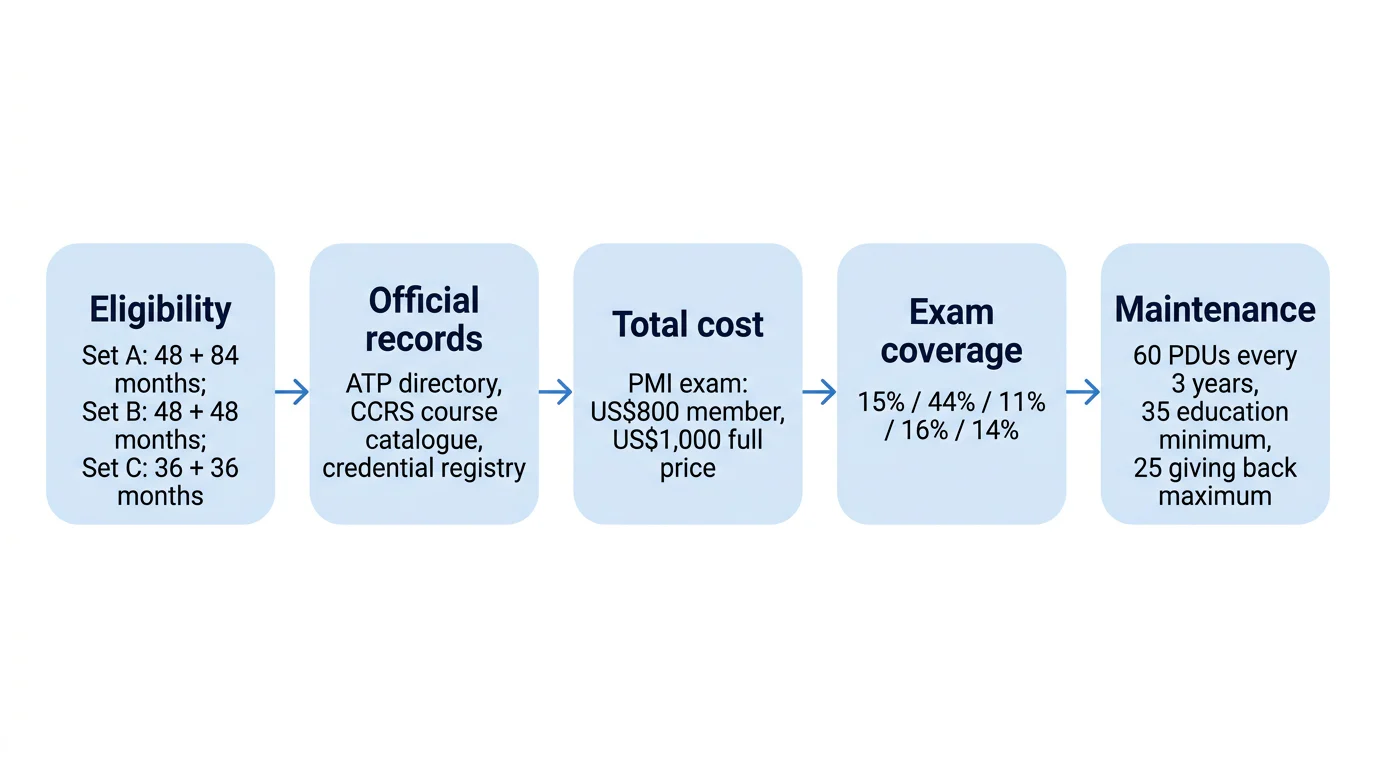
PMI’s three published PgMP routes are based on education and professional experience, not on buying a preparation course. Check your route before comparing tuition, mock questions or mentoring. PMI’s current PgMP certification page (2026) sets out the requirements below.
If none of these routes fits your record, pause the purchase decision. A course may still teach programme-management practice, but it does not replace qualifying experience. Readers whose title does not say programme manager can also assess whether their evidence may fit in this eligibility guide.
| Route | Education | Project-management experience | Programme-management experience |
|---|---|---|---|
| Set A | Secondary-school diploma or equivalent | 48 months, or PMP | 84 months within the past 15 years |
| Set B | Bachelor’s degree or higher, or equivalent | 48 months, or PMP | 48 months within the past 15 years |
| Set C | Bachelor’s or postgraduate degree from a GAC-accredited programme | 36 months, or PMP | 36 months within the past 15 years |
A PDU claim answers a different question
A PDU certificate can be useful after certification, but it is not evidence that you qualify to apply. PMI’s maintenance rules (2026) require PgMP holders to earn 60 PDUs in every three-year cycle, including at least 35 Education PDUs and no more than 25 Giving Back PDUs.
For every PDU claim, ask for the course title, provider name, delivery method, dates and Talent Triangle allocation. Then search the PMI CCRS course catalogue (2026), which shows those fields for listed courses. This PDU record checklist explains the five records to compare before enrolment.
| Question | Evidence to inspect | What it establishes |
|---|---|---|
| Can I apply for PgMP? | Education and unique professional-experience record | Initial eligibility |
| Can I use this learning after certification? | PDU details in CCRS and course-completion evidence | Potential credential maintenance value |
Ask for evidence behind status, trainer and outcome claims
A provider that claims PMI official content should be checkable in the PMI Authorized Training Partner directory (2026). PMI states that only Authorized Training Partners use PMI official course content. Treat that as one check, not a substitute for examining the course itself.
For a trainer who claims a PMI credential, search the PMI Certification Registry (2026) by country, credential and name. The registry allows credential holders to opt out, so an absent result is not a conclusion. Ask the trainer for a direct confirmation where the public search cannot settle the question.
A pass-rate percentage needs enough detail to be meaningful. Request the cohort dates, learner count, exam-sitter count, first-attempt definition and the way withdrawals were counted. Application support needs equally clear boundaries: feedback can help you structure evidence, but your final descriptions must remain your own. Read the practical boundary in our guide to PgMP application review support.
Compare the purchase with the exam you are actually taking
PMI’s current PgMP exam fee is US$800 for members and US$1,000 at full price, and PMI says the fee is required after application acceptance and when you are ready to schedule. A course fee and an exam fee therefore pay for different things. PMI’s PgMP page (2026) provides the fee and timing, while this fee comparison separates the two budgets.
Also compare course scope against the March 2024 Exam Content Outline. PMI weights Strategic Program Alignment at 15%, Program Life Cycle Management at 44%, Benefits Alignment at 11%, Stakeholder Engagement at 16% and Governance at 14%. PMI’s March 2024 Examination Content Outline is the reference for that coverage.
| Claim | Question to ask before paying |
|---|---|
| Access period | How long are lessons, recordings, mocks and mentor support available? |
| Live support | How many live sessions are included, and what happens if I miss one? |
| Application feedback | What feedback is included, and how will I retain authorship of my responses? |
| Exam practice | How many questions are included, and how is coverage mapped to the current outline? |
| Refund or transfer | What written cancellation, future-batch and access terms apply? |
Our PgMP options, stated plainly
As of September 2026, our PgMP Fast Track Program Oct ’26 costs US$950 for 365-day access, with two US$475 monthly payments available. It includes two weekend live online sessions, self-paced video learning, application support, 1,000+ exam questions, a 24-PDU training certificate, a mentor gap-assessment session, programme templates, case studies, community access and one-year access to live-session recordings.
We also offer PgMP Self-Paced Learning for US$549 with 180-day access, and PgMP Application Writing Support for US$199 with 60-day access. The Fast Track format suits learners who want scheduled discussion and recorded access. It is not a substitute for the professional experience PMI requires, and it is not the lowest-cost option for someone who only needs application feedback.
Put the checks in a fixed order
Running these checks in order prevents a PDU certificate or a persuasive sales claim from distracting from the eligibility gate. Keep copies of the provider’s answers, course terms and official-search results before you pay.
What evidence to get before paying