Karnataka School Deal Makes Project Portfolio Management Training Urgent


TL;DR
Karnataka signed a ₹2,500 crore programme with ADB on 21 August 2026 to develop 500 public-school clusters. We examine what has been confirmed, why AI and bilingual teaching are only part of the delivery challenge, and how project portfolio management training helps leaders govern benefits, dependencies, and evidence through 2030.
Karnataka has moved a major public-school expansion from policy into a financed delivery programme. The Asian Development Bank approved a US$182.89 million loan on 1 July 2026 to support the initiative.
On 21 August 2026, Karnataka signed an agreement with ADB for a ₹2,500 crore programme to develop 500 Karnataka Public Schools. With ₹1,750 crore from ADB and ₹750 crore from the state, project portfolio management training matters because results will depend on coordinated benefits, governance, and delivery from 2026 to 2030.
We look at what the programme is meant to deliver, where execution risk sits, and what public-sector portfolio leaders should watch next.
What Karnataka Agreed to Deliver
The agreement commits Karnataka to develop 500 integrated public-school clusters, with reported financing split between ₹1,750 crore from ADB and ₹750 crore from the state. The programme is scheduled to run from 2026 to 2030, according to the published agreement details.
The core proposition is broader than a facilities upgrade. ADB describes a model offering continuity from pre-primary through secondary education, alongside stronger teacher capability, curriculum and assessment systems, school governance, STEAM learning, and industry-aligned skills. That matters because a cluster cannot produce better outcomes simply by opening new classrooms or adding devices.
Each KPS is intended to have capacity for at least 1,200 students. Across 500 schools, that implies at least 600,000 direct places, while ADB’s wider programme ambition is to improve learning for more than one million students. Those are not interchangeable measures. One is planned school capacity, while the other reflects broader system reach.
The Delivery Challenge Is Wider Than AI
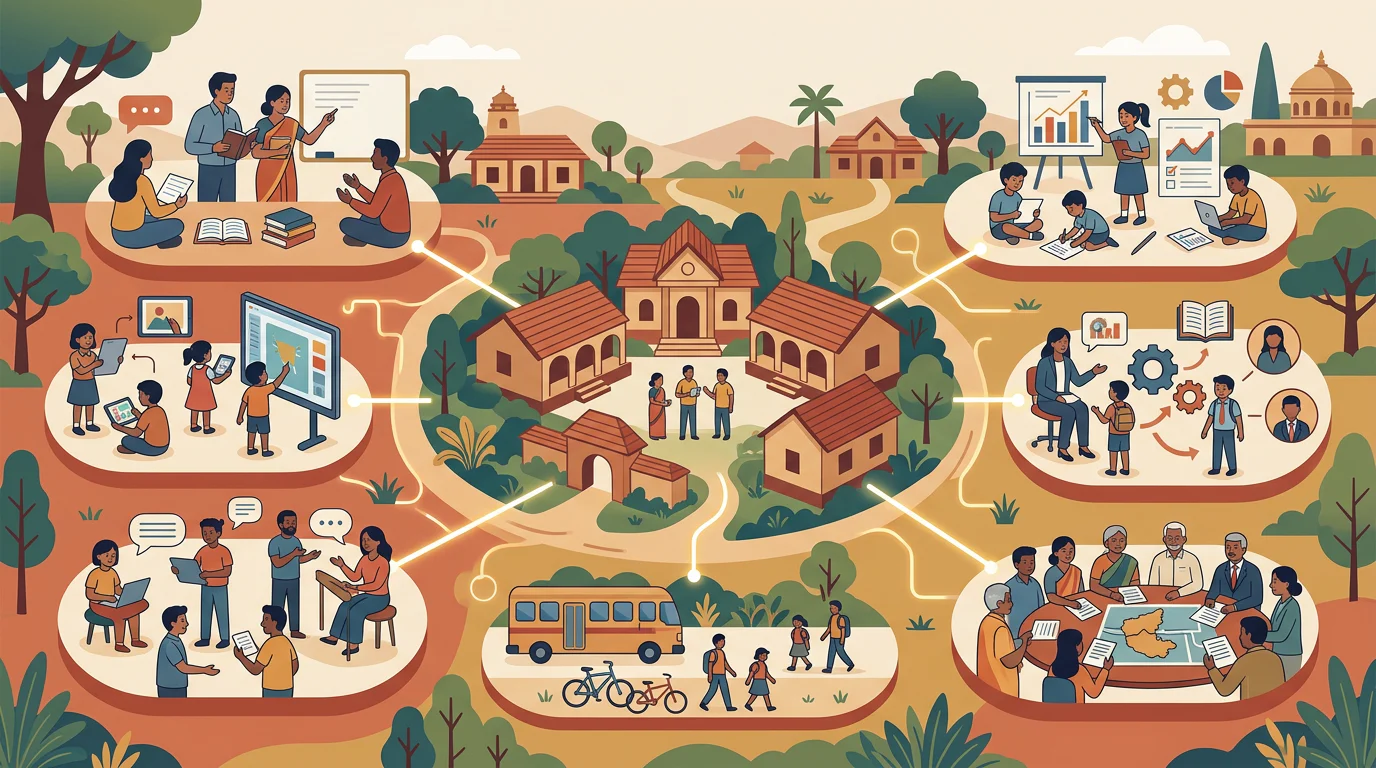
AI learning, bilingual teaching, transport, competitive-exam preparation, and career guidance have drawn understandable attention. Yet they are connected delivery streams, not independent features that can be assessed one at a time.
Bilingual Learning Needs Teacher Support
Karnataka is not beginning from zero. A 2024 parliamentary response recorded 4,129 English-Kannada bilingual sections already operating in government schools, while more than ₹20 crore supported spoken-English materials and teacher training for over 20 lakh students in Classes VI to X. The same government response noted digital content in 108 languages and 280 virtual science and mathematics labs.
The practical test is whether teachers can use bilingual resources consistently, whether material fits the curriculum, and whether students can progress without language becoming another barrier. Counting sections opened is useful, but it is not proof of learning.
AI Requires Operating Conditions
Computer and AI education are planned components of the KPS model. Their value will depend on infrastructure, content quality, teacher confidence, classroom time, learner safeguards, and a realistic way to assess whether the tools improve understanding.
This is why portfolio leaders should resist a technology-first narrative. A device rollout can be completed on schedule while the underlying outcome, stronger learning and future readiness, remains unproven.
Exam Preparation Must Fit the School Model
Competitive-exam preparation and career guidance are planned from Class 6 onward. That raises an important governance question: how will leaders balance exam support with foundational learning, inclusion, and the broader purpose of a public-school cluster?
The programme is more credible when these decisions are made through shared outcomes and trade-offs, rather than through a growing list of activities.
What Project Portfolio Management Training Can Learn
Project portfolio management is centralized decision-making across projects, programmes, operations, and investments to meet strategic objectives. PMI’s portfolio definition is useful here because Karnataka’s initiative combines several workstreams that compete for funding, leadership attention, and implementation capacity.
Measure Benefits, Not Activity
A completed school building, installed software, or delivered training session is an output. Benefits are the changes those outputs create, such as student retention, equitable access, teacher adoption, learning progress, and credible pathways to further education or work.
For this programme, leaders should keep direct KPS capacity separate from wider beneficiaries. Clear definitions make reporting more useful and prevent programme success from being reduced to a headline number.
Assign Decision Rights Early
The difficult choices will not be confined to one department. Leaders will need to decide how to sequence upgrades, where teacher support is most urgent, when to change an underperforming component, and which data can trigger intervention.
That is the practical value of portfolio governance. It creates a route from evidence to a decision, with someone accountable for making it.
Manage Dependencies Across the Portfolio
Teacher training affects the usefulness of bilingual materials and AI tools. Transport affects attendance. Assessment systems affect whether leaders can distinguish improved access from improved learning. These dependencies are why a collection of worthwhile projects still needs one governing portfolio.
For senior practitioners building that judgement, our PfMP application guide explains how to frame strategic portfolio experience clearly.
What Portfolio Leaders Should Monitor Next
Karnataka’s 2026 to 2027 budget had already identified 500 schools for ADB-supported upgrading within a wider plan for 800 KPS schools, with ₹3,900 crore planned over three years. It also referenced filling 15,000 teacher vacancies across schools and colleges, a reminder that workforce capacity remains central to delivery. The state budget update provides useful context for the programme’s scale.
The next phase should be judged by transparent implementation evidence, not only the financing agreement. A strong review rhythm would monitor:
- Selected school clusters and rollout sequencing.
- Procurement, infrastructure, and digital-readiness milestones.
- Teacher recruitment, preparation, and classroom adoption.
- Baseline learning, attendance, retention, and equity measures.
- Annual benefit reporting and the actions taken when results differ from plan.
The most useful lesson is straightforward. Large education investment portfolios succeed when leaders can connect strategic intent to measurable outcomes, then adjust resources when evidence changes.
Augment Consultancy Can Help Leaders Build Portfolio Judgement
At Augment Consultancy, we help senior programme and portfolio leaders turn complex initiatives into evidence-based governance decisions. This news is a useful case for professionals preparing to assess strategic alignment, benefit ownership, portfolio risk, reporting, and resource trade-offs, rather than treating delivery as a list of independent projects. Our coaching concentrates on the reasoning behind executive choices: what to fund, what to measure, when to intervene, and how to describe portfolio experience credibly. If you are building the judgement needed for a PfMP application or a high-stakes PMO role, visit Augment Consultancy Home.
FAQs on Project Portfolio Management Training
When Was the Karnataka ADB Agreement Signed?
The agreement was signed on 21 August 2026. Its ₹2,500 crore financing combines ₹1,750 crore from ADB with ₹750 crore from Karnataka and runs through 2030.
How Many Students Could the New Schools Serve?
At least 1,200 students are planned per KPS, so direct school capacity differs from the more than one million learners ADB expects the broader programme to help.
What Should Portfolio Leaders Monitor First?
Monitor selected clusters, procurement, teacher readiness, baseline outcomes, annual results, and resource changes when evidence shows a component is underperforming. These are portfolio-level proof points.