What Does PgMP Training with Application Support Actually Include?
See what PgMP training with application support includes: eligibility review, panel prep, five exam domains, simulations, and mentoring.

The PgMP credential is built for experienced program leaders, and the final assessment is a 170-question exam completed in 240 minutes. Before a candidate can schedule it, PMI also evaluates their submitted experience through panel review, which makes exam-only preparation incomplete for many applicants.
Complete PgMP training with application support helps candidates document eligible program experience, improve their own strategy, leadership, and governance summaries, prepare for panel review, learn every exam domain, and use simulations to correct weaknesses. It should offer candid feedback without writing false claims or replacing the applicant’s judgment and responsibility.
Here, we separate the certification stages, the learning resources, and the support levels so you can judge what you genuinely need. We last reviewed this guidance on August 18, 2026.
What Should PgMP Training with Application Support Include?
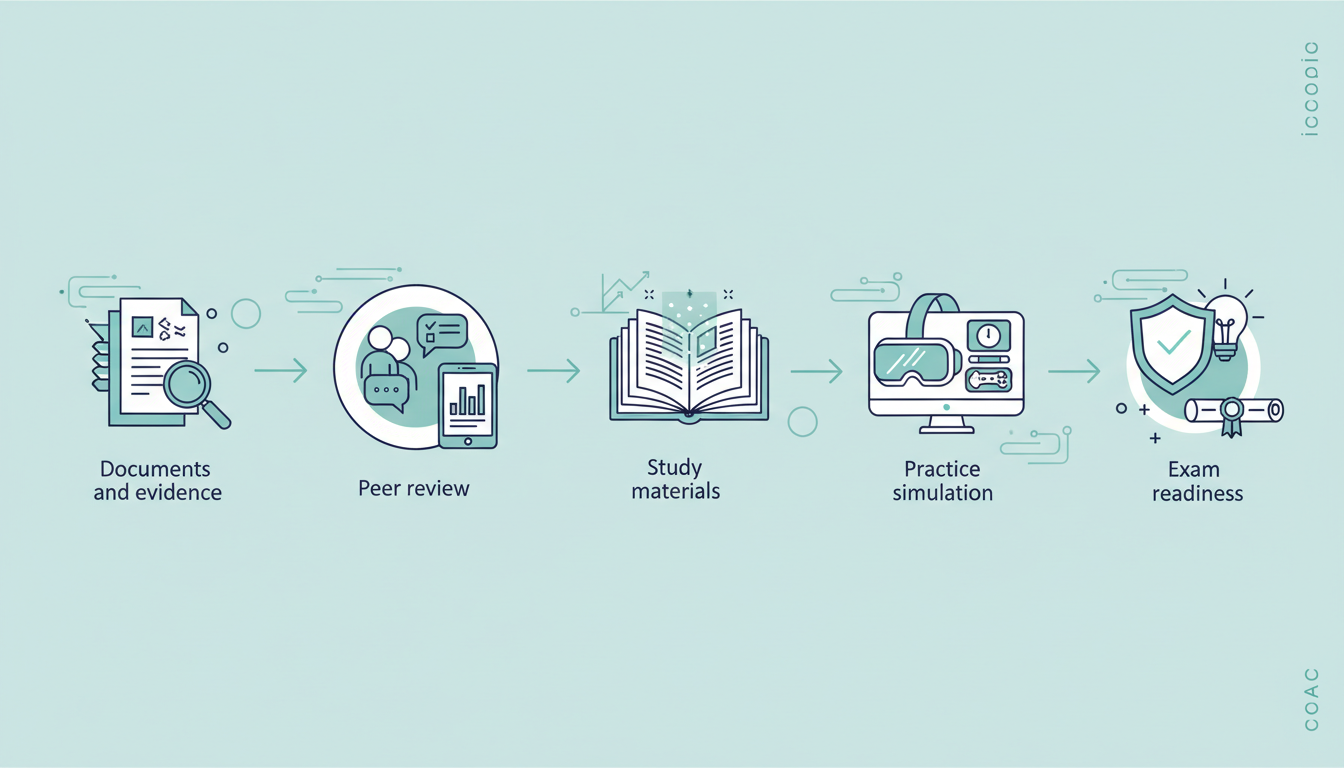
A complete route follows the way PMI evaluates candidates, not the way a generic exam course is easiest to package. We build our preparation around the evidence candidates must assemble, the review they must pass, and the judgment they must demonstrate under timed conditions.
- Eligibility review: Confirm which education and experience route fits before writing.
- Application support: Help organize genuine program evidence and make summaries clearer.
- Panel preparation: Explain what reviewers assess and identify gaps before submission.
- Domain learning: Teach strategic alignment, lifecycle management, benefits, stakeholders, and governance.
- Mock analysis: Use practice results to identify weak reasoning, weak concepts, and time-management problems.
The distinction matters because a strong exam score cannot repair unclear experience summaries, and a polished application cannot replace domain knowledge. Our application-versus-exam guide helps candidates decide where to focus effort first.
We use live teaching for judgment calls and questions, recordings for revision, self-paced materials for flexible study, and case studies for applying concepts to realistic programs. Practice questions have a narrower but valuable role: they should expose gaps and improve decision-making, never imitate restricted exam content.
Do I Meet PMI’s PgMP Eligibility Requirements?
PMI has three current eligibility routes, each combining education with project and program-management experience. We start with this check because the best curriculum cannot compensate for experience that does not fit the application criteria.
| Route | Education | Project Management Experience | Program Management Experience |
|---|---|---|---|
| A | Secondary degree | 48 months or PMP | 84 months |
| B | Bachelor’s degree or higher | 48 months or PMP | 48 months |
| C | GAC-accredited bachelor’s degree or higher | 36 months or PMP | 36 months |
The current PMI requirements place all of those experience windows within the past 15 years. PMI also asks candidates to document their role, responsibilities, program objectives, and component projects, then provide experience summaries addressing program strategy, governance, and leadership.
What Happens After Eligibility Is Confirmed?
The practical journey has five stages. First, choose the experience route and suitable program examples. Second, document project and program work and prepare the experience summaries. Third, submit the application, respond to any audit request, pay the fee, and enter panel review. Fourth, study the domains and use diagnostic practice. Fifth, schedule and take the exam after panel approval.
PMI allows up to three exam attempts within one year. After certification, PgMP holders must earn 60 PDUs during each three-year cycle to maintain the credential.
When experience comes from a nonstandard environment, the job title alone rarely tells the story. Our application domain guide shows how to map the work itself to the evidence PMI expects.
What Should Application and Panel Review Support Cover?
The application is not a formality before the “real” test. It is where a candidate must show they managed an integrated program rather than a collection of unrelated projects, which is why useful support begins with evidence selection instead of writing tips.
How Should Candidates Select Program Examples?
We help candidates identify examples with a shared strategic purpose, connected components, meaningful governance, and a credible personal leadership role. That approach is especially useful for public-sector, infrastructure, regulated, or government-contracting work, where the language may differ from commercial IT but the underlying program evidence can still be assessed clearly.
The aim is not to force a familiar template onto every background. It is to describe the actual program, its intended benefits, its stakeholders, and the decisions the candidate personally led. Candidates working in complex public programs can also use our government program guide to frame their experience without relabeling projects as programs.
What Does a PgMP Panel Review Preparation Course Do?
A credible panel-review course explains the review sequence, tests whether each summary demonstrates program-level responsibility, and provides line-level feedback on clarity and completeness. Our preparation focuses on the candidate’s own evidence, then uses live discussion to surface weak links before the application goes forward.
The practical outputs should include an experience inventory, an evidence-gap assessment, clearer summaries, and a submission checklist. We also make the next support step explicit, so candidates know whether they can ask questions after submission, during an audit, or after official feedback.
For a deeper look at the distinction between application review and test preparation, read our panel review comparison.
Where Is the Boundary Between Editing and Misrepresentation?
We can ask questions, explain PMI terminology, challenge unsupported statements, and edit for clarity. We cannot invent experience, submit false claims, or make the applicant appear to have led work they did not lead.
That boundary protects the candidate and the credential. PMI’s integrity policy requires complete and accurate explanations and supporting documentation where needed, so every summary must remain candidate-owned and defensible.
How Does the Curriculum Prepare Candidates for the Exam?
Our curriculum keeps application work and exam work connected without treating them as identical. The application establishes that a candidate’s experience qualifies, while the exam measures program-management knowledge and judgment across five weighted domains.

| Module | Focus | Outcome |
|---|---|---|
| 1 | Program fundamentals, roles, PMO, program versus portfolio | Establish program-management context |
| 2 | Strategic program alignment | Build strategic-domain judgment |
| 3 | Benefits alignment | Connect programs to measurable benefits |
| 4 | Stakeholder engagement | Practice stakeholder analysis and action |
| 5 | Governance | Apply governance structures and decisions |
| 6 | Program life cycle management | Work through planning, delivery, and closure |
| 7 | Application and experience summaries | Prepare panel-review evidence |
| 8 | Exam strategy and integrated review | Connect concepts to timed decisions |
| 9 | Simulator and mock analysis | Create a focused readiness plan |
Which Current Domains Must the Course Cover?
The exam content outline assigns 15% to Strategic Program Alignment, 44% to Program Life Cycle Management, 11% to Benefits Alignment, 16% to Stakeholder Engagement, and 14% to Governance. We cover all five, while giving lifecycle management the attention its weighting warrants.
What Does Each Learning Format Contribute?
Live sessions let candidates ask why one course of action is stronger than another. Recordings and self-paced resources make revision possible around senior work schedules. Case studies help connect abstract domain language to real program decisions, while practice questions test whether that reasoning still holds under pressure.
The simulator should do more than produce a percentage. We use it to identify whether a wrong answer came from a knowledge gap, a judgment error, a misread scenario, or poor pacing. Our readiness scorecard gives candidates a practical way to turn that diagnosis into a study plan.
What Should Mentor Feedback Produce?
Personalized feedback should leave a candidate with a priority order, not a vague instruction to “study more.” We expect it to produce a domain-level gap view, a record of repeated mistakes, a realistic revision sequence, and a clear decision about whether the next effort belongs in application work, knowledge review, or simulation practice.
Which PgMP Training Route Fits Your Situation?
The right route depends on what is uncertain. A candidate with clear qualifying experience and strong self-discipline may need less help than someone who is unsure whether their programs meet PMI’s standard or who needs feedback on summaries and mock-exam reasoning.
| Support Element | Self-Study | Application-Only Support | Self-Paced Training | Mentored Complete Training |
|---|---|---|---|---|
| Eligibility review | Candidate-led | Included | Worksheet-led | Personalized |
| Line-level summary feedback | No | Included | Usually not | Included |
| Panel preparation | Candidate-led | Confirm scope | Usually not | Live, if included |
| Live access | No | Limited | No | Included |
| Simulator use | Candidate-selected | Add-on or none | Varies | Included, if stated |
| Post-course support | None | Defined term | Portal-access term | Defined mentoring term |
Can I Self-Study the Application Process?
Yes, if you can interpret the criteria, document your role accurately, choose credible program examples, and review your own writing critically. Coaching is not a PMI eligibility requirement, but it can be valuable when the candidate’s experience is complex or their application evidence is difficult to frame concisely.
Can I Buy Application Support Separately?
You may be able to, but confirm exactly what the service includes. Ask about the eligibility review, feedback rounds, panel-review preparation, post-submission help, live access, and whether exam instruction or simulator use are outside the scope.
How Do I Switch Providers Midway?
Switching providers does not change your PMI application. Keep your candidate-owned drafts and evidence inventory, compare the new scope carefully, and make sure you understand what feedback, live support, or simulation access remains available.
Our personalized route comparison can help you compare support levels without assuming every candidate needs the same route.
Why Choose Augment Consultancy for PgMP Training?
At Augment Consultancy, we built this PgMP training with application support for senior leaders whose experience is substantial but difficult to compress into PMI’s evidence format. We teach directly from certified PgMP® and PfMP® professionals with real-world program and portfolio management experience, then connect live learning, recordings, cases, summary feedback, and mock analysis into one certification-stage path. Bring us the work you actually led, including complex regulated or public-sector programs, and we will help you test its fit, organize it clearly, and prepare your own submission responsibly. We do not treat a simulator score as a substitute for the application or treat application feedback as a substitute for domain learning. If your priority is a clear scope, practitioner feedback, and a preparation path you can scrutinize before enrolling and compare against your commitments, time, and budget, start with Augment Consultancy.
FAQs on PgMP Training with Application Support
These answers address the practical questions candidates ask while deciding between independent preparation, limited application help, and a complete mentored route. Each answer assumes the candidate remains responsible for the accuracy of their PMI submission.
What Does PgMP Training Include?
Complete training covers eligibility mapping, candidate-owned evidence, panel-review preparation, all five domains, live or recorded learning, simulations, and a defined feedback period after submission for candidates.
Is PgMP Coaching Essential, or Can I Self-Study the Application?
Coaching is not a PMI requirement. Self-study works when you can interpret criteria, document your role accurately, build a practice plan, and diagnose repeated mistakes independently.
What Is a PgMP Panel Review Preparation Course?
A panel-review course helps candidates select truthful examples, explain program-level responsibilities, refine summaries for clarity, and understand available feedback, support, and next steps after submission.
Can I Buy PgMP Application Support Separately?
Yes, if offered separately, but confirm review scope, feedback rounds, panel preparation, post-submission support, live access, and whether exam preparation is excluded from the service.
How Do I Switch PgMP Training Providers Midway?
Switching providers does not change your PMI application. Retain candidate-owned evidence and drafts, compare the new scope, and avoid sharing or seeking restricted exam content.
Does Government Contracting Experience Count for PgMP?
Government contracting experience can be relevant when it shows program-level integration, strategic alignment, benefits, stakeholder engagement, and governance. Map actual responsibilities rather than relabeling projects.