How to Map Non-Standard Program Experience to PgMP Application Domains

TL;DR
PgMP application domains don't require PMI vocabulary. See the translation framework, industry examples, and before/after phrasing that get panel approval.
How to Map Non-Standard Program Experience to PgMP Application Domains
Every eight to 12 weeks, an entire Agile Release Train, sometimes 50 to 125 people across five to 12 teams, gathers for PI Planning to set the next block of program-level objectives, and not one slide in that room says "Strategic Alignment" or "Governance." That's the disconnect thousands of program managers hit the moment they open PMI's PgMP application and try to describe scaled agile, healthcare, manufacturing, or public-sector work in PMI's five-domain language.
PMI's PgMP application accepts industry-specific terminology if you clearly map your experience to the required domains, Strategy, Governance, Benefits, Stakeholder, and Life Cycle, with concrete, measurable examples of strategic alignment and program-level outcomes. Panel reviewers are trained to recognize the underlying capability behind unfamiliar vocabulary, not the label your organization happened to give it.
This piece gives you the translation layer the application itself skips. We explain what each domain actually tests for, show how the same experience reads across agile, healthcare, manufacturing, and public-sector vocabularies, and give you a self-check to run against every summary before you submit.
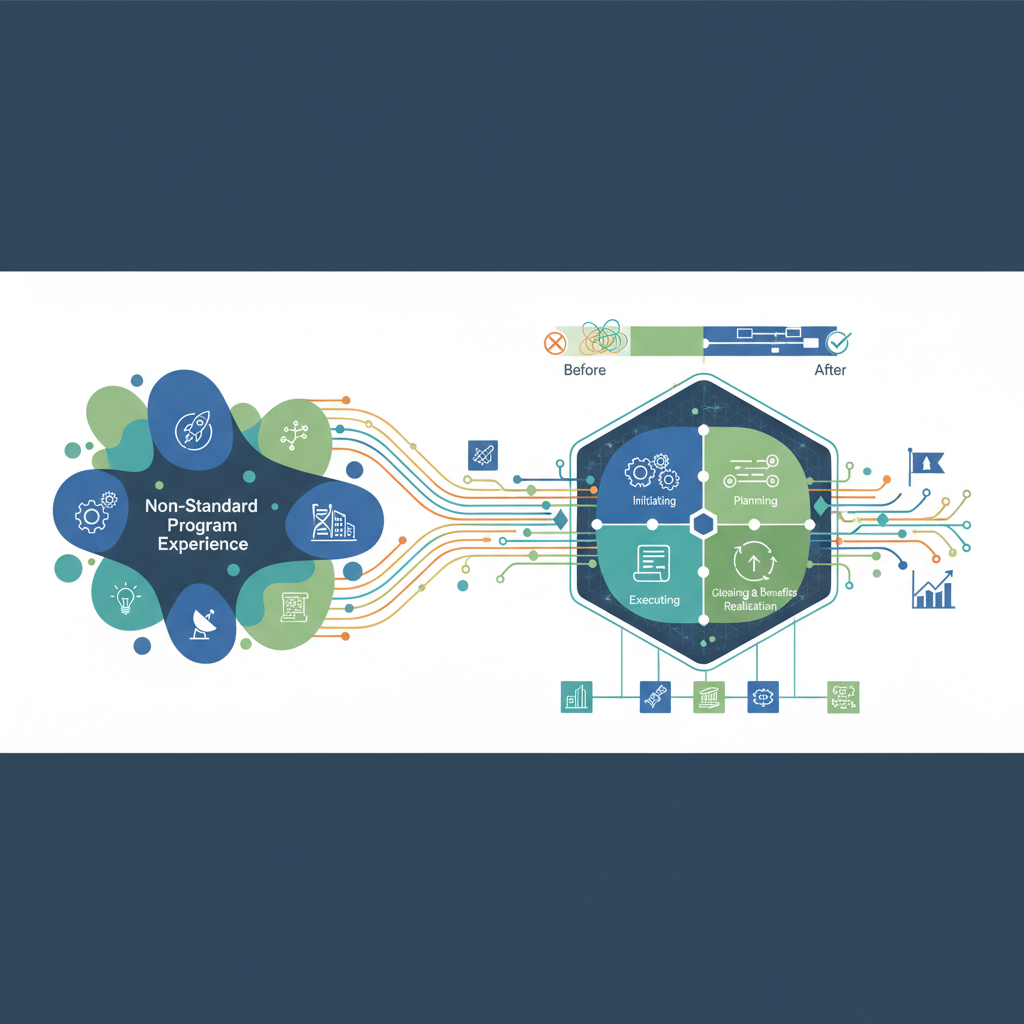
What PMI Actually Wants: a Domain Translation Framework
PMI built the PgMP around five performance domains defined in the PgMP exam content outline, and every domain describes a capability, not a vocabulary list. Before you draft a single summary, separate what PMI is testing from the words your organization uses to describe it.

| Domain | What PMI Is Actually Looking For | Terminology That Often Hides It |
|---|---|---|
| Strategic Alignment | Program delivers on a defined business strategy and adapts when that strategy shifts | PI planning, roadmap alignment, portfolio prioritization |
| Governance | Structured decision rights, oversight, and escalation paths exist and get used | steering committee, compliance board, change control board |
| Benefits Management | Benefits are defined, tracked, and sustained after the program closes | KPI dashboards, retention metrics, throughput, readmission rates |
| Stakeholder Engagement | Stakeholder needs are identified, managed, and reconciled across the program | customer councils, union relations, community liaison |
| Life Cycle Management | Components are integrated, sequenced, and transitioned across the full program duration | release trains, phased rollout, sprint cadence |
The pattern is the same in every domain: PMI cares about the decision you made and the outcome you produced, not the noun your industry attaches to the process. Our PgMP training methodology walks candidates through this exact separation before they touch the panel review forms, because trying to write summaries and learn the domain logic at the same time is where most applications stall.
If you're unsure whether your organization's process actually satisfies a domain or just resembles one on the surface, run it against the outcome column first. A weekly status meeting is not governance. A structured body with defined authority to approve, reject, or escalate program decisions is governance, regardless of what your company calls it. That distinction is also the core of how our PgMP certification training coaches candidates through their experience summaries, one domain at a time.
Industry-Specific Examples by Domain
Generic advice tells you to "show strategic alignment" without showing what that looks like outside a construction or IT program. The examples below pull from agile, healthcare, manufacturing, and government contexts so you can see the same domain satisfied in five different vocabularies, plus the phrasing shift that makes each one panel-ready.
Strategic Alignment: from PI Planning to Program Strategy
Scaled agile programs set direction through Program Increment planning, a cadence-based event where multiple teams agree on shared objectives every eight to 12 weeks. That cadence is a strategic alignment mechanism even though nobody in the room uses PMI's phrase for it.
- Before: "Led quarterly PI planning for five agile release trains."
- After: "Aligned program increment objectives across five release trains to the company's cloud-migration strategy, and re-sequenced two features when a regulatory deadline moved earlier than planned."
The after version keeps the agile term (release train, PI) but adds the two things PMI is scoring: a named strategic objective and a decision made in response to a changing condition. Candidates preparing summaries like this often work through our PgMP exam prep playbook alongside their panel review drafts, since the same strategic-thinking questions show up on the exam.
Governance: from Compliance Boards to Program Oversight
Regulated healthcare programs run compliance and safety boards. These boards function exactly like the governance structures PMI's Governance domain describes: defined decision rights, oversight, and escalation paths, even if no one on the floor calls it governance.
- Before: "Chaired the clinical program compliance board."
- After: "Established a governance structure with defined escalation thresholds and decision rights across four hospital systems, so that submission milestones automatically triggered executive review before proceeding."
Notice the after version names the mechanism (escalation thresholds, decision rights) instead of just naming the meeting. That's the shift a compliance board needs to read as governance rather than as routine reporting.
Benefits Management: from Retention Metrics to Program Value
Manufacturing and customer-facing programs rarely use the phrase "benefits realization." However, the Benefits domain is really asking whether value was defined, measured, and sustained after delivery, which is exactly what these operational metrics track.
- Before: "Tracked equipment effectiveness and customer retention monthly."
- After: "Defined equipment-effectiveness and retention measures as program benefits, reported variance to the sponsor each quarter, and reallocated resources to a lagging plant line when the target was missed."
Stakeholder Engagement: from Union Relations to Program Alignment
Programs involving labor groups, community boards, or multiple regulatory bodies are dense stakeholder environments, they just don't call it "stakeholder engagement" on the shop floor.
- Before: "Managed union relations during plant consolidation."
- After: "Identified competing expectations across union representatives, plant leadership, and a regional regulator, then built a communication plan that resolved conflicting requirements before consolidation milestones locked in."
Life Cycle Management: from Release Trains to Program Integration
Government and defense contracting programs sequence work across contractor teams and acquisition milestones rather than sprints, but the underlying discipline, integrating and transitioning components across the full program duration, is the same capability PMI defines for Life Cycle Management.
- Before: "Managed release trains for the modernization program."
- After: "Sequenced and integrated deliverables across five contractor teams throughout the program life cycle, transitioning each release into sustainment operations in line with acquisition milestones."
Programs built around federal acquisition cycles have their own compliance layer on top of this, which is why we built a dedicated government contracting PgMP track for candidates translating DoD and civil-agency experience into panel-ready language.
Programs that combine predictive and agile methods, common in regulated industries running hybrid delivery models, often satisfy two or three domains inside a single initiative. That's fine. PMI doesn't require one program per domain, it requires each domain to appear somewhere across your submitted portfolio of experience.
How to Self-Check Your PgMP Summaries
Before you submit anything, read each summary as a panel reviewer would: looking for evidence, not vocabulary. This section gives you a short, repeatable check you can run against every summary before it goes into the application.

Ask these five questions of every program summary you write:
- Strategic alignment check: Does the summary name a specific business strategy or objective, and show a moment where you adjusted the program because that strategy or an external condition shifted?
- Governance check: Does it describe a decision-making structure, who had authority to approve, escalate, or reject, rather than just a meeting you attended?
- Benefits check: Does it name at least one measurable outcome the program was tracking, and what happened when that measure moved off target?
- Stakeholder check: Does it show you identifying and reconciling competing needs across more than one stakeholder group, not just communicating updates?
- Life cycle check: Does it show integration or transition across the full duration of the program, not just a single phase or release?
If a summary fails two or more of these checks, it's describing project-level work, not program-level work, no matter how large the initiative sounds. Senior PMO leaders often find this the hardest habit to break, since their day-to-day language is built around delivery, not domain evidence, which is part of why our training for senior PMO leaders spends dedicated time rewriting summaries against this exact checklist before candidates submit.
Common Translation Mistakes That Sink PgMP Applications
Most rejected or delayed PgMP applications don't fail because the underlying program experience was too small. They fail because the summary described tasks instead of decisions. This section covers the four mistakes that show up most often in panel review feedback.

- Project-level detail: Describing a single deliverable, system rollout, or feature launch instead of the program-level decisions that coordinated multiple related projects toward a shared objective.
- Vague outcome language: Writing "improved efficiency" or "increased satisfaction" without naming the measure, the target, or what you did when performance moved off track.
- Missing governance evidence: Listing meetings you attended or reports you produced without showing the authority structure behind them, who could actually approve, escalate, or stop the work.
- Terminology mismatch without translation: Leaving industry jargon (PI, sprint, compliance board, release train) in the summary with no accompanying sentence that maps it to the underlying capability a reviewer unfamiliar with your industry needs to see.
- One domain overrepresented: Writing five summaries that all demonstrate strategic alignment while leaving governance or benefits management thin, which signals an incomplete program rather than a strong one.
Reviewers see hundreds of these summaries a cycle, and the pattern that gets flagged most consistently is strong technical detail paired with weak decision evidence. Fixing that gap is usually a rewriting exercise, not a new-experience problem, and it's the single biggest driver of how long the PgMP certification cost and ROI timeline stretches when applications bounce back for revision.
Get Panel-Ready PgMP Summaries with Augment Consultancy
Translating a program career into five PMI domains is harder alone than it looks, especially when your background is agile, regulated, or public-sector and none of PMI's example language matches your world. Augment Consultancy is built around certified PgMP and PfMP professionals who have written and reviewed exactly this kind of experience summary, in exactly these industries. Instead of generic templates, you get direct feedback on whether your summaries show strategic alignment, governance, and benefits, regardless of the terminology your program actually used. Browse real candidate outcomes from professionals who translated non-standard experience successfully, or explore the full course catalog to find the format that matches your timeline. The next step is simple: get your current summaries reviewed against PMI's actual domain evidence before you submit.
FAQs on PgMP Application Domains
How Flexible Is PMI About Industry-Specific Terminology in PgMP Applications?
PMI evaluates the capability behind your language, not the exact vocabulary. Industry terms are acceptable as long as the summary clearly shows the strategic, governance, or benefits evidence each domain requires.
How Do I Map Agile Program Work to PMI's PgMP Domains?
Translate agile artifacts to their underlying capability: PI planning maps to Strategic Alignment, a release train's integration cadence maps to Life Cycle Management, and sponsor-facing metrics map to Benefits Management.
What If My Program Experience Doesn't Fit PMI's Five Domains Cleanly?
Most programs satisfy multiple domains within a single initiative. Break your experience into separate evidence points per domain rather than forcing one program description to cover all five at once.
Can Hybrid Program Experience Count Toward PgMP Eligibility?
Yes, PMI's own guidance recognizes hybrid and agile approaches as valid program delivery methods, so hybrid experience qualifies as long as the summary demonstrates program-level, not project-level, outcomes.
What's the Biggest Mistake Candidates Make in PgMP Domain Summaries?
The most common error is describing tasks and meetings instead of decisions and measurable outcomes, which reads as project-level work even when the underlying program was large and complex.
How Long Should Each PgMP Experience Summary Be?
Summaries should be concise enough to read quickly but specific enough to name a strategy, a governance mechanism, or a measurable benefit, typically a few tightly written sentences rather than a narrative history.