Personalized PgMP Training: Application Feedback vs. Generic Webinar Content | Augment Consultancy
Compare personalized PgMP training by narrative feedback, mentor access, and application complexity, then choose support beyond generic webinars.

The PgMP exam has 170 questions to answer in 240 minutes, according to PMI’s exam page. But the deeper gate comes before the exam, when your experience must read as program leadership rather than a collection of project tasks.
Personalized PgMP training is worth prioritizing when your application needs more than templates: choose a program that reviews your own experience narratives, explains the reasoning behind revisions, and gives you direct access to a qualified mentor. Webinar content can prepare you for the exam, but it cannot by itself test whether your stories read at program level.
This comparison shows how to evaluate feedback depth, choose the right support for your application complexity, and keep application coaching separate from exam preparation.
Why Personalized PgMP Training Needs More Than Content Coverage
Most PgMP programs can explain the domains, offer question banks, and replay webinars. Those resources matter, especially later in your preparation. They do not automatically show whether your application demonstrates strategic intent, benefits ownership, governance choices, and coordination across related projects.
PMI’s PgMP handbook says panel reviewers assess candidates through their Program Management Experience Summaries. The handbook also asks candidates to use specific examples, show program rather than project management, and keep responses uniquely their own. That is why we treat feedback as a separate buying criterion, not a bonus feature. Our panel review guide explains the distinction in more detail.
A generic course can help you learn what good program management looks like. Individual narrative feedback helps you show where you personally made the decisions, managed the interdependencies, and directed work toward an organizational objective.
How We Compare Application Feedback
Personalization should be observable, not an adjective in a sales page. We compare support models by what happens to a candidate’s own draft, how directly the learner can reach an instructor, and whether the provider states the boundaries of that support.
Define the Review Unit
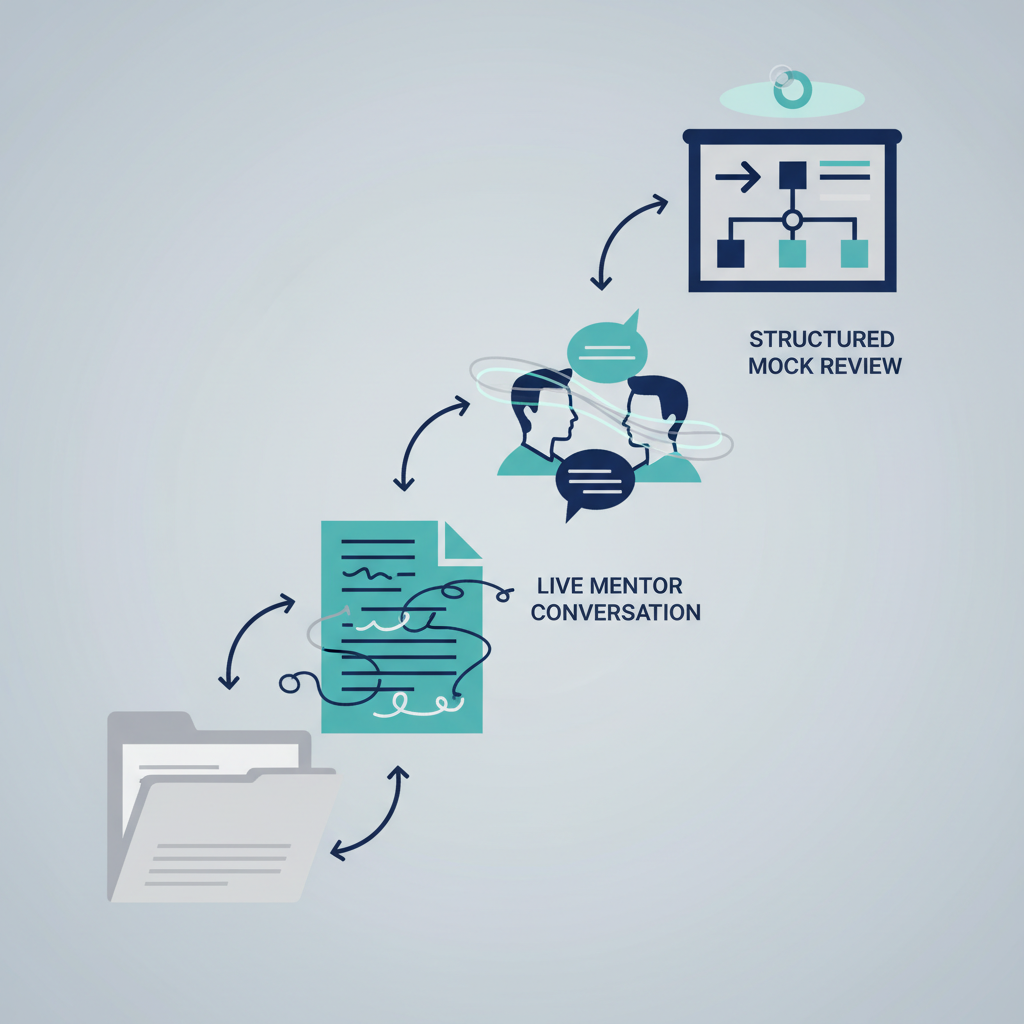
The important question is not whether a program mentions “application support.” Ask what is actually reviewed. A template is reusable guidance. Written comments address your own wording. A live session can test the logic behind your example. A mock review can expose whether your narrative holds together when examined from several angles.
Use a Transparent Personalization Rating
We rate only what a provider can disclose or confirm in writing: reviewer credentials, whether they review your actual narrative, the number of feedback opportunities, access to a mentor, and any stated response commitment. We do not treat an unverified promise as evidence, and we do not confuse a template library with individual review.
Compare Feedback Models
| Support Model | What The Learner Receives | Instructor Engagement | Personalization Rating | Best Fit |
|---|---|---|---|---|
| Template Library | Examples, prompts, and reusable structures | No individual review is implied | Low | Conventional first application |
| Generic Webinar Cohort | Group lessons and shared Q&A | Group access during scheduled sessions | Low To Moderate | Candidates focused on content coverage |
| Written Narrative Review | Comments on the candidate’s own draft | Asynchronous reviewer access | Moderate To High | Candidates needing clearer evidence |
| Live One-To-One Review | Discussion of actual examples and revisions | Scheduled direct mentor access | High | Complex experience mapping |
| Mock-Panel Simulation | Narrative review plus challenge questions | Direct, structured feedback | Highest | Revision after unsuccessful feedback |
A stronger model is not automatically necessary for every candidate. It becomes more valuable as your experience becomes harder to translate, your time becomes tighter, or the consequence of an unclear narrative becomes greater. Our training method shows how we connect application work with disciplined learning.
Choose Support by Application Complexity
The right level of support depends on the work you need to explain, not on how impressive a course catalog looks. A leader with clearly bounded programs may need a disciplined checklist. Someone whose experience spans transformation, public-sector delivery, operations, products, or blended roles may need help connecting the same experience to program-level evidence.
First Attempt with Conventional Experience
If your programs have clear objectives, related component projects, and visible outcomes, start with a structured self-review. Focus on concrete decisions, governance mechanisms, benefits, and your authority. Our experience-mapping guide can help you identify where non-standard work still belongs in the application.
Revision After Panel Feedback
A revision deserves more scrutiny than a first draft. Read feedback against the original narrative, isolate the missing evidence, and test whether each revision answers the prompt without drifting into textbook language. The goal is not more words. It is more relevant program-level reasoning.
Nontraditional or Blended Backgrounds
Candidates who have led enterprise change, platforms, contracting programs, shared services, or large operational initiatives often have legitimate experience that is difficult to label neatly. Live review is useful here because a mentor can ask follow-up questions and help separate your decisions from the surrounding organization’s activity.
| Application Situation | Minimum Useful Support | What To Test Before Enrolling |
|---|---|---|
| First Submission, Clearly Defined Programs | Templates plus self-review checklist | Whether examples demonstrate program authority |
| First Submission, Mixed Responsibilities | Written narrative review | Whether comments address the candidate’s own evidence |
| Revision After Feedback | Written review plus live discussion | Whether revision strategy is included |
| Nontraditional Background | Live one-to-one review | Whether the reviewer can map complex experience |
| High-Stakes Deadline | Clear response commitment | Whether support access matches the timeline |
The support decision should also reflect the time you have before submitting. If a course promises access but does not state how quickly a mentor responds, that uncertainty matters more when application work is your immediate priority. Candidates should document their questions, identify the narratives that require the most revision, and ask whether the support model can handle those specific drafts.
For a complete preparation sequence, use our first-time path to plan the application and exam as connected stages, while still evaluating each stage on its own merits.
Separate Application Help from Exam Preparation
Application support and exam preparation are related, but they solve different problems. Application feedback tests whether your lived experience is described clearly and ethically. Exam preparation builds judgment under time pressure across the PgMP domains. Mixing them into one vague promise makes it difficult to know what you are paying for.

The current PMI certification details list a US$800 member exam fee and US$1,000 full price, separate from any education or coaching costs. The exam covers five domains, with Program Life Cycle Management carrying the largest share at 44 percent. That is why a course should make its application support, content coverage, practice approach, and access model easy to distinguish.
The application side is about evidence. Confirm who reviews narratives, what they review, and whether your authorship remains protected. The exam side is about judgment. Confirm how the course teaches scenario reasoning, domain coverage, and timed practice. When providers bundle these elements together, use the table above to identify which part of the offer actually addresses your immediate risk.
A realistic study plan also needs room for collecting examples, revising your narratives, learning the framework, and practicing exam questions. We recommend setting milestones for each activity rather than assuming one type of effort will substitute for another. Exam practice can sharpen decision-making, but it cannot create evidence that is absent from an application. Narrative work can clarify your professional record, but it cannot replace timed scenario practice.
For deeper exam planning, review our exam-domain guide. Keep the listed PMI fee, tuition, study resources, and optional coaching as separate cost categories before comparing total investment.
Augment Consultancy: A More Deliberate Next Step
Choosing a PgMP program should feel like a decision about the support you will receive, not a wager on a course catalogue. Our cost guide can help you separate tuition, study resources, and optional coaching from the listed PMI fee. We encourage experienced candidates to start with their application complexity, the time they can protect for study, and the type of feedback they can use. Ask whether it gives you a clear owner for application questions and exam preparation. We will not pretend a template can speak for your career. Your submitted narratives must remain your work, grounded in your decisions and outcomes. If you are weighing a first submission, a complicated background, or a revision after panel feedback, use this framework to define the questions worth asking before enrolling. Visit our learning resources, compare the support you need, and plan a disciplined PgMP path with confidence at Augment Consultancy
FAQs on Personalized PgMP Training
Use these answers before enrolling. Match each decision to the support you need.
Is Personalized PgMP Training Necessary?
Not always. If your experience is conventional and you can distinguish program decisions from project tasks, a checklist may suffice, but draft-level review reduces ambiguity.
What Is the Difference Between Templates and Narrative Feedback?
Templates organize information, while narrative feedback tests whether your own examples explain strategic intent, benefits, governance, and cross-project coordination in language a reviewer can follow.
What Support Helps After Unsuccessful Panel Feedback?
Choose support that reviews the original feedback, identifies the missing evidence, and rehearses a focused revision. The aim is clearer program-level reasoning, not a rewritten application.
Does PgMP Eligibility Require Formal Training Hours?
PMI’s stated eligibility sets focus on education and qualifying experience. Training can improve preparation, but it does not replace the experience required for the credential.
How Should I Compare PgMP Training Costs?
Start by separating the listed PMI fee from tuition, study resources, and optional coaching. Then compare the support commitment, not only the course’s headline price.