
TL;DR
Compare real self-paced, rolling-enrollment, and hybrid PfMP programs on content-unlock rules, mentor SLAs, and panel-review coaching before you enroll.
Rigid cohort calendars are the single biggest complaint against most PfMP prep programs, and the pattern shows up in the fine print of published class schedules: one widely used PfMP mentoring program runs on a fixed six-week cycle with a set start date and a set end date, no room for a slow week or a business trip.
The real trade-off in PfMP prep is flexibility versus live support: programs that let you start anytime and unlock content immediately rarely include real application-review coaching, while programs offering mentor feedback and panel-review prep almost always run on some kind of schedule, even a loose one. Pick based on which constraint costs you more.
This piece breaks down the three enrollment models actually used across PfMP prep providers, walks through how to test whether a "self-paced" claim is real or a sales-page word, compares several programs on their published enrollment policies rather than their marketing copy, and closes with five specific questions to ask before you enroll.
Self-Paced Milestone Programs: How to Tell Real Flexibility from Marketing
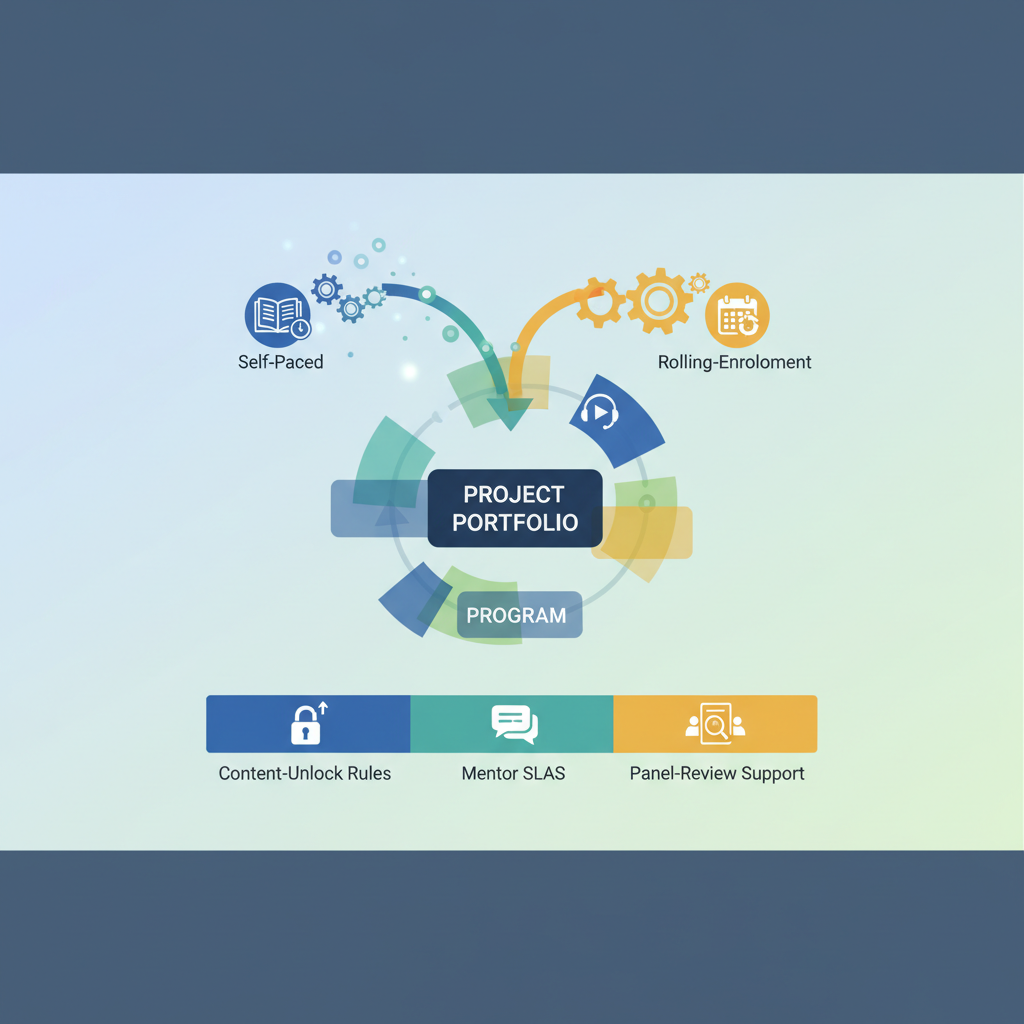
"Self-paced" is the most overused phrase in PfMP marketing, and it means two different things depending on who wrote the sales page. Some providers unlock the entire course library the moment you pay. Others gate every module behind a quiz or a progress check, which is closer to a slow-motion cohort than true self-pacing.

The test is simple: ask what happens the minute you complete checkout. If the answer is "everything is available," you have a genuine full-access self-paced format, the kind one PfMP video program offers with ten recorded sessions and no time limits on rewatching them. If the answer involves "you'll unlock module two after passing a quiz on module one," you're buying a milestone-gated course, which behaves a lot like a cohort with an invisible calendar.
A separate self-paced course built around 30 contact hours of condensed video content follows the same full-access pattern: 24/7 access from any device, no quiz gates, no waiting. Neither of these programs, by their own published descriptions, includes live mentor interaction or application coaching bundled into the base self-paced tier. That's the hidden trade-off nobody puts on the pricing page: true self-pacing usually means you're on your own for the parts of PfMP prep that benefit most from a second pair of eyes, especially the application narrative and the panel-review interview. We cover this gap in detail in our own boutique PfMP training breakdown, because it's the single biggest reason candidates who "finished" a self-paced course still get stuck at the application stage.
Rolling-Cohort Programs: Monthly Start Dates with Live Support
Rolling-cohort programs sit between the two extremes. You're not locked into one annual intake, but you're also not starting the moment you feel ready. Instead, a new cohort opens roughly every few weeks, and your content unlocks on that cohort's calendar rather than on-demand.
The published class schedules for one live mentoring program show this clearly: new sections start in mid-February, mid-March, and early April, each running for six weeks with weekly live sessions at fixed times. That's rolling enrollment in the literal sense (you don't wait a full year for a start date) but it's not self-paced. Miss a live session and you're catching up on a recording, not skipping ahead.
The upside of this model is real-time mentor access built into the format by default, since the weekly sessions are the delivery mechanism, not an add-on. The downside is the same rigidity that frustrates candidates about longer bootcamps, just compressed into a shorter window. If your constraint is "I need to start within the next three days," a rolling cohort with a mid-March opening date doesn't solve your problem any better than an eight-week bootcamp does. We break down this exact mismatch, and which formats actually solve for it, in our PfMP training alternatives comparison.
Hybrid Async Programs: Self-Paced Content Plus Scheduled Mentor Access
Hybrid async is the format most providers claim to offer and fewest actually deliver.

PMI's own Authorized Training Partner network formally recognizes this as a distinct delivery category, separate from instructor-led and virtual instructor-led formats, in its training partner guidance. That recognition matters because it confirms self-paced exam prep is an accepted, PDU-eligible format on its own, not a lesser substitute for live training.
What separates a genuine hybrid model from a self-paced course with a marketing veneer is whether mentor access is scheduled and guaranteed, or offered as a vague "email us anytime" promise with no response commitment. A real hybrid program tells you, before you pay, how many mentor sessions or review slots you get and roughly when you can book them. Our own PfMP certification playbook lays out what a properly structured hybrid timeline looks like from application through exam, including where mentor check-ins actually need to happen for the panel review to succeed.
Comparing PfMP Training Without Fixed Schedule: Enrollment Policies Side by Side
None of this matters until you can see the actual policies side by side, drawn from what providers publish rather than what their homepage promises. The table below compares enrollment windows, content-unlock rules, mentor-response commitments, and whether application or panel-review coaching is included, based on each provider's own published course pages.
Read it against your own constraint.
| Provider | Enrollment Window | Content-Unlock Model | Mentor-Response SLA | Application-Review Included |
|---|---|---|---|---|
| vCare PfMP Self-Paced | Start anytime, self-checkout | Full library unlocked immediately | Not published, recorded content only | No |
| vCare PfMP Mentoring Program | Monthly cohorts, fixed start and end dates | Weekly modules unlocked on cohort calendar | Real-time during scheduled weekly live sessions | Yes, folded into mentor sessions |
| PM Training School Self-Paced | Start anytime, 24/7 access | Full course unlocked at purchase | Not published | No |
| PMI On-Demand (ATP network) | Start anytime | Full course unlocked at purchase | Not published, self-service model | No |
| Augment Consultancy Boutique Track | Rolling enrollment, mentor-paired start windows | Milestone modules paired with live mentor access | Mentor window confirmed at enrollment, led by certified PgMP and PfMP professionals | Yes, including panel-review coaching |
Notice the pattern: every provider that unlocks all content immediately also leaves the mentor-SLA field blank in its own published terms. That's not an oversight, it's how the economics of pure self-paced content works. Live human feedback doesn't scale the same way a video library does, so providers either sell it separately or don't sell it at all. Senior candidates weighing this trade-off against their own timeline should read our PfMP certification guide before assuming a full-access course will get them through the panel review unassisted.
Questions to Ask Before Enrolling in Self-Paced PfMP Training
Sales pages describe programs in the best possible light, which is exactly why you need a short list of direct questions that force a specific answer rather than a general one. Ask these five before you pay, and get the answers in writing if you can.

- Content-unlock schedule: does everything unlock the moment I enroll, or are modules gated behind quizzes, dates, or milestones I have to clear first?
- Mentor-response window: if I submit a question or a draft application section, what is the actual promised turnaround, in hours or days, not "as soon as possible"?
- Application and panel-review coaching: is feedback on my PMI application narrative and mock panel-review practice included in the base price, or is it a separate add-on?
- Extension and pause policy: if I need more time than the course allows, what happens to my access, and is there a fee to extend it?
- Proof of the claim: can the provider show me an actual published enrollment calendar or terms page, rather than describing the format only in sales copy?
Candidates preparing alongside colleagues should also ask how group pricing or shared mentor time works, since that changes the math on flexibility versus cost; our breakdown of PfMP training for small teams covers that scenario specifically. Once you have answers to all five, you can compare providers on substance instead of adjectives.
Get Flexible PfMP Training with Augment Consultancy
If you've read this far because a rigid cohort schedule doesn't fit your calendar, but you still want real feedback on your application and panel-review prep, that combination is the whole point of our approach. Augment Consultancy pairs milestone-based, rolling-enrollment content with mentor access led by certified PgMP and PfMP professionals who've been through the actual panel review themselves, not a generic instructor reading slides.
Start by browsing our full course catalog to see current enrollment windows, then explore the learning portal to understand how content unlocks on your schedule rather than a cohort's. If you want to see how this plays out for real candidates, our success stories walk through actual timelines, not projected ones.
FAQs on PfMP Training Without Fixed Schedule
Can I Start Mid-month?
Yes, in genuine rolling-enrollment or self-paced formats you can start any day, since access is granted at purchase rather than tied to a fixed cohort launch date on a calendar.
What Happens If I Need an Extension?
Policies vary by provider: some full-access self-paced courses include lifetime or unlimited access, while cohort-based programs typically charge a fee or require re-enrollment in the next cycle to extend.
Do Self-paced Courses Include Panel-review Prep?
Usually not by default. Most pure self-paced video libraries skip live application coaching entirely, so confirm in writing whether panel-review practice is bundled or sold as a separate add-on.
Is Rolling Enrollment the Same as Self-paced?
No. Rolling enrollment means new cohorts start frequently, often monthly, but you still follow that cohort's fixed weekly schedule once you join, unlike true self-paced access.
How Do I Verify a Provider's Self-paced Claim Before Paying?
Ask to see the actual enrollment terms or content-unlock policy, not the sales page. If everything unlocks immediately with no quiz gates, the claim is genuine.
Does Self-paced Mean No Mentor Support at All?
Not always, but often. Some hybrid programs pair self-paced content with scheduled mentor windows, while pure self-paced video courses typically offer no live mentor access at all.