Augment Consultancy's PgMP Application Documentation: Past Work, Strategy, and Governance
Compare PgMP application documentation for past work, strategic thinking, and governance, with a practical writing-effort model.

The PgMP journey involves more than exam preparation: PMI’s current credential page lists a 170-question exam, but candidates must first clear a professional-experience review.
PgMP application documentation should be treated as two connected jobs: establish credible past program work, then use the experience summaries to demonstrate strategic judgment, leadership, and governance. PMI does not publish a component scoring formula, so candidates should use weighted drafting effort as a planning tool, not as an official pass-fail rubric.
This guide separates what belongs in the background record from what reviewers need to see in the narrative, then provides a practical model for allocating writing time.
PgMP Application Documentation Is Evidence First, Then Judgment
The most useful way to resolve the resume-like versus strategic-narrative tension is to distinguish an evidence base from a reviewer-facing argument. Your program entries establish that the work happened, how long it lasted, what the program aimed to achieve, and what benefits it created. Your summaries show how you acted as the person responsible for coordinating related components toward that outcome.
PMI states that panel reviewers assess the Program Management Experience Summaries to verify that an applicant managed multiple related component projects, under limited supervision, toward a common organizational objective. That means a detailed work history matters, but it is not enough on its own. The narrative must make your decisions and program-level contribution visible. The official PgMP handbook is clear that applicants should use specific examples rather than theoretical definitions.
For our application work, we use three lenses:
- Past-work verification: Dates, scope, component relationships, role, benefits, budgets, timelines, and results that establish an accurate factual record.
- Strategic thinking depth: The business objective, roadmap, benefit logic, trade-offs, methods, and choices that connect program activity to organizational value.
- Governance maturity: Decision rights, oversight routines, criteria, risks, escalations, reporting, and personal accountability for moving the program forward.
If your role did not carry the title “program manager,” the evidence can still be mapped carefully. Our guide to application domains helps turn non-standard experience into program-level evidence without inflating a project into a program.
What PMI Asks You to Record Before Review
Before writing the narrative summaries, build a reliable source file. For candidates with a four-year degree, PMI currently requires 48 months of project-management experience or an active PMP, plus 48 months of program-management experience. Candidates without a four-year degree need 84 months of program-management experience, and experience is counted without double-counting overlapping months. Those current requirements make accurate past-work documentation a qualification requirement, not optional administrative work.
The application asks for each program’s objective, your role and responsibilities, and benefits achieved. It also captures brief information about component projects, including their names, budgets, and timelines. PMI specifically asks applicants to frame the program objective strategically and describe tangible, measurable benefits, while avoiding a deep project-by-project narrative in the benefits summary. Review our exam prep playbook after your application foundation is complete, so study time does not displace evidence gathering.
| Application Area | What To Document | What It Proves | Common Writing Risk |
|---|---|---|---|
| Eligibility Record | Education, dates, qualifying months, project experience where required | You meet the credential threshold | Counting overlapping time twice |
| Program Experience | Objective, role, responsibilities, benefits | Your work was program-level and outcomes-led | Listing tasks without organizational value |
| Component-Project Details | Names, budgets, and timelines | The program coordinated related work | Treating unrelated projects as one program |
| Experience Summaries | Strategy, leadership, and governance examples | How you personally managed the program | Repeating background instead of demonstrating judgment |
A current PMP can simplify the project-experience entry, but every applicant must document program experience. That distinction is useful when planning PgMP certification training because the application and the exam ask for different kinds of preparation.
Our Editorial Rubric Comparison for Writing Effort
PMI does not publish percentage weights for past work, strategy, or governance in the panel review. We therefore do not present the following model as PMI policy. It is an editorial writing framework, built from what PMI asks applicants to submit and what its guidance says reviewers assess.
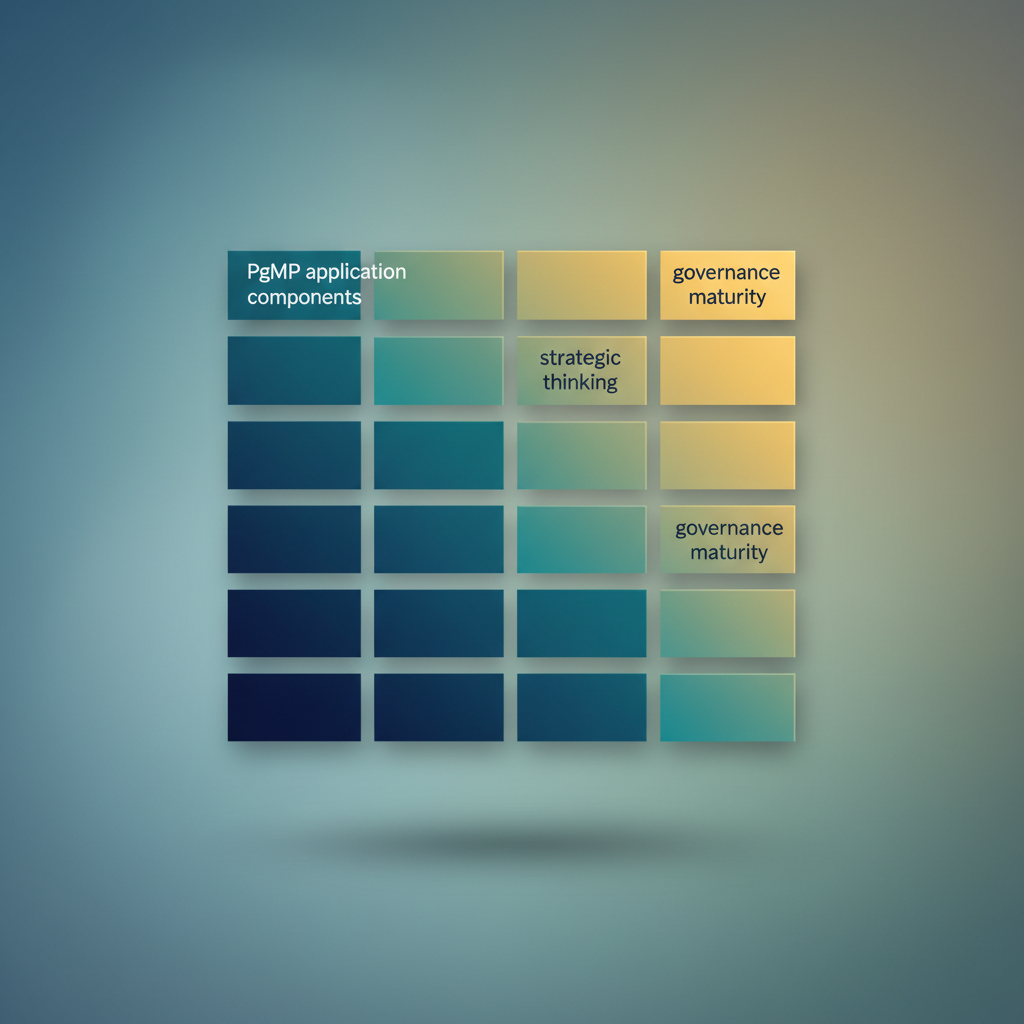
The percentages describe the balance of attention within each component. They prevent a common problem: spending nearly all drafting energy documenting history, then leaving too little space to show how you made program decisions.
| Application Component | Past-Work Verification | Strategic Thinking | Governance Maturity | Recommended Emphasis |
|---|---|---|---|---|
| Program Experience And Benefits Summary | 65% | 25% | 10% | Establish scope, role, and measurable benefits |
| Strategy Experience Summary | 25% | 65% | 10% | Explain roadmap, alignment, choices, and benefits |
| Leadership Experience Summary | 35% | 35% | 30% | Show personal influence and stakeholder alignment |
| Governance Experience Summary | 20% | 20% | 60% | Show decision mechanisms, escalation, and oversight |
The table is deliberately not an exam blueprint. PMI’s published exam percentages apply to the multiple-choice test, while the panel review concerns experience summaries. The organization’s summary guidance says responses should include program-specific objectives, stakeholders, barriers, expectations, criteria, risks, escalations, methods, and quantified results.
A strong program management certification application should also be internally consistent. A benefit claimed in the background section needs the same context in the relevant summary, but the summary should add the decision, action, and result rather than copy the background description. We teach this cross-checking approach in our PgMP training methodology.
Write for the Reviewer Lens, Not a Resume Lens
A resume normally compresses accomplishments into outcomes and responsibilities. A panel-review response needs more cause and effect. It should show the business context, your individual action, the governance or strategic mechanism you used, and the result that followed.
PMI says adequately detailed summary responses will likely be 350 words or more, with a maximum allowance of 700 words. That word-limit guidance rewards focused detail. It does not reward generic statements about “leading teams,” “managing stakeholders,” or “ensuring alignment” when the reader cannot see what you actually did.
Program Description: Prove the Program Exists
Start with a strategic objective, then name your role, responsibilities, component projects, and measurable benefits. This is where verified facts earn their place. A reviewer should be able to see a coordinated program with a common objective, not a single large project described with elevated language.
Include enough detail to make the relationship between components believable. Avoid trying to narrate every workstream. The individual program summary is an evidence map, not the place to prove every leadership decision.
Strategy Summary: Explain the “Why” Behind the Roadmap
A strategy narrative should connect an organizational need to your roadmap, priorities, benefit measures, and decisions. Identify the constraint, opportunity, or changing condition that made program-level coordination necessary. Then explain how you selected an approach and monitored whether it remained aligned to the intended benefit.
Use first-person verbs with evidence. “I redesigned the roadmap after adoption data showed a barrier” gives a reviewer a decision and a reason. “The roadmap was redesigned” hides the applicant’s contribution. Our personalized training comparison explains why targeted application feedback can be more useful than generic content at this stage.
Governance Summary: Make Oversight Observable
Governance is stronger when it is concrete. Show the forum, criteria, escalation route, decision or recommendation, and resulting action. You do not need to name proprietary systems, but the reader should understand how decisions moved from evidence to accountable action.
A vague statement such as “I reported risks to leadership” is weak because it omits the threshold, audience, action, and result. A stronger account identifies the risk signal, the governance body or decision route, your recommendation, and what changed. This same program-level lens supports study for governance coverage later in the certification journey.
Leadership Summary: Show Personal Alignment Work
Leadership evidence is not a list of stakeholders. It is the work of analyzing their needs, setting expectations, resolving competing interests, and gaining agreement on acceptance criteria. Focus on your role in the decision process, especially where the program crossed functions, geographies, suppliers, or executive groups.

Before submission, read each narrative as though you are a reviewer who has never met you. Can that reader identify the program objective, your individual action, the governing mechanism or strategic choice, and the measurable result? If not, revise for specificity before adding more jargon.
Work with Augment Consultancy on Your PgMP Application
At Augment Consultancy, we help experienced leaders turn substantial program work into a clear, credible application story without overstating their role or forcing every achievement into one template. We start by separating eligibility evidence from panel-review narratives, then help you test whether each example demonstrates the level of strategic coordination, individual leadership, and governance accountability that the application requires. Our approach is especially useful when your work sits across transformation, operations, technology, government, or PMO environments where the program structure is real but the job title is not always obvious. We work with you to identify evidence gaps, sharpen first-person decision narratives, and build a submission that makes your ownership, program context, and measurable benefits straightforward for a reviewer to follow at first reading. When you are ready to combine application preparation with structured PgMP training, you can explore our course store.
FAQs on PgMP Application Documentation
Is PgMP Application Documentation Mostly a Resume?
No. It establishes qualifying history, while reviewers assess detailed summaries showing your individual strategic, leadership, and governance decisions across coordinated programs, not merely responsibilities or chronology.
Does PMI Publish Panel-Review Scoring Weights?
No. PMI publishes no percentages for those criteria. Treat any model as a drafting framework, not an official formula, and use it only to organize effort.
How Long Can PgMP Experience Summaries Be?
PMI states that adequately detailed responses will likely exceed 350 words, and each experience-summary response has a maximum allowance of 700 words in the application.
Should I Repeat My Program Description in Every Summary?
No. Reviewers receive background information, so each summary should add personal decisions, methods, challenges, and measurable results rather than repeat descriptions already supplied in the record.
Can One Program Support Multiple Experience Summaries?
Yes, if each summary answers a distinct prompt with unique evidence. Reuse context sparingly and see our panel review comparison for the wider process planning.