
TL;DR
A PgMP certification timeline for teams: phase-by-phase breakdown, stagger vs simultaneous matrix, and risk table for certifying 3 program managers in 9 months
Leadership wants three infrastructure program managers certified before the next fiscal year, which means someone needs a real PgMP certification timeline for teams, not just one applicant's checklist. PMI's own applicants report panel review waits of up to 60 days for a single application to clear, before the exam is even scheduled.
Nine months is realistic for three program managers, but only if each one already meets PMI's experience-hour thresholds, has program-level documentation ready, and the team staggers applications six to eight weeks apart instead of launching all three at once. Teams that start simultaneously and share one coach tend to bottleneck at panel review, not at the exam itself.
PMI's certification page and most prep providers explain the individual path well: hours required, audit steps, exam format. None of them model what happens when three managers move through panel review at the same time, or what you do if one fails while the other two pass. This piece breaks down the per-person timeline, gives you a 3-manager eligibility audit, compares staggered against simultaneous plans side by side, and maps where each phase actually breaks so you can buffer it in advance.
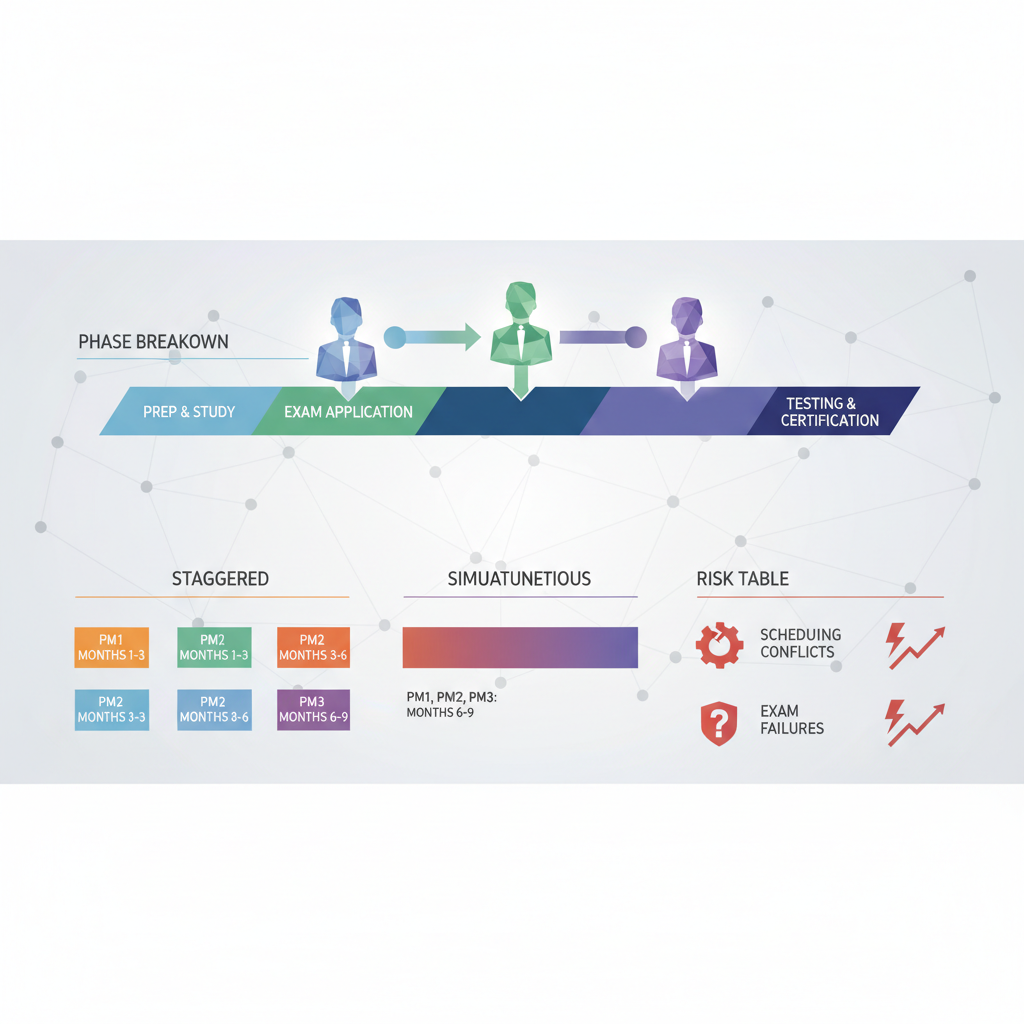
PgMP Certification Timeline for Teams: Phase-by-Phase Breakdown
Every team plan starts from the same building block: how long PgMP takes for one person. PMI splits the credential into distinct stages, and each one has a documented range from real applicants, not just an official estimate. Here's the breakdown per manager, before you multiply by three.
| Phase | Typical Minimum | Typical Maximum | What Drives the Range |
|---|---|---|---|
| Experience documentation & domain mapping | 2 weeks | 6 weeks | Whether program hours are already logged, or scattered across old project files |
| Application submission & audit | 1 day | 2 weeks | PMI can clear an audit fast or flag it for detailed review; one applicant reported a 24-hour turnaround, another waited days |
| Panel review | up to 60 days | up to 60 days | This is the documented ceiling PMI sets for the first evaluation stage, and it runs regardless of how well-written the application is |
| Exam eligibility window & scheduling | 1 week | 3 weeks | Testing center availability and how quickly the candidate books after clearance |
| Exam prep (post-panel) | 4 weeks | 8 weeks | Whether the candidate has been studying in parallel with the application, or waiting for panel results first |
| Exam itself | 240 minutes | 240 minutes | Fixed: the PgMP exam is 170 questions across four hours |
Add these up and a single, well-prepared candidate is realistically looking at 4 to 6 months from first document pulled to exam passed. That's the number every individual-focused resource gets right. What none of them address is what happens when you run this pipeline three times inside one team, competing for the same coaching bandwidth, the same manager's attention for documentation review, and the same program's continuity needs.
Eligibility Pre-Check: 3-Manager Audit Template
Before building any timeline, audit each manager against PMI's hour requirements. Most teams skip this step.

PMI's baseline eligibility, confirmed across PMI's certification page and independent training providers, requires:
- At least four years (6,000 hours) of project management experience
- Four years (6,000 hours) of program management experience if the candidate holds a bachelor's degree
- Seven years (10,500 hours) of program management experience if they don't, per Project Management Academy's breakdown
- Program experience logged as 4,000 hours minimum across non-overlapping programs, per the application field guide on Scribd
Run each manager through this table before you commit to a start date:
| Manager | PM Hours Logged | Program Hours Logged | Bachelor's Degree? | Domain Summaries Drafted? | Gap Identified |
|---|---|---|---|---|---|
| PM 1 | |||||
| PM 2 | |||||
| PM 3 |
If any manager is short on program-governance hours specifically, not project hours, program hours, 9 months is not achievable for them regardless of how the other two are staggered. That gap has to close before the application clock starts, and it's the single most common reason teams blow past their target date. If any of the three have led non-standard programs (transformation initiatives, multi-vendor infrastructure rollouts, or work that wasn't labeled "program" internally), map that experience to PMI's domains before drafting anything, see our guide on mapping non-standard program experience to PgMP application domains.
Simultaneous vs. Staggered: The Decision Matrix
Once all three managers clear the eligibility audit, the real decision is sequencing. Two plans work; they trade speed for risk in opposite directions.

Simultaneous plan: All three managers start documentation and application drafting the same week, then move into panel review at roughly the same time, which means one coach is reviewing three applications at once and three exam-prep tracks run in parallel.
Staggered plan: Managers start six to eight weeks apart. PM 1 begins documentation while PM 2 and PM 3 are still finishing eligibility gaps. By the time PM 1 hits panel review, PM 2 is starting their application draft.
| Factor | Simultaneous | Staggered (6–8 weeks apart) |
|---|---|---|
| Time to last certification | Faster on paper (~6–7 months if no delays) | Slower on paper (~8–9 months) |
| Program continuity risk | High, all three may be in exam-prep mode at once, pulling focus from live infrastructure work | Low, only one manager is deep in prep at any given time |
| Coaching/bandwidth bottleneck | High, one coach, three applications, same review windows | Low, coach reviews one application in depth before the next arrives |
| Exposure to a single failed panel review | High, if one fails, it doesn't slow the other two, but it does compress your buffer for a retry before the 9-month mark | Low, a failure surfaces early, giving the other two time to adjust |
| Best fit for | Teams where all three already meet eligibility cleanly and program work can absorb three simultaneous prep periods | Teams where at least one manager has a documentation gap, or where the program can't lose focus from more than one manager at a time |
The staggered plan is slower on a calendar but far more forgiving of the two failure modes that actually derail these plans: a rejected application and a program that can't function with three managers distracted at once. If leadership's real constraint is "all three certified within 9 months," staggered starting six weeks apart still lands inside that window for most eligible candidates, it just leaves less slack for a retry.
Risk Table: What Delays Each Phase and How to Buffer It
| Phase | Common Delay | Mitigation | Buffer Needed |
|---|---|---|---|
| Documentation & domain mapping | Program experience logged as project work, not program work, so summaries don't map to PMI's domains cleanly | Have each manager draft experience summaries against PMI's domain structure before submitting, not after audit flags it | 2–4 weeks |
| Application audit | PMI selects the application for detailed audit rather than a fast clearance | Build slack into the schedule rather than assuming the fastest-reported turnaround | 1–2 weeks |
| Panel review | Review takes the full 60-day window rather than resolving early | Don't schedule exam prep to start only after panel results, overlap study with the review window | Plan for the full 60 days, not the best-case outcome |
| Panel review failure | One manager's summaries are rejected for lacking detail or contradicting other answers | Have a second reviewer (ideally someone PgMP-certified) proofread all three applications before submission for consistency and specificity | 4–6 weeks for reapplication and revision |
| Exam scheduling | Testing center availability post-eligibility | Book the exam slot as soon as panel clearance arrives, don't wait to "feel ready" first | 1 week |
| Exam prep | Program workload increases mid-prep and study time gets deprioritized | Set a fixed weekly study block that's protected on each manager's calendar, independent of program deadlines | 2 weeks |

The panel review failure row is the one most teams underestimate. If it happens to one manager, the other two do not need to pause. A staggered plan absorbs this naturally because the failure surfaces before the next manager has committed significant time. A simultaneous plan absorbs it far less gracefully, you're now managing one reapplication cycle while two other exam-prep clocks are still running, and coaching attention gets split three ways at the exact moment one manager needs it most.
Should You Pause Program Work During Exam Prep?
Not entirely, but expect a dip. The 4-to-8-week exam prep window is when most candidates need real focus time, and pretending a program manager can carry a full workload plus intensive study is how teams end up missing both the exam date and program milestones. Build lighter coverage into the roster during each manager's final prep month rather than assuming business as usual continues on both fronts.
Get Your Team's PgMP Timeline Reviewed by Augment Consultancy
A generic 9-month plan doesn't account for what's actually in your three managers' experience files or how much bandwidth your program can spare for exam prep. Augment Consultancy works directly with PgMP® and PfMP® certified professionals with real-world program and portfolio management experience, and can review each manager's eligibility gaps before you commit to a stagger or simultaneous plan. See how other teams have sequenced this in our PgMP & PfMP success stories, browse the course store for training options built for exactly this scenario, or start with our breakdown of PfMP training for teams of three if your certification mix includes portfolio management alongside program management.
FAQ
What If One Person's Application Is Rejected?
The manager receives PMI's feedback and can revise and resubmit, which typically adds four to six weeks. The other two do not need to pause, and a staggered plan absorbs the setback more gracefully because the rejection surfaces before the next application has gone in.
Can We Hire a Coach for All Three?
Yes, hiring one coach is highly efficient. However, ensure their schedule can handle three concurrent reviews without delaying feedback. Always verify their capacity before committing all managers.
Should We Submit All Three Applications at Once?
For most teams, no. Submitting six to eight weeks apart keeps only one manager in deep prep at any time, protects program continuity, and leaves room to absorb a single panel-review rejection without putting the nine-month target at risk.