PgMP Training for Cloud Migration Leaders
PgMP training for cloud migration leaders: coordinate workstreams, governance, dependencies, benefits, and executive decisions.

PgMP Training for Cloud Migration Leaders
A cloud migration becomes a large migration at 300 or more servers under AWS migration guidance, but leadership complexity can arrive much earlier when applications, data, security, operations, and change teams must release together. We explain how experienced project leads can step up without pretending to be the technical authority for every workstream.
PgMP training for cloud migration leaders helps a leader manage the system connecting workstreams rather than direct each technical project. It develops the program-level discipline to define outcomes, reveal dependencies, govern decisions, balance resources, manage benefits and transition risks, and give executives one reliable view of progress.
How Does PgMP Training for Cloud Migration Leaders Change Your Role?
The move from project lead to program manager is a shift from optimizing a delivery stream to governing the connections among delivery streams. A project lead can keep one migration workstream on schedule. A program manager has to decide what happens when that workstream cannot proceed until security approves an exception, data completes a cutover rehearsal, operations accepts support ownership, and the business confirms adoption readiness.
PMI’s March 2024 exam outline places 44% of PgMP examination content in Program Life Cycle Management, with the remaining content distributed across strategic alignment, benefits, stakeholder engagement, and governance. That balance reflects why this is more than a PMP extension: it tests the coordination of components toward shared benefits. Review the current PMI exam outline alongside our PgMP vs PMP guide before deciding which capability gap you need to close.
| Project Lead | Cloud Migration Program Manager |
|---|---|
| Owns a defined workstream scope, plan, and delivery risk | Owns the integrated outcome, cross-workstream trade-offs, and benefit path |
| Escalates blockers when project authority ends | Establishes escalation thresholds, decision forums, and accountable owners |
| Reports project health and milestones | Reports outcomes, critical dependencies, decision needs, and transition readiness |
| Coordinates a delivery team | Aligns technical, operational, business, security, and change leaders |
| Closes delivery after acceptance | Governs handover and benefit sustainment beyond component completion |
Your first weeks should create clarity, not a bigger status meeting. Start by confirming the business outcome and sponsor, then build a program charter, map critical dependencies, establish decision rights, and make a shared scorecard visible. A phased 12-week transition can make that progression practical, while the pace and measures must reflect your organization’s verified priorities.
- Weeks One And Two: Confirm the mission, business case, constraints, sponsor, and intended outcomes.
- Weeks Three And Four: Build the charter, workstream structure, roadmap, and release or wave logic.
- Weeks Five And Six: Assign benefit owners, identify transition risks, and define success evidence.
- Weeks Seven And Eight: Create the stakeholder map, communication cadence, and escalation routes.
- Weeks Nine Through Twelve: Run governance forums, test reporting, and correct unresolved dependencies before they become wave blockers.
How Should You Structure a Cloud Migration Program?
A program structure should follow the outcome your organization is trying to achieve, not simply mirror its department chart. For a migration, that normally means organizing around a sequence of readiness, migration, stabilization, and operational transition, with workstreams accountable for the conditions each release requires.
AWS describes a core flow from foundation and governance through portfolio assessment into migration execution. The portfolio workstream provides discovery data, application prioritization, and wave planning that the migration workstream needs to cut over safely. That is a useful AWS workstream model because it makes upstream and downstream responsibility explicit rather than assuming every team can progress independently.
Build your charter around the whole program, then let individual project plans carry local delivery detail. Our application domains resource can also help experienced leaders describe this integrated work accurately when they prepare for certification.
- Strategic Outcomes: State the business result, affected capabilities, and benefit owners.
- Program Scope: Name the workstreams, component projects, releases, and transition states.
- Governance: Define forums, escalation thresholds, decision rights, and reporting cadence.
- Benefits: Identify what changes, who receives value, how it is measured, and who sustains it.
- Constraints: Record funding, compliance, resourcing, timing, operational, and technology boundaries.
- Dependencies: Name the conditions that must exist before a wave, release, or handover can proceed.
What Governance Turns Coordination into Decisions?
Cloud migration governance is not a calendar of meetings. It is the operating system that determines who may approve a change, accept a risk, delay a wave, release constrained specialists, or reset a benefit forecast when evidence changes.
The best governance makes decisions close to the work until impact crosses a defined threshold. AWS separates strategic governance, program governance, workstream forums, application-owner commitment meetings, and operational discussions so each forum has a distinct purpose. Its AWS governance guidance supports a practical principle: executives should receive decisions they can make, not a longer version of the project status report.
| Decision | Recommends | Decides | Consulted | Required Evidence |
|---|---|---|---|---|
| Release A Migration Wave | Migration And Application Leads | Sponsor Or Delegate | Security, Operations, Change | Readiness Evidence And Open Risks |
| Accept A Security Exception | Security Lead | Named Risk Owner | Architecture And Compliance | Compensating Controls And Expiry |
| Reprioritize Shared Specialists | Program Manager | Program Governance Forum | Workstream Leads | Critical-Path Impact |
| Change A Benefit Baseline | Benefits Owner | Steering Committee | Finance And Business Owner | Outcome Impact And Revised Forecast |
The program charter should also say what remains within workstream authority. When a decision affects a shared dependency, material benefit, regulatory posture, or release commitment, the program manager brings it to the correct decision owner with alternatives and consequences. Our program director guide explores the leadership judgment that sits behind that escalation discipline.
How Do You Manage Dependencies Across Migration Workstreams?
Dependency management is where program leadership becomes visible. A delay is not automatically a program problem, but a dependency becomes one when it changes another workstream’s ability to meet a shared release, transition, or benefit commitment.
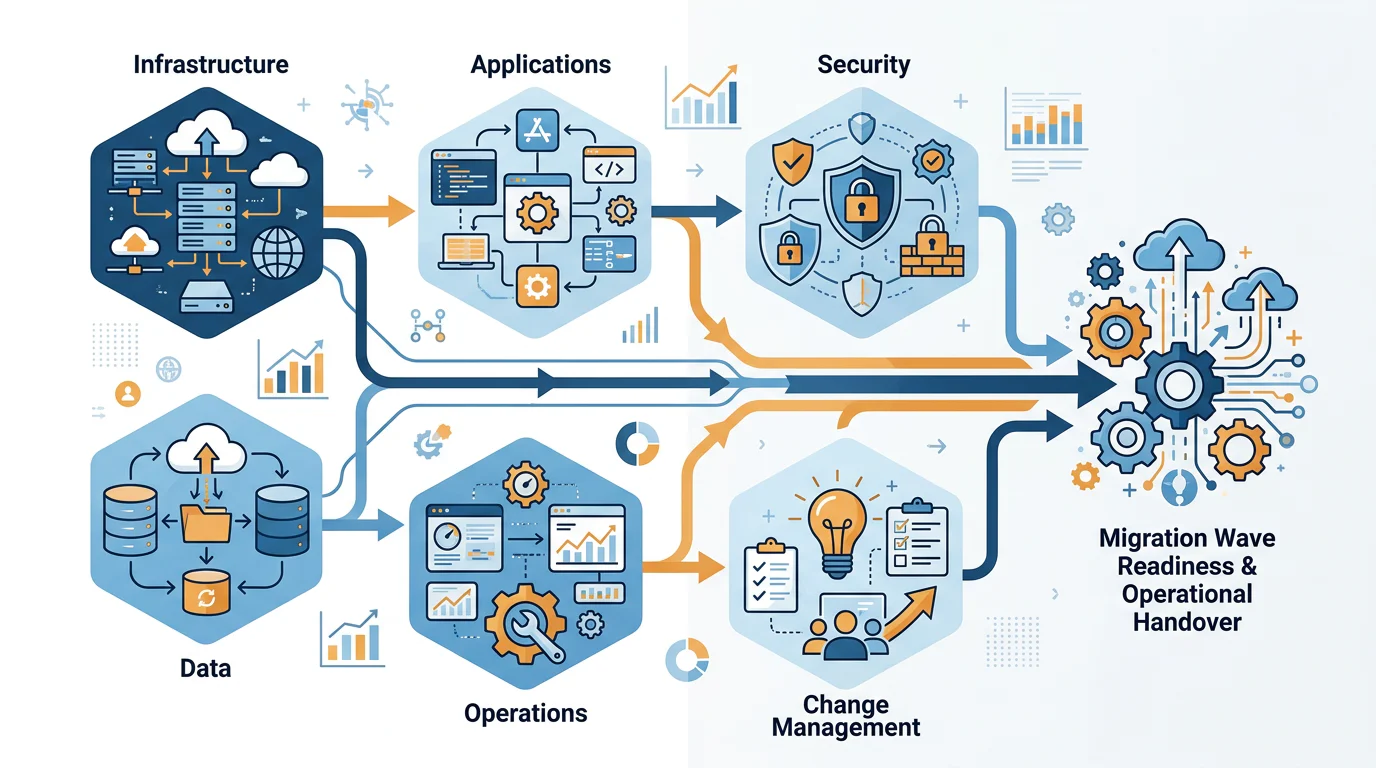
A useful dependency map makes each handoff inspectable. It should show who provides the prerequisite, who consumes it, what evidence proves readiness, what happens if it fails, and when the issue must be escalated. The map below is an illustrative example, not a universal technical design.
| Workstream | Provides | Dependent Workstream | Program-Level Escalation Trigger |
|---|---|---|---|
| Infrastructure And Platform | Landing Zone, Identity, Network Connectivity | Applications, Data, Security | Required Environment Is Not Ready For A Planned Wave |
| Security And Compliance | Control Approval, Risk Treatment | Applications, Operations | Unresolved Exception Affects Release Decision |
| Data | Classification, Replication, Reconciliation | Applications, Operations | Data Validation Prevents Cutover Or Acceptance |
| Applications | Remediation, Testing, Business Owner Sign-Off | Migration, Change | Workload Is Not Ready For Its Scheduled Wave |
| Operations | Support Model, Monitoring, Runbooks | Change, Benefits | Team Cannot Sustain The Service After Handover |
| Change And Adoption | Training, Communications, Readiness Feedback | Benefits, Operations | Users Or Support Teams Cannot Adopt The New State |
Map the Work Before a Wave
Build a map at the level of releases and transition states, then supplement it with local technical plans. The program manager does not need to design the landing zone or validate a database migration. We need to make the dependency between those specialist decisions and the migration outcome visible early enough for the right people to act.
Use One Dependency Record
Each dependency record should include an owner, a consuming workstream, a needed-by date, readiness evidence, fallback approach, business impact, and escalation threshold. That structure prevents a risk register from becoming a mixed list of observations with no path to resolution.
Integrate Risks, Issues, Resources, and Benefits
Track project-local work where it belongs, but elevate cross-workstream risks, resource conflicts, benefit threats, and unresolved issues into a single program view. AWS recommends a layered RACI approach rather than one giant responsibility chart, because ownership becomes more detailed as portfolio discovery reveals new migration patterns. Use that AWS RACI guidance with our working managers learning path when you need a manageable way to apply program discipline alongside delivery.
Escalate Before a Handoff Fails
Escalation should be based on impact, not hierarchy. Define the point at which a dependency threatens a critical wave, consumes a shared resource, weakens a control, or changes an expected benefit. Then bring the accountable leader a concise decision, the evidence, options, and the consequence of waiting.
What Should Executives See in a Migration Scorecard?
Executives need a view of whether the migration is achieving its purpose and what only they can decide. They do not need every sprint metric, ticket count, or local milestone unless it changes an outcome, dependency, resource allocation, risk exposure, or transition decision.
Use one scorecard that brings delivery and value together. Any metric values included in the live scorecard should be illustrative until replaced with verified organizational values. Cost governance belongs in that view because the 2025 FinOps Foundation survey included 861 respondents representing about $69 billion in cloud spend, showing why migration leaders need a credible link between technical progress and financial accountability.
- Outcome And Benefit: State the intended business result, owner, current confidence, and evidence of realization.
- Wave And Transition Readiness: Show whether the next release can move, stabilize, and hand over safely.
- Critical Dependencies: List only the few constraints that can change the integrated forecast.
- Decision Needed: Name the decision owner, deadline, options, and cost of delay.
- Risk And Resource Trend: Show cross-workstream exposure and constrained capabilities, not every local issue.
- Adoption And Operations: Confirm user readiness, support ownership, monitoring, and service acceptance.
A good scorecard is a conversation tool, not a reporting artifact. It lets a sponsor challenge assumptions, clear a blocker, authorize a trade-off, or confirm that benefits remain credible after transition. See how leaders turn that evidence into a career narrative in our success stories.
Where Does PgMP Training End and Cloud Platform Learning Begin?
Program management training and cloud technical learning solve different problems. PgMP-aligned learning helps leaders coordinate a complex system of projects, decisions, benefits, stakeholders, governance, and transitions. It does not make a program manager the architect, security engineer, operations lead, or FinOps practitioner for every technical choice.
PMI’s eligibility rules reinforce that distinction. The credential requires documented program and project experience, and the application review examines whether a candidate coordinated related components toward a common organizational objective with realized benefits. Review the current PMI eligibility rules before treating any course as a substitute for experience.
What This Training Should Build
We focus on program charters, benefit realization, stakeholder engagement, governance, dependency management, escalation, integrated reporting, and component transition. These are the practices a cloud transformation leader uses to help specialists work as one program.
What Technical Specialists Should Own
Cloud architecture, landing-zone engineering, identity design, security implementation, workload migration tooling, operational observability, and FinOps practices remain specialist disciplines. The program manager sets outcomes, decision paths, interfaces, and readiness criteria, then gives the accountable expert room to lead.
What Experienced PMP Holders Should Do Next
Start by documenting your coordinated experience, especially where you aligned multiple projects around shared benefits, risk, stakeholder decisions, or transitions. Then use a structured training method to connect that experience with the PgMP domains and application evidence.
What We Teach Through a Cloud Scenario
We use the cloud migration scenario to make program management concrete. Instead of memorizing isolated terms, you practice building the charter, dependency map, decision-rights matrix, executive scorecard, and transition checklist that a new program leader needs when several workstreams must move together.
Build Your Cloud Migration Leadership with Augment Consultancy
At Augment Consultancy, we teach PgMP-aligned program management through the decisions leaders actually face when a cloud migration starts pulling priorities apart. Our learning focuses on program charters, benefits, dependency reviews, decision rights, escalation paths, and executive reporting, so you can practice the transition before a steering meeting forces it. We also help experienced candidates translate genuine program work into clear PgMP application evidence, rather than treating exam preparation as memorization. Our PMI-certified experts bring more than 20 years of experience to the coaching conversation. If you need a focused way to build program leadership capability while respecting technical specialists' ownership, we can help you set the boundary and build the governance habits that make cross-functional migration leadership credible. Start with a structured discussion of your role, evidence, and migration responsibilities, then choose the learning path that fits your next program mandate. Explore Augment Consultancy Home.
FAQs on PgMP Training for Cloud Migration Leaders
Where Should I Start When Coordinating Multiple Cloud Migration Workstreams?
Start by naming the shared outcome, appointing accountable workstream owners, mapping prerequisites for every wave, and creating a clear escalation route for conflicts project managers cannot resolve alone.
Is There a Formal Certification for Managing Interconnected Enterprise Projects?
Yes. PMI’s PgMP credential recognizes experienced leaders who coordinate multiple related components toward common benefits, but candidates must meet documented experience requirements before they can schedule the exam.
How Is Program Management Different from Portfolio Management?
A portfolio selects and balances investments strategically. A program integrates related projects, dependencies, benefits, and transitions to produce one coordinated organizational outcome under shared governance.
Does PgMP Training Replace Cloud Architecture or Security Learning?
PgMP training builds program leadership, while cloud architecture, security engineering, platform operations, and FinOps need specialist learning. Effective migration leaders coordinate those experts instead of replacing them.