What Counts as Strategic Portfolio Work? | Augment Consultancy


TL;DR
Learn what counts as strategic portfolio work for PfMP: map infrastructure leadership to alignment, governance, investment evidence, and outcomes.
Infrastructure leaders often carry genuine portfolio responsibility without using portfolio language. For them, what counts as strategic portfolio work depends on the investment decisions they influenced, not only the projects they delivered. In one public example, a national major-project portfolio comprised 189 projects, showing why investment choices matter as much as individual delivery performance.
Strategic portfolio work means selecting, prioritizing, balancing, funding, governing, or changing investments so the organization advances its objectives. Coordinating schedules or delivering several projects is not enough by itself. A PfMP example becomes portfolio-level when it shows the strategic objective, competing components, decision authority, evidence considered, and portfolio-wide outcome.
This guide explains what counts as strategic portfolio work, how to map infrastructure leadership honestly, and how to recognize the evidence that supports a PfMP application and stronger situational decisions. We also show how to assess what counts as strategic portfolio work before you invest time in an application.
What Counts as Strategic Portfolio Work?
Strategic portfolio work is work performed across an investment mix. To decide what counts as strategic portfolio work, ask whether the organization is funding, sequencing, changing, or stopping the right components to advance its strategy, rather than whether one component is being delivered well.
PMI describes portfolio management as centralized management that enables executive decisions across projects, programs, and operations to meet organizational goals. The central distinction is strategic choice: PMI portfolio guidance focuses on alignment between investments and business strategy.
A leader can manage many projects and still be operating at a delivery level. Conversely, a leader may not own every project plan but can have strategic portfolio work if they assess competing investments, prepare scenarios, make recommendations through governance, and help change the component mix. This is the practical test for what counts as strategic portfolio work.
Do I Meet Current PfMP Experience Requirements?
What counts as strategic portfolio work for eligibility is narrower than seniority, title, or the size of a capital plan. When testing what counts as strategic portfolio work, PMI’s current eligibility paths require both professional business experience and portfolio-management experience, so candidates should inventory months and evidence before writing any application narrative.
Requirements Reviewed: 25 July 2026
- Set A: Secondary diploma, 96 months of professional business experience within the past 15 years, and 84 months of portfolio-management experience within the past 15 years.
- Set B: Bachelor’s degree or higher, 96 months of professional business experience within the past 15 years, and 48 months of portfolio-management experience within the past 15 years.
- Set C: Bachelor’s degree or higher from a GAC-accredited program, 96 months of professional business experience within the past 15 years, and 36 months of portfolio-management experience within the past 15 years.
PMI also lists an exam of 170 questions in 240 minutes and a maintenance requirement of 60 PDUs every three years. Use the live PMI requirements as the controlling source before submitting, because requirements can change.
A dated eligibility block clarifies requirements, but what counts as strategic portfolio work still depends on the evidence behind each claimed month. PMI asks candidates to describe specific portfolios and how their management helped achieve strategic objectives. Overlapping months cannot be counted twice, and a persuasive application makes the candidate’s own contribution visible. Our application guide can help you organize that evidence before you commit it to the form.
How Do Project, Program, and Portfolio Work Differ?
The portfolio management versus program management experience distinction becomes easier when you follow the decision being made. Asking what counts as strategic portfolio work shifts attention from the number of initiatives to the choice made across them. A project decision protects a deliverable, a program decision coordinates related benefits, and a portfolio decision changes investment choices in response to strategy, value, risk, or constrained resources.
| Dimension | Project Work | Program Work | Strategic Portfolio Work |
|---|---|---|---|
| Purpose | Deliver a defined output | Realize coordinated benefits | Advance organizational objectives through the investment mix |
| Decision Scope | One initiative | Related and interdependent initiatives | Projects, programs, operations, funding, capacity, and priorities |
| Authority | Delivery decisions | Cross-component coordination | Recommend, authorize, escalate, rebalance, defer, accelerate, or stop components |
| Artifacts | Charter, schedule, RAID log | Benefits map, dependency plan, roadmap | Strategy map, prioritization model, scenario analysis, funding decision, dashboard, governance minutes |
| Outcomes | Accepted deliverable | Benefits realization | Strategic alignment, resource balance, managed risk, changed component mix |
This table is not a hierarchy of importance. Project and program work can be highly complex. The difference is whether your actions influenced the organization’s choice of investments. The PMI portfolio standard distinguishes portfolios by their organizational scope and their changing relationship to strategic objectives.
This is the practical answer to what counts as strategic portfolio work: name the decision first. “I recommended which components should proceed after strategy changed” is stronger and more precise than “I managed a large programme.”
Our portfolio coverage guide helps candidates separate portfolio governance from the coordination logic they may know from program delivery.
How Do I Map Infrastructure Work to PfMP?
Infrastructure work maps to PfMP when the story moves from coordinating assets to making or informing investment choices across assets. The question of what counts as strategic portfolio work is answered by the decision, not by the asset category. The strongest PfMP strategic portfolio experience examples do not inflate delivery responsibilities. They identify the strategic objective, the competing components, the governance route, and the resulting portfolio decision.
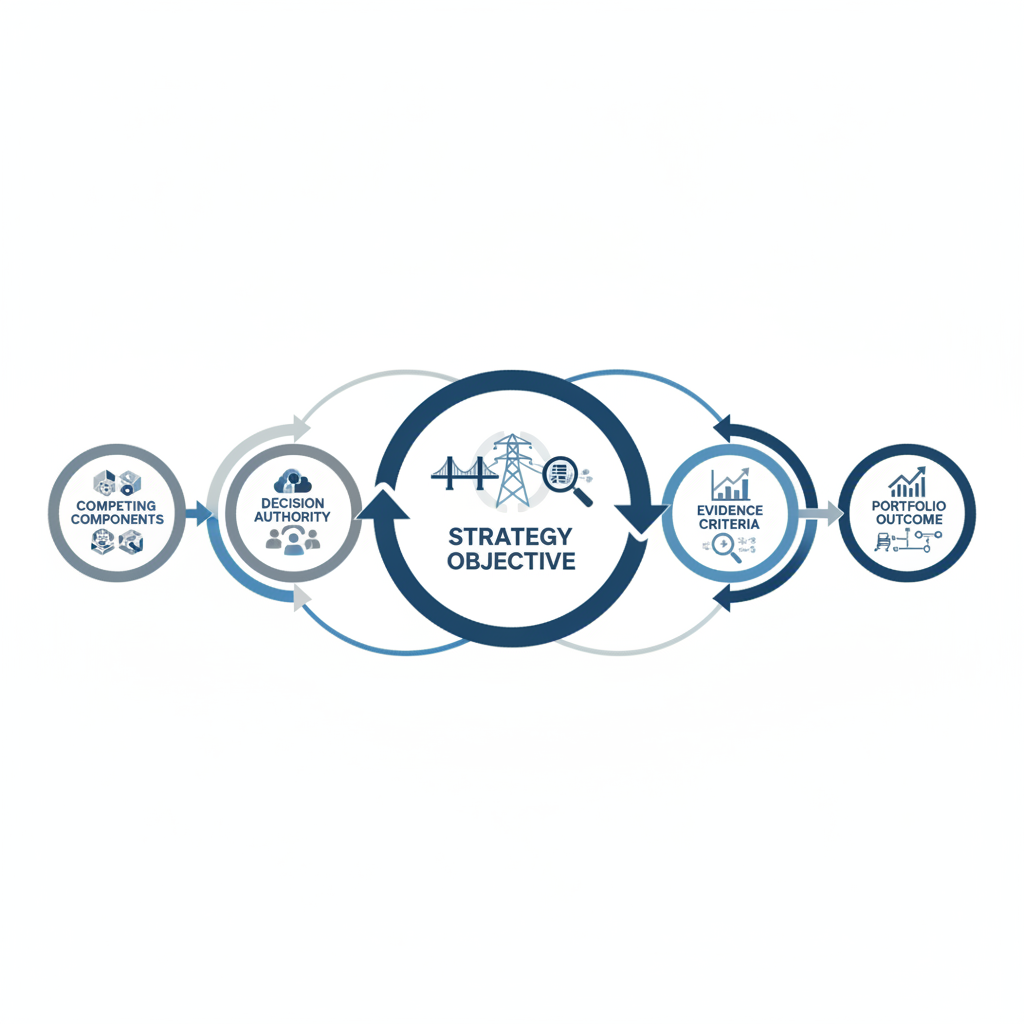
Use this five-part evidence formula for every example:
- Strategic Objective: State the organizational outcome the investment mix was intended to advance.
- Competing Components: Identify the projects, programs, operations, or investment options competing for funding, capacity, or priority.
- Decision Authority: Name your role, the decision forum, and whether you recommended, authorized, escalated, or implemented a portfolio decision.
- Evidence Considered: Describe the criteria used, such as regulatory need, lifecycle cost, benefits, dependencies, risk, service performance, or strategic fit.
- Portfolio-Wide Outcome: Show what changed across the portfolio, including funding, sequencing, component health, risk exposure, or expected benefits.
For example, an asset-renewal leader may have coordinated many renewal packages. That becomes strategic portfolio work only if they used agreed criteria to recommend which packages to fund, defer, or sequence across a constrained plan. A network-resilience leader may have balanced compliance, capacity, and risk investments, then escalated a trade-off that changed the portfolio roadmap. A regional modernization leader may have compared interdependent capital components and secured authorization for a different investment mix. Each example answers what counts as strategic portfolio work with evidence rather than title-based claims.
PMI’s exam outline explicitly includes prioritization criteria, scenario analysis, recommendations to governance, and assessment of strategic change impacts. That makes the exam outline useful both for studying and for testing whether an example is really portfolio-level.
For more context on leadership expectations, read our senior leaders guide.
What Evidence of Strategic Alignment for PfMP Should I Gather?
Evidence of strategic alignment for PfMP should show a traceable chain from objective to investment decision. For candidates considering what counts as strategic portfolio work, the best evidence shows not only what was reported but how that information affected a portfolio decision. A dashboard alone is not enough if it merely reports schedule status. A governance meeting alone is not enough if you cannot explain the decision rights, criteria, or action that followed.
Collect artifacts that support your memory without copying confidential material into an application. The purpose is to verify the decisions you can truthfully describe and to identify gaps before you write.
- Strategy Map: The objective, mission, regulatory commitment, or strategic priority connected to the portfolio.
- Component Register: The projects, programs, operations, or investment options under consideration.
- Prioritization Model: The agreed scoring criteria, weights, or decision rules.
- Scenario Analysis: Options showing alternative component mixes, timing, risk, or cost.
- Funding Decision: The approved allocation, deferral, release, or reallocation of investment.
- Portfolio Roadmap: The sequencing, dependencies, constraints, and strategic milestones.
- Authority Matrix: The decision rights, escalation thresholds, and accountability structure.
- Governance Minutes: The record of recommendation, challenge, authorization, or escalation.
- Performance Dashboard: Portfolio-wide value, resource, risk, benefit, and component-health information.
- Benefit Report: Evidence of expected, realized, or revised portfolio benefits.
The artifact checklist makes what counts as strategic portfolio work easier to substantiate. A mature portfolio assesses investments together, not as isolated projects. The GAO investment framework identifies cost, benefit, schedule, and risk as core criteria and emphasizes selection, reselection, and termination decisions as organizational priorities change.
If your evidence is scattered, our five-domain readiness test can help you distinguish an evidence-organization problem from a genuine experience gap.
How Do I Know Whether My Experience Is Strong Enough?
The most honest answer to what counts as strategic portfolio work is sometimes “not yet.” Strong wording cannot turn routine schedule coordination into an investment decision. That is good news when identified early, because it prevents an application from relying on vague claims that cannot withstand review.
Use this Red, Amber, Green rubric to assess your examples. It translates what counts as strategic portfolio work into a practical decision about whether to proceed, gather evidence, or gain more exposure.
| Rating | What Your Evidence Shows | Best Next Step |
|---|---|---|
| Red | Delivery controls, status reports, schedules, or coordination only, with no portfolio decision or strategic linkage | Build portfolio exposure before applying, rather than rewriting project work as strategy |
| Amber | Analysis or recommendations supported a portfolio decision, but your authority, criteria, artifacts, or outcome are unclear | Gather evidence and clarify your individual contribution |
| Green | Strategic objective, competing components, decision criteria, governance route, and portfolio-wide outcome are all visible | Develop concise application narratives and scenario judgment |
A useful stop or go check is simple. Stop and reassess if you cannot identify more than one component, the strategic objective, the decision body, and a resulting decision. Go forward if those facts exist but your current language hides them behind tactical verbs. This check prevents a loose interpretation of what counts as strategic portfolio work.
The wording shift should stay truthful:
| Tactical Wording | Truthful Portfolio Evidence |
|---|---|
| “Managed schedules for multiple infrastructure projects.” | “Prepared portfolio scenarios for competing components and presented their strategic, risk, and capacity implications to the authorized decision body.” |
| “Reported project status to executives.” | “Consolidated component health, resources, benefits, and strategic risks to inform portfolio corrective decisions.” |
| “Tracked capital spend.” | “Supported allocation decisions by identifying the impact of funding choices across competing components.” |
Our practice-test guide explains why recognizing this level of decision is also essential when choosing between plausible exam answers.
Why Do PfMP Scenarios Feel so Situational?
PfMP questions feel situational because the best answer often protects portfolio alignment before it solves a local delivery problem. This is why what counts as strategic portfolio work on the application mirrors the logic needed in the exam. Candidates with strong PMP or PgMP experience can still second-guess themselves if they answer from the perspective of one project, one sponsor, or one urgent issue.
Start by asking what changed: strategy, risk, benefit expectation, funding, capacity, stakeholder priority, or component performance. Then identify the portfolio action that should occur under the governance model. The correct logic usually involves evaluating impact, applying approved criteria, making a recommendation through the right authority, and communicating the decision.
PMI allocates 25 percent of the exam to Strategic Alignment, 20 percent to Governance, 20 percent to Portfolio Performance, 15 percent to Portfolio Risk Management, and 20 percent to Communications Management. Those five exam domains explain why rereading a standard can be useful but insufficient if the candidate has not practiced portfolio-level decision logic.
Structured support is worth considering when you consistently choose delivery actions over governance-led portfolio actions, cannot map your examples across the domains, or need a candid evidence review. It is not a substitute for qualifying experience. Our study method focuses on building that decision-making discipline.

Work with Augment Consultancy on PfMP Readiness
Choosing support should be a decision about evidence and judgment, not anxiety. At Augment Consultancy, we help experienced leaders identify the real portfolio decisions already present in their work, test them against the five-domain logic, and write claims that remain accurate under review. We begin by clarifying what counts as strategic portfolio work in your actual experience. We do not turn routine coordination into strategic portfolio work, and we do not treat a course as a substitute for qualifying experience. Instead, we help you separate a missing artifact from a missing decision, recognize when an application needs more evidence, and practice choosing governance-led actions in difficult scenarios. If you are unsure whether your infrastructure background is Red, Amber, or Green, bring the facts: objectives, components, decisions, authorities, and outcomes. We will help you assess whether structured PfMP preparation is useful before you commit time or money and choose a path that fits your evidence. Begin with Augment Consultancy Home
FAQs on What Counts as Strategic Portfolio Work
Does Managing Multiple Infrastructure Projects Count as Portfolio Management?
It counts only when you influence investment choices, priorities, funding, governance, or portfolio-wide changes. Managing schedules and reporting status alone is project or program delivery work.
What Is Evidence of Strategic Alignment for PfMP?
For PfMP, evidence connects an organizational objective to prioritization criteria, competing components, a governance decision, and a measurable portfolio-wide outcome, including reallocation, sequencing, or revised benefits.
Can I Use Project Coordination Experience in a PfMP Application?
Use it only if coordination supported a portfolio decision you can explain truthfully, including your strategic contribution, authority path, decision criteria, and resulting portfolio outcome.
Why Do PfMP Mock Questions Feel Different from PMP Questions?
They test judgment across investments, not only delivery control. Identify the strategic impact first, then apply governance, prioritization, and portfolio information before selecting an action.
When Should I Seek PfMP Certification Support?
Seek support when evidence is Amber, application examples lack decision logic, or mock answers stay project-focused despite study. It cannot replace qualifying portfolio experience.