PfMP Mentoring Explained: Portfolio Governance Coaching vs. Exam-Tip Services


TL;DR
PfMP mentoring explained: compare governance coaching with exam-tip services, spot red flags, and know what strong mentoring sessions include.
Portfolio leaders are expected to decide which work advances strategy, not merely manage delivery. Organizations with mature portfolio-management practices complete 35% more programs successfully, which helps explain why governance capability matters.
PfMP mentoring should do more than offer exam tips. Strong mentoring teaches you to explain and defend portfolio decisions: how initiatives align with strategy, which trade-offs a governance board should make, and how risk, capacity, value, and performance evidence change the choice. We compare the service types and show what credible sessions include.
What PfMP Mentoring Actually Includes
The PfMP credential is designed for experienced leaders managing portfolios of projects, programs, and operations. Its current blueprint has 170 questions in 240 minutes across strategic alignment, governance, portfolio performance, risk management, and communications management. Governance alone represents 20% of the exam.
That breadth is why useful mentoring has two connected jobs. First, it helps candidates prepare an accurate application and learn the certification language. Second, it helps them practise portfolio-level judgment, including how to explain why one initiative should be funded, paused, sequenced, or stopped.
Exam preparation is still valuable. Timed questions, answer rationales, and study plans reveal gaps and build pace. But they should sit beside, rather than replace, conversations about real decision rights, portfolio trade-offs, and executive communication. Our readiness test can help candidates identify whether their main need is application support, domain understanding, or structured practice.
What Governance Coaching Actually Teaches
Governance coaching turns abstract terms into decisions a portfolio leader can defend. The official outline calls for candidates to establish governance models, create portfolio management plans, recommend portfolio decisions, and continuously improve the processes behind them.
Strategic Alignment and Portfolio Scenarios
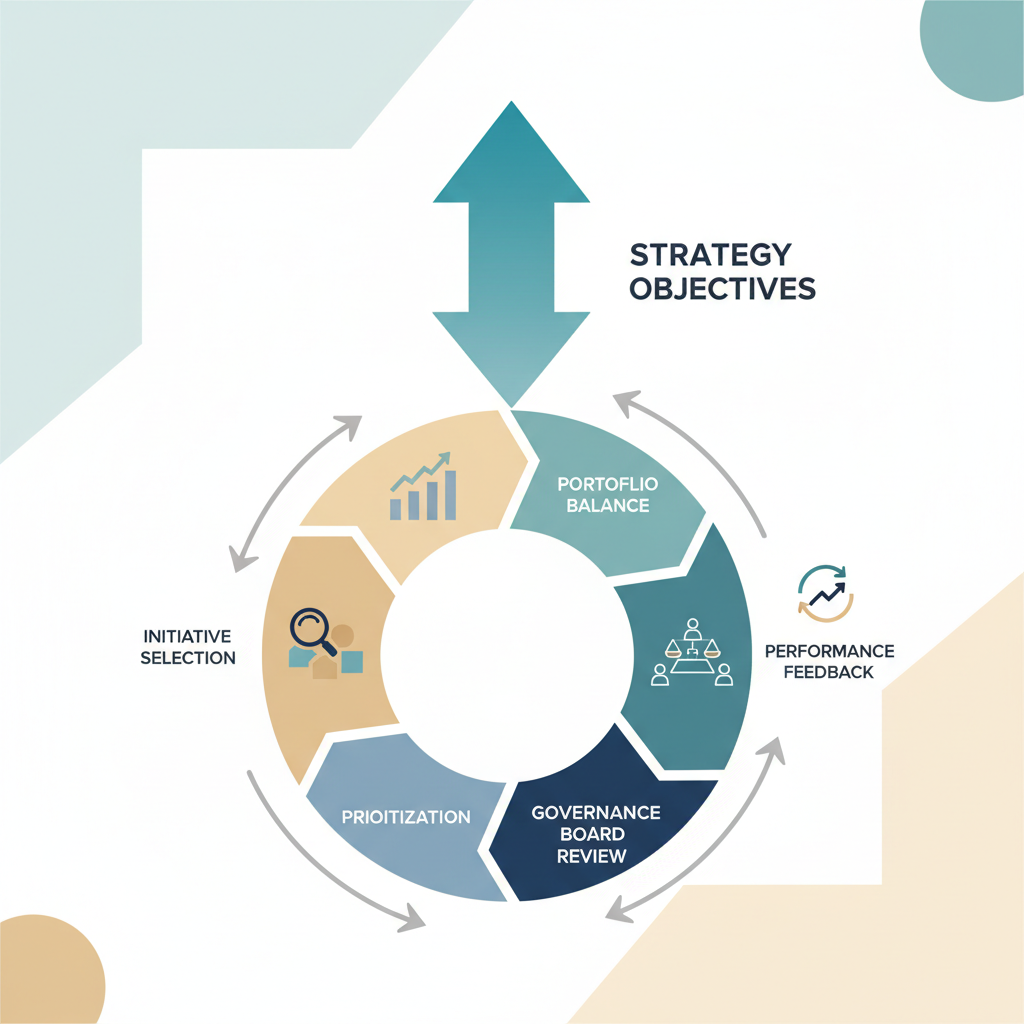
A coach should ask more than whether an initiative sounds valuable. They should ask which strategic objective it serves, what evidence supports that connection, what changes if the strategy shifts, and what alternatives compete for the same capacity.
Scenario work also helps candidates distinguish portfolio thinking from project thinking. The unit of analysis is the overall mix of investments, dependencies, benefits, and constraints. Readers who need help framing that experience can review our guide to portfolio work.
Governance Boards and Decision Rights
A governance model clarifies who recommends, decides, escalates, and communicates. Good mentoring can simulate a governance-board conversation in which the candidate must recommend approval, deferral, reprioritization, suspension, or termination.
The point is not to memorise a script. It is to explain a recommendation using decision rights, thresholds, risk tolerance, expected value, strategic fit, and available resources. That is the level of reasoning a formula sheet cannot assess.
Portfolio Balancing and Performance Trade-Offs
Portfolio balance means examining competing demands, including short and long horizons, risk and return, dependencies, capacity constraints, and competing strategic priorities. A mentor can introduce a fictional portfolio, change one constraint, then ask the candidate to revisit the component mix.
That feedback loop is particularly useful when a candidate has strong project delivery experience but needs to articulate how a portfolio manager protects strategic alignment across the full investment landscape. Candidates can also explore our success stories to see how structured support has helped other certification journeys.
Risk, Escalation, and Executive Communication
Portfolio risk is not simply a collection of project risks. It includes aggregate exposure, interdependencies, risk appetite, thresholds, escalation routes, and the consequences of a changed strategy. A credible session should connect those ideas to KPIs, governance thresholds, and concise executive reporting.
Governance Coaching vs. Exam-Tip Services
The distinction is not that one format is always good and the other is always bad. Most candidates need some practice questions. The useful question is whether a service makes its scope clear, then delivers the type of feedback the candidate actually needs.
| Component | Exam-Tip Service | Hybrid Certification Prep | Governance-First Mentoring |
|---|---|---|---|
| ECO And Domain Explanation | Yes | Yes | Yes |
| Timed Practice And Rationales | Yes | Yes | Sometimes |
| Application Or Panel Support | Sometimes | Yes | Yes |
| Portfolio Scenario Discussion | No | Limited | Yes |
| Governance-Board Simulation | No | Rare | Yes |
| Portfolio Balancing Discussion | No | Limited | Yes |
| Feedback On Decision Reasoning | Limited | Yes | Yes |
| Claims Access To Real Exam Content | Red Flag | No | No |
A question bank can show whether a learner selected the best response. A coach can ask why that response fits the governance model, what assumption changes the answer, and how the candidate would defend the recommendation to executives. Those are different learning outcomes.

Legitimate preparation must respect exam confidentiality. PMI’s exam-security rules state that exam questions, content, and answers are confidential. Practice materials should be original, domain-aligned, and explained, never presented as leaked or remembered exam content. For practice that feels less predictable than a simple quiz, see why PfMP practice tests can expose reasoning gaps.
How to Choose a Mentor and What to Expect
Start by asking what happens in a typical live session. A credible answer should identify the agenda, the feedback method, the domains covered, and whether the mentor will challenge your explanation of a portfolio decision. Vague promises of “support until you pass” reveal much less than a transparent learning design.
Verify Credentials and Relevant Experience
Ask whether the mentor holds relevant credentials and has worked with portfolio-level governance, prioritization, performance reporting, or investment decisions. PMI’s registry search can help verify credentials, although credential holders may choose not to appear publicly.
Also ask for an anonymized example of a scenario they use in coaching. They should be able to describe the decision, the trade-off, and the learning objective without exposing client information or confidential exam content.
Ask for a Visible Session Design
Look for a syllabus that separates application support, governance learning, independent study, and question practice. That separation matters because candidates may need one service intensely and another only lightly.
- Live feedback: The mentor should respond to your reasoning, not simply confirm an answer key.
- Scenario work: The programme should include portfolio choices with constrained capacity, risk, dependencies, and changing strategy.
- Action plan: Each session should end with a focused assignment, reflection, or practice goal.
- Clear boundaries: The provider should explain what it can review and what candidates must write or decide themselves.
Watch for Exam-Tip-Only Red Flags
Be cautious if a service leads with “real questions,” avoids explaining governance concepts, cannot identify mentor credentials, or gives no detail beyond downloadable notes and a large question count. A strong mentor may use study aids, but should also be able to discuss decision rights, portfolio metrics, escalation, and strategic alignment in context.
A Sample 75-Minute Session
A live session does not need to be theatrical to be useful. It should create enough space to diagnose the candidate’s reasoning, practise it under pressure, and convert the feedback into a next step.
| Session Stage | Typical Focus |
|---|---|
| Opening | Candidate goal and decision context |
| Diagnostic | Relevant domain, assumptions, and knowledge gap |
| Scenario Review | Strategic alignment or portfolio-balancing case |
| Board Simulation | Candidate recommendation and defence |
| Feedback | Governance language, logic, and improvement points |
| Next Actions | Targeted study, reflection, and practice questions |
For candidates preparing their evidence as well as their knowledge, our panel review guide explains the separate application challenge.

What PfMP Mentoring Costs and Covers
There is no reliable universal price range for mentoring because formats vary sharply. A self-paced programme with limited Q&A is not comparable to one-to-one guidance that includes application review, live scenario work, and post-session feedback. The better comparison is total support received, not the headline fee alone.
Before paying, ask how many live hours are included, whether the fee covers application support, how long materials remain available, whether question practice is original and explained, and what happens if you miss a session. Compare the expiry date, refund terms, group access, and individual-feedback scope in writing.
Mentoring also cannot create eligibility. PMI’s current requirements include 96 months of professional business experience within the past 15 years, plus 84, 48, or 36 months of portfolio-management experience depending on education. Coaching can help candidates describe genuine experience accurately, but it cannot substitute for it.
If schedule flexibility is your main concern, compare training options before choosing a format. The best fit is the one that gives you governance depth where you need it and practice where it adds value.
Learn with Augment Consultancy
At Augment Consultancy, we built our PfMP mentoring around the decisions senior portfolio leaders actually make, not around memorising isolated answer patterns. We help you connect PMI language to your portfolio evidence, then practise explaining that logic under questioning. Our mentors bring certified PgMP® and PfMP® experience alongside real-world program and portfolio management perspective, so every conversation can move from a standard to a defensible recommendation. We can support your application narrative, domain understanding, practice approach, and confidence in live discussion without blurring the line between legitimate preparation and confidential exam content. If you want to see how our framework fits your experience and schedule, we will help you identify the right starting point, clarify your readiness, and choose a practical path through application, learning, and exam preparation. Take your next step, when you're ready for personal guidance, with Augment Consultancy.
FAQs on PfMP Mentoring
What Credentials Should a PfMP Mentor Have?
Look for verifiable PfMP or PgMP credentials, substantial portfolio decision experience, a transparent syllabus, and the ability to discuss governance scenarios without claiming access to confidential exam questions.
How Often Should PfMP Mentoring Sessions Occur?
Schedule sessions around your gaps: more frequent early conversations for application and governance calibration, then targeted reviews between independent study blocks and timed practice as needed.
What Does PfMP Mentoring Cost?
Costs vary by live access, individual feedback, application review, and included materials. Compare total support hours, expiry dates, refund terms, and whether the fee includes question practice.
Can a Mentor Help with Panel Review?
Yes, a mentor can help organize experience summaries and connect evidence to portfolio responsibilities, but candidates must provide accurate accounts of work they personally performed.