How to Study PfMP with Real Cases: A PfMP Study Plan with Case Studies
A practical PfMP study plan with case studies, healthcare scenarios, mock diagnostics, and readiness criteria for scenario questions.

The PfMP examination gives candidates 240 minutes for 170 questions, with Strategic Alignment and Portfolio Performance each accounting for 25% of the blueprint, according to the PMI blueprint. That weighting makes it risky to treat preparation as a memorization exercise.
A PfMP study plan with case studies is stronger than theory-only preparation because PfMP questions require portfolio-level decisions about strategy, funding, governance, risk, performance, and communication. We recommend turning every reading into a decision rule, testing it in realistic cases, and reviewing each mock error for the flawed reasoning behind it.
We show how to diagnose all five domains, build a phased plan, work healthcare portfolio scenarios, repair mock-exam errors, and decide whether you are ready to sit the exam or need structured support.
What Does PfMP Preparation Require Beyond Reading the Standard?
Reading the standard matters, but it is the input, not the finish line. Portfolio management is about choosing and changing a mix of investments in response to strategy, capacity, risk, value, and performance. A good answer therefore explains what the portfolio leader should do next, who owns the decision, and why that action protects organizational value.
PMI’s own application guidance makes the distinction unusually clear. Candidates must describe how they operationalized portfolio concepts, why they used them, and what results followed. Repeating the standard in different words is not enough, as the PfMP handbook explains.
Begin with a Five-Domain Baseline
Before building a schedule, we would take a short baseline across Strategic Alignment, Governance, Portfolio Performance, Portfolio Risk Management, and Communications Management. The purpose is not to chase an early score. It is to see whether you are missing knowledge, answering at the wrong management level, putting valid actions in the wrong order, or choosing an option that weakens the portfolio.
The official blueprint also breaks the domains into 8 Strategic Alignment tasks, 5 Governance tasks, 10 Portfolio Performance tasks, 6 Portfolio Risk Management tasks, and 6 Communications Management tasks. Your baseline should touch all of them, then leave you with a simple heat map of what to repair first.
Turn Each Reading into a Decision Rule
For every chapter, write one rule that tells you how to act in a scenario. “Strategic alignment” becomes, “Compare components against approved objectives before allocating scarce capacity.” “Governance” becomes, “Escalate a decision when it crosses the portfolio board’s authority threshold instead of solving it inside a delivery team.”
This is where our case-based preparation approach becomes useful. It changes passive notes into choices you can defend under time pressure.
Separate Portfolio Work from Project Work
A project answer may focus on completing a deliverable, resolving a team issue, or protecting a project schedule. A portfolio answer asks whether the component still deserves investment relative to all other components. It considers strategic fit, aggregate value, risk concentration, available capability, and executive decision rights.
When two answers look plausible, ask which one improves the portfolio as a whole. That question often exposes the tempting project-level option.
What Is a PfMP Study Plan with Case Studies?
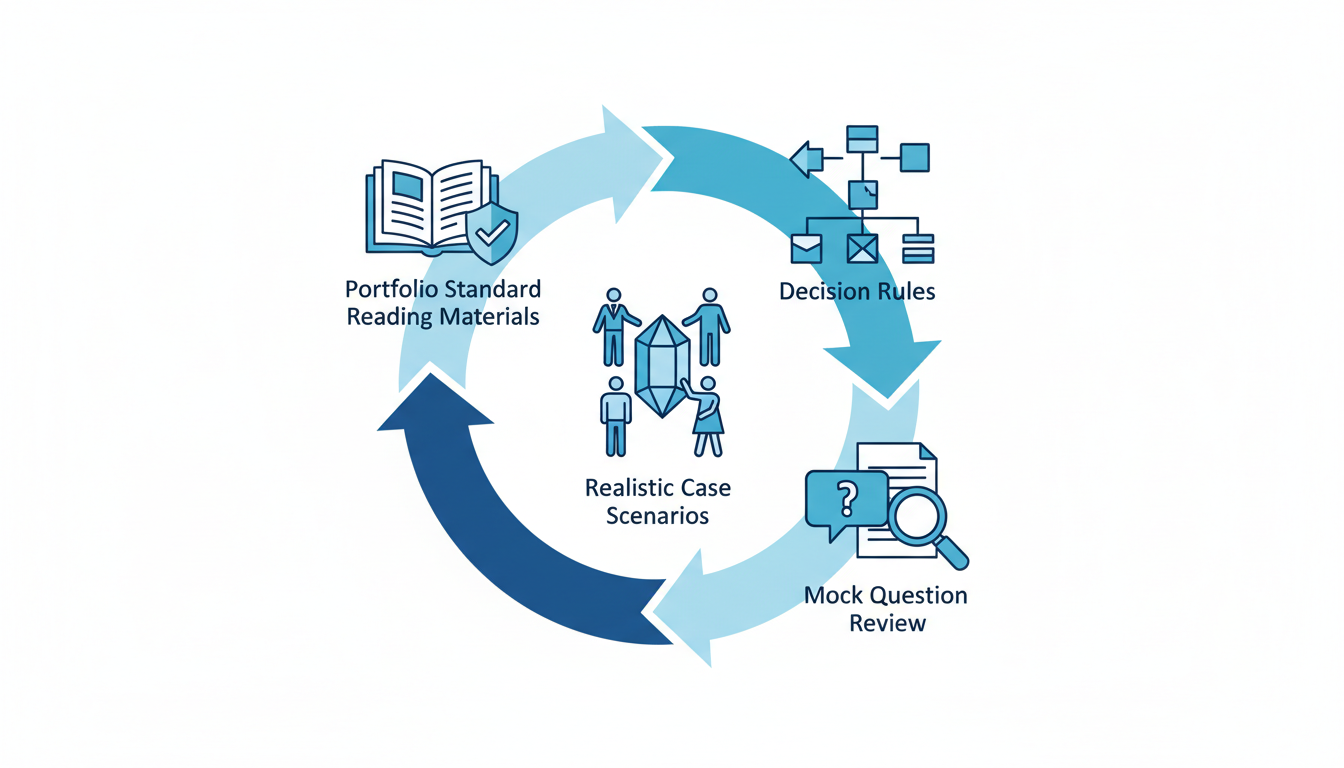
We built this plan around a repeated learning loop: read a focused section, express its rule, apply the rule to a case, explain your choice, then log mistakes from practice. It gives experienced practitioners a way to convert familiar terms into sound situational judgment.
PMI describes portfolio management as the management of projects, programs, and other work grouped to meet strategic objectives in its portfolio standard. That is why every phase below produces an artifact that shows how components connect to enterprise choices.
| Phase | Objective | Readings | Case Exercise | Artifact | Mock Activity | Exit Criterion |
|---|---|---|---|---|---|---|
| Baseline | Diagnose all five domains | Exam blueprint and handbook | Identify the decision level in mixed scenarios | Domain heat map and error log | Untimed mixed set | Explain each error by type |
| Strategic Choices | Connect strategy to component decisions | Strategic alignment, value, capacity | Select and prioritize constrained components | Scoring sheet and rationale | Domain-focused questions | Defend the selected mix |
| Governance and Control | Apply decision rights and escalation | Governance and communications | Escalate a funding, benefits, or compliance conflict | Governance map and escalation path | Governance-focused questions | Name the right decision owner |
| Balance and Optimize | Make cross-portfolio trade-offs | Performance and risk | Fund, defer, rebalance, or terminate work | Dashboard and options paper | Timed mixed sets | Use value, capacity, and risk together |
| Integrate and Prove | Sustain reasoning under time pressure | Targeted rereads only | Work the three cases below | One-page rationale per case | Two full simulations | Show stable, explainable decisions |
| Final Readiness | Protect judgment and pacing | Error log and blueprint | Rework recurring error patterns | Exam-day checklist | Light mixed review | No unresolved recurring errors |
The accelerated route uses 12 weeks of deliberate work, with roughly 14 study hours protected each week. The standard-paced route spreads the same 168 planned hours over 24 weeks, at about seven hours weekly. These are planning allocations, not guarantees of a passing result.
Use the accelerated route only if you already have qualifying portfolio context, can sustain the workload, and are preparing application evidence in parallel. Our situational-question framework can help you make every practice session more diagnostic rather than simply longer.
Create Artifacts, Not Just Notes
A scoring sheet, risk view, decision-rights map, and executive recommendation force you to expose your reasoning. If you cannot state which strategic objective a component serves, what capacity it consumes, and who must approve a change, you have found a real learning gap.
Keep those artifacts in a shared workspace. They will become the evidence behind your revision decisions and reduce the urge to reread every source after a weak mock.
Use Mocks to Test Reasoning
A full simulation tests stamina, pacing, and decision quality. A short domain set tests one rule at a time. Both matter, but neither helps much if you mark an answer wrong and move on without deciding whether the problem was knowledge, scope, sequence, or judgment.
We would start timing only after you can explain the portfolio logic in an untimed set. Speed built on weak reasoning just makes the same mistakes faster.
Are Case Studies Needed for PfMP Preparation?
Yes. Cases are where abstract portfolio language becomes a practical choice between plausible alternatives. They should not imitate confidential business records or claim to predict live questions. Their job is to make you compare options, identify decision rights, and explain why one action creates more organizational value.
Healthcare cases are especially useful because they make trade-offs concrete. More than 99% of U.S. non-federal acute-care hospitals had adopted certified EHRs by 2024, according to ONC data. The challenge is no longer simply adopting technology, but balancing clinical value, regulatory change, resilience, interoperability, and scarce specialist capacity.

Worked Case One: Select and Prioritize the Portfolio
A health system has four proposals: EHR workflow optimization, cybersecurity remediation, a patient-access upgrade, and a clinician documentation tool. The board has insufficient funding and informatics capacity to start all four at once.
The right portfolio action is not to select the loudest sponsor’s initiative or the project with the fastest standalone benefit. First, compare each proposal against approved strategic objectives, mandatory obligations, dependencies, risk exposure, and constrained capability. Then recommend a balanced sequence that protects critical resilience work, advances the most relevant strategic outcomes, and does not overload the same specialists.
The rejected alternatives are revealing. Funding every initiative weakens delivery confidence. Selecting only the highest financial return ignores risk and clinical obligations. Letting each department decide independently bypasses portfolio optimization. Use this case to create a scoring sheet and an executive recommendation. For more context on the required level of experience, read our strategic portfolio work guide.
Worked Case Two: Balance Funding and Regulatory Pressure
A payer-facing interoperability initiative now has a fixed external deadline, while a promising analytics component competes for the same data specialists. Current CMS policy requires certain prior authorization provisions from January 1, 2026, while impacted payers primarily have until January 1, 2027 for API requirements under the CMS final rule.
The portfolio response is to examine the whole capacity and risk picture, not merely declare the regulatory initiative urgent. Confirm the deadline, map dependency and specialist demand, compare the cost of delay, and present options to the governance body with the authority to change funding or sequencing. The likely recommendation is to protect essential compliance and patient-access work, defer lower-priority analytics scope, and review the mix at a stated threshold.
The weak alternatives are to split every resource evenly, ask the project team to solve an enterprise funding decision, or continue both initiatives without acknowledging capacity constraints. This case practises funding, balancing, escalation, and executive oversight in one sequence.
Worked Case Three: Terminate, Rescue, or Re-Scope a Component
A virtual-care component is consuming more specialist time than planned, has not achieved its expected adoption trajectory, and now creates an avoidable dependency risk for a higher-priority clinical initiative. The delivery team wants more time because it has already invested heavily.
The portfolio manager should not decide from sunk cost or delivery effort. Review the component’s strategic contribution, benefits trend, risk profile, capacity impact, and alternatives. If its performance threshold has been crossed, take a structured recommendation to the appropriate governance forum: terminate it, re-scope it to a smaller strategic purpose, or approve a time-boxed recovery with explicit measures.
The strongest answer identifies decision rights. The portfolio manager assembles the analysis and recommends a path. The portfolio governance body authorizes a material investment decision. Executive leaders receive the implications for strategy, patient impact, risk, and capacity. For more timed practice, use our PfMP practice guidance.
Why Am I Failing PfMP Mock Exams After Reading the Standard?
Repeated reading can make concepts familiar without making decisions automatic. If you are scoring inconsistently, do not respond with another complete reread. Review every miss through a taxonomy that identifies the thinking failure, then repair that failure with a fresh scenario.
A useful error log prevents one bad result from turning into vague anxiety. It also distinguishes a genuine knowledge gap from a candidate who knows the concept but answers as a program manager, chooses the right action at the wrong time, or overlooks the better portfolio-level outcome.
| Error Type | What It Looks Like | Corrective Question | Repair Exercise |
|---|---|---|---|
| Knowledge | You do not know the concept or domain | What rule am I missing? | Retrieve the rule, then apply it to a new case |
| Scope | You answer at project or program level | Whose decision is this? | Label the decision level before choosing |
| Sequencing | Your action is reasonable but premature | What must happen first? | Write the decision sequence in order |
| Judgment | You choose a locally attractive option | Which action best protects portfolio value? | Compare the best option with its nearest alternative |
Repair Knowledge Errors
Knowledge errors need targeted retrieval, not broad panic. Revisit the exact concept, write its decision rule in your own words, and answer a new scenario that requires it. Do not count recognition of a definition as proof that you can apply it.
Repair Scope Errors
Scope errors are common for experienced project and program leaders moving into portfolio management. Before looking at the options, identify whether the scenario concerns a component, a program, the portfolio, a governance body, or an executive sponsor.
Repair Sequencing Errors
Many options can be sensible eventually. The exam asks what should happen now. A strong sequence usually starts with assessing strategic alignment and available information, comparing viable choices, escalating when authority requires it, authorizing action, communicating the decision, and monitoring the portfolio effect.
Repair Judgment Errors
Judgment errors are the final distinction. You know the terms and sequence, but select the option that feels helpful locally instead of the one that best protects enterprise value. Our mock diagnostic helps turn these patterns into a repeatable review routine.
Can Healthcare Portfolio Managers Get PfMP-Ready in Four Months?
Four months can be realistic for exam readiness when you are already eligible, have genuine portfolio examples, and can protect the accelerated schedule. It is not a promise that certification will be complete in four months because application processing, panel review, audit status, and appointment availability are outside a study plan.
The practical question is whether you can work at portfolio altitude. Healthcare practitioners should be able to balance clinical outcomes, digital dependencies, cybersecurity, regulation, patient access, budget, and specialist capacity without reducing the decision to a single department’s priorities.
| Route | Study Cadence | Best Fit | Case Work | Mock Work | Main Risk |
|---|---|---|---|---|---|
| Accelerated | 12 weeks, about 14 hours weekly | Already eligible practitioners with a fixed exam target | One substantial case each week | Timed sets, then two full simulations | Rushing application evidence or error review |
| Standard-Paced | 24 weeks, about 7 hours weekly | Leaders with volatile workloads or broader gaps | Cases spaced for reflection and revision | Progressive domain sets and simulations | Losing momentum without milestones |
If you have never made decisions about portfolio selection, balance, governance, or strategic change, do not assume theory alone closes that gap. Build relevant experience first, document it accurately, and use the study plan to strengthen how you explain it. If you are deciding whether structured support is justified, our support readiness test gives you a focused way to assess that choice.
Prepare with Augment Consultancy
At Augment Consultancy, we help experienced portfolio practitioners move from familiar terminology to defensible portfolio decisions. We use case discussion, structured review, and mock analysis to expose the gaps that repeated reading often leaves behind. Our approach is most useful when you can describe real portfolios but need sharper reasoning about selection, balance, governance, escalation, risk, and executive communication.
We will not tell you that a course can create the experience PMI expects. Instead, we help you assess whether your examples are portfolio-level, practise explaining why a decision protects strategic value, and organize a plan around your deadline. If your diagnostic shows that self-study remains the best fit, you should have that clarity early. If structured support would save rework, we can focus the work on your actual error patterns and scenarios. We tailor study milestones to the evidence you need to trust. Explore Augment Consultancy.
FAQs on PfMP Study Plan with Case Studies
Are Case Studies Needed for PfMP Preparation?
Yes. We use cases to practise strategic selection, balancing, governance, and termination decisions. Reading supplies vocabulary; deliberate case review proves whether you can apply it.
Why Do I Keep Failing PfMP Mock Exams?
Most recurring misses fall into knowledge, scope, sequencing, or judgment errors. Log each error, write the corrective rule, and retest it using a different scenario.
Can I Pursue PfMP Without Strategic Portfolio Experience?
You can study the material, but qualifying experience must demonstrate portfolio-level work. Focus first on gaining and documenting strategic selection, governance, balancing, and performance responsibility.
Is Four Months Enough for Healthcare Portfolio Managers?
It can support exam readiness for eligible practitioners with protected study time. Certification timing still depends on application review, panel review, and exam appointment availability.
When Is Structured PfMP Support Worth Paying For?
It is useful when your reasoning stays inconsistent despite self-study, errors repeat, or a fixed deadline requires focused feedback, accountability, and review from an experienced practitioner.