
A Defined Cohort Gives Augment’s First-Attempt Claim Meaning

TL;DR
A first-attempt pass rate measures an exam outcome only when the cohort, outcome event and exclusions are defined. It does not by itself describe the whole certification journey, which can include eligibility review, audit and panel review before an exam is scheduled.
A first-attempt result is one event in a longer route
A first-attempt claim should be read as an outcome at a named point in a process, not as a shorthand for every stage a candidate completes. For PgMP, PMI requires an education-and-experience route, an application, a possible audit, payment, panel review and then an examination. PMI’s 2026 PgMP certification guidance says candidates can schedule the exam only after panel review succeeds.
That sequence matters for readers comparing preparation options. A course can support study or application clarity, but it cannot replace qualifying experience, PMI’s audit process or the independent panel decision. For the full candidate route, see the PgMP certification process.
The published wording identifies a claim, not its calculation
Augment’s PgMP training page uses the phrase “98.5% First-attempt pass rate.” A rate becomes interpretable when its wording is connected to a defined candidate group and a named outcome event. The table separates what each published label says from what a reader should avoid inferring from the label alone.
| Published label | What the label says | What a reader should not infer |
|---|---|---|
| 98.5% first-attempt pass rate | A PgMP training-page claim about first-attempt passing. | That the figure covers every certification stage or every Augment product. Source: Augment PgMP training page, 2026. |
| 6,000+ professionals mentored and 50+ countries | A reported reach figure displayed beside the PgMP training claim. | That these figures form the pass-rate denominator. Source: Augment PgMP training page, 2026. |
| 98% first-time pass success rate | A result label used on the PgMP self-paced course page. | That it uses the same cohort, period or outcome definition as 98.5%. Source: Augment PgMP self-paced course page, 2026. |
| 99% first-attempt success rate | A historical result label on an Augment blog page. | That a historic label and a current label describe the same metric. Source: Augment Program Management Key Benefits page, 2023. |
A methodology makes the percentage testable
A first-attempt methodology should answer six practical questions before a reader relies on the rate:
- Which credential and product are included?
- What start and end dates define the reporting period?
- Who enters the denominator, counted once per person?
- What exact event counts as a first-attempt pass?
- How is that outcome verified?
- How are withdrawals, no-shows, unknown outcomes, retakes and duplicate enrolments handled?
The essential calculation is straightforward: verified first-attempt passes divided by the defined set of eligible first-attempt candidates. The hard part is maintaining records that make each term in that calculation auditable.
A methodology should also keep application help in its proper boundary. PMI’s PgMP handbook says that applicants’ responses must be unique to them, and it treats panel review as a separate gate before the exam. PMI’s PgMP Certification Handbook, 2024 is the controlling source for that boundary.
A first attempt sits after panel review
PMI describes the PgMP examination as 170 questions completed in 240 minutes. That exam is the natural event to name when a provider means an examination first attempt, while eligibility, audit and panel review remain distinct process stages. PMI’s 2026 PgMP certification page provides the current exam format and sequence.
The certification stages around an exam attempt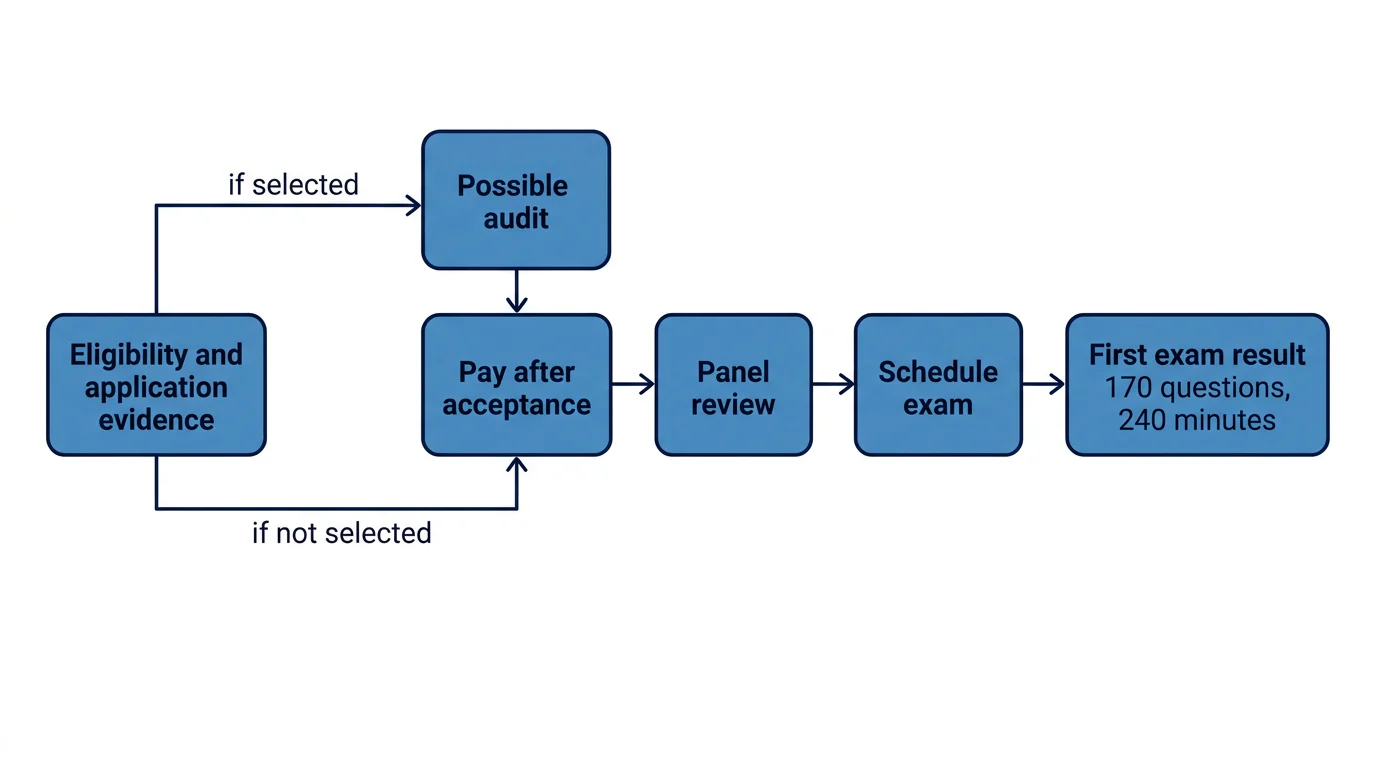
Readers who need help separating the independent gate from preparation support can review what a PgMP panel review means.
Use a pass-rate claim as one input, not the decision
A pass-rate claim can prompt useful questions, but it cannot decide whether a course fits a candidate’s actual gap. Candidates should separately assess whether they need help documenting genuine experience, understanding program-level scenarios, practising timed questions or planning study time.
This approach is not useful for someone seeking a guarantee of eligibility, panel approval or an exam result. Those decisions remain with PMI and the candidate’s own evidence. A better purchase decision connects the support offered to the stage where the candidate needs help, rather than treating a percentage as a substitute for that diagnosis.
Keep reading



Frequently asked
No. A first-attempt pass rate can describe the result of an initial examination sitting. A certification-success rate would need to state whether it includes every required stage, including eligibility, any audit, panel review and the examination.
No. PMI treats panel review and the examination as separate requirements. Its 2026 PgMP information states that candidates schedule the 170-question examination after successfully completing panel review, so a methodology should identify the event counted as success.
A usable methodology names the credential and product scope, reporting period, eligible unique-candidate denominator, first-attempt outcome, verification source, treatment of retakes and duplicate enrolments, and treatment of withdrawals, no-shows and unknown outcomes.
Assess the evidence in your PgMP application
Explore support designed to help you organise and clarify your own application evidence.
Explore application support