

TL;DR
We built this PfMP preparation system for experienced program leaders who must govern agile, predictive, and hybrid work across jurisdictions. It combines PMI’s five domains with regulatory overlays, scenario practice, provider-selection criteria, and a readiness dashboard so you can prepare for the credential without confusing portfolio governance with regional legal advice.
PfMP Preparation for Global Hybrid Portfolios
Hybrid work is no longer an edge case in portfolio leadership. In PMI’s global research, 31.5% of respondents reported using hybrid approaches always or often in 2023, making PMI’s 2024 survey a useful reality check for senior leaders balancing different delivery models.
PfMP Preparation for Global Hybrid Portfolios works best when you keep PMI’s five portfolio domains as the common management layer, then add delivery-method and jurisdiction overlays to each scenario. Study strategic alignment, governance, performance, risk, and communications together while practising decisions on regulatory ownership, evidence, dependencies, funding, and escalation.
This guide explains the credential checkpoints, a diagnostic-led study sequence, hybrid governance, regional overlays, provider selection, and a dashboard for tracking readiness.
What PfMP Checkpoints Must Global Portfolio Leaders Meet?
Eligibility comes before study planning because it determines whether your portfolio experience can move from a career story to a credential application. PMI’s current routes require 96 months of business experience plus either 84, 48, or 36 months of portfolio experience, depending on education, as set out on PMI’s eligibility page.
| Checkpoint | What To Confirm | Why It Matters For Global Hybrid Leaders |
|---|---|---|
| Secondary-school route | 96 months business experience and 84 months portfolio experience within 15 years | Global delivery work must be framed as portfolio-level decisions, not component execution alone |
| Bachelor’s route | 96 months business experience and 48 months portfolio experience within 15 years | Your evidence should show selection, prioritization, balancing, and governance |
| GAC-accredited bachelor’s route | 96 months business experience and 36 months portfolio experience within 15 years | Confirm the academic route before building the application narrative |
| Panel review | Professional experience summaries assessed after payment | Prepare examples that show portfolio authority, strategic alignment, and executive decisions |
| Exam | 170 questions in 240 minutes, English only | Timed practice must test portfolio judgement, not terminology recall |
| Maintenance | 60 PDUs every three years | Treat continuing development as part of your long-term portfolio practice |
PMI may select an application for audit, so retain degree and experience documentation before you start polishing narratives. Our application evidence guide helps distinguish a strong portfolio example from a project or program delivery example that does not prove portfolio authority.
How Should You Build PfMP Preparation for Global Hybrid Portfolios?
The five exam domains are not five isolated chapters. They are a decision system: strategy sets the investment logic, governance defines authority, performance shows whether the mix is working, risk tests the portfolio’s exposure, and communications moves decisions through the right stakeholders. The exam content outline weights Strategic Alignment and Portfolio Performance at 25% each, Governance at 20%, and Risk and Communications at 15% each.
Start with a Portfolio Diagnostic
Begin with a short diagnostic across all five domains, then log not only right and wrong answers but also why your reasoning failed. A senior program leader may understand delivery dependencies well yet need more work on investment tradeoffs, portfolio authorization, or benefits-driven rebalancing.
This is where the PgMP-to-PfMP shift matters. Program leadership coordinates related work toward a shared outcome. Portfolio leadership compares investments, maintains strategic fit, and recommends action when the mix itself needs to change.
Study in Decision Order
| Domain | Exam Weight | Study Output | Global Hybrid Scenario |
|---|---|---|---|
| Strategic Alignment | 25% | Prioritization criteria and portfolio roadmap | Reallocate funding when one region’s strategic priority changes |
| Governance | 20% | Decision rights, thresholds, and escalation map | Decide who can approve a cross-region dependency exception |
| Portfolio Performance | 25% | Consolidated metrics and rebalance recommendation | Compare delayed predictive milestones with agile release evidence |
| Portfolio Risk Management | 15% | Aggregate risk view and appetite statement | Escalate data, supplier, currency, or capacity exposure |
| Communications Management | 15% | Stakeholder and reporting design | Tailor executive reporting across time zones and authorities |
Use the table as a repeating cycle rather than a one-pass syllabus. Study a domain, answer scenarios, map it to your own portfolio, then revisit it when another domain changes the decision.
Reconcile Sources Before You Memorize
Use a source hierarchy: current PMI credential requirements first, then the examination outline, then the portfolio standard, followed by your course materials and official regional sources. PMI describes its portfolio standard as applicable regardless of delivery approach, which is the reason your governance layer can stay consistent while component controls differ.
Our case-based plan is most useful after you create that hierarchy. It helps turn reference reading into decisions about prioritization, governance, performance, risk, and communications.
Practise the Transition, Not Just the Terms
For every mock question, ask what a portfolio leader should authorize, defer, rebalance, escalate, or communicate. Then add a second question: what evidence would the governing body need to support that action across regions and delivery methods?
Use scenario practice to spot whether a low score comes from a domain gap, an exam-reading error, or an inability to distinguish portfolio governance from component-level delivery control.
How Should Portfolio Governance Work Across Agile, Predictive, and Hybrid Components?
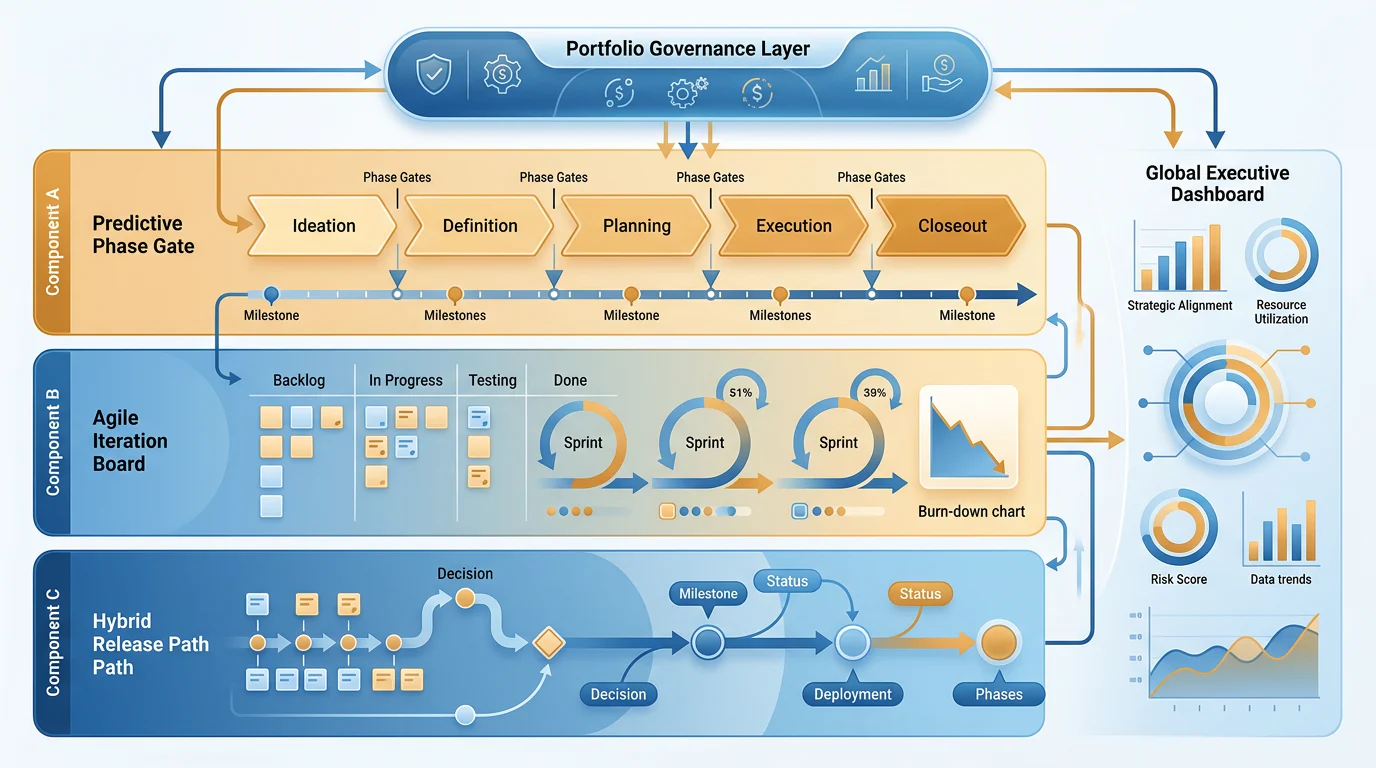
A portfolio does not become hybrid simply because it contains different kinds of projects. It becomes governable when its leadership team keeps a consistent basis for prioritization, investment, risk appetite, reporting, and escalation while allowing components to use controls suited to their delivery conditions. PMI’s agile portfolio guidance treats governance as part of overall strategy, not as a demand that every team follows one lifecycle.
| Delivery Approach | Portfolio-Level Invariant | Component-Level Evidence | Escalation Trigger |
|---|---|---|---|
| Predictive | Strategic fit, funding, benefits, risk appetite, decision rights | Baselines, phase gates, forecasts, approved changes | Material variance, gate failure, dependency delay |
| Agile | Strategic fit, funding, benefits, risk appetite, decision rights | Backlog outcome, release evidence, flow data, validated learning | Value erosion, blocked dependency, capacity conflict |
| Hybrid | Strategic fit, funding, benefits, risk appetite, decision rights | Defined blend of milestones, iterations, releases, and controls | Conflict between fixed commitments and changing evidence |
The portfolio manager should not convert agile measures into artificial waterfall reporting, or dismiss predictive milestones as inflexible. Instead, create a consolidated decision view: what changed, what strategic value is affected, what risk moved, which threshold was crossed, and who must decide next.
How Do You Build a Regional Regulatory Overlay Without Changing the PMI Core?
Regional requirements should affect the scenario, not replace the portfolio framework. Your common layer remains strategic alignment, governance, performance, risk, and communications. The overlay identifies where obligations change the evidence, timing, accountable owner, funding decision, or escalation route.

Build the Overlay Template
| Overlay Field | What To Record |
|---|---|
| Jurisdiction | Country, region, regulator, and applicable business unit |
| Scope | Data, product, supplier, public-company, or sector exposure |
| Trigger | Event, threshold, materiality assessment, or reporting condition |
| Accountable Owner | Legal, privacy, security, finance, or operational decision owner |
| Evidence | Decision log, incident record, approval, assessment, or report |
| Reporting Clock | Deadline, cadence, and time-zone convention |
| Portfolio Impact | Funding, dependency, risk appetite, roadmap, or escalation effect |
| Source Currency | Official source URL, reviewed date, and unresolved question |
Verify the Reporting Clock
For example, an EU personal-data breach that is likely to risk individuals’ rights and freedoms may require notification within 72 hours, according to the EU breach rules. That clock belongs in the overlay because it can change portfolio priorities, executive availability, vendor dependencies, and contingency funding.
A United States public company has a different context. The SEC generally requires a material cybersecurity incident disclosure within four business days after the materiality determination, under the SEC disclosure rule. Do not turn that rule into a generic deadline for every organization or incident.
Singapore’s notifiable data-breach requirement is generally no later than three calendar days, while Brazil’s current incident communication rule sets three working days in the relevant circumstances. Record these separately using the Singapore notification rule and Brazil incident rule, rather than collapsing them into one global assumption.
Separate Legal Interpretation from Portfolio Governance
We recommend assigning legal interpretation to the accountable legal, privacy, or compliance owner. The portfolio leader’s job is to show what the obligation means for strategy, risk exposure, decision rights, evidence, delivery dependencies, and stakeholder escalation.
This separation makes study scenarios more realistic and more useful. Our practical training approach treats compliance information as a governed input, not as a substitute for specialist advice.
Score Cross-Region Scenarios
Use one scenario that includes a cross-region funding decision, an agile release constrained by data requirements, a predictive vendor milestone, an aggregate risk threshold, and an executive escalation. Score your response on strategy, authority, delivery fit, evidence, timing, and communications.
| Rubric Area | Weak Response | Developing Response | Ready Response |
|---|---|---|---|
| Strategic Fit | Protects activity without testing value | Notes strategic impact | Recommends a value-based portfolio action |
| Governance | Names a stakeholder vaguely | Identifies an owner | Uses decision rights, thresholds, and escalation |
| Delivery Fit | Forces one method | Recognizes different methods | Preserves component controls and consolidated oversight |
| Regulatory Overlay | Mentions compliance generally | Identifies a rule or owner | Maps trigger, evidence, clock, and portfolio impact |
| Communications | Sends a status update | Identifies key stakeholders | Tailors decision-ready escalation and reporting |
What Should You Expect from a PfMP Preparation Provider?
A provider should help you test judgement under realistic conditions, not merely supply more slides. For global hybrid portfolio work, compare the quality of scenario explanations, instructor portfolio experience, application support, and the presence of cases that include different regions, stakeholders, delivery models, and governance thresholds.
| Preparation Route | Best For | Evidence To Expect | Price And Access Disclosure |
|---|---|---|---|
| Official-source self-study | Leaders with strong portfolio experience and disciplined study time | Current credential requirements, exam outline, and source log | Confirm current access and credential fees directly before purchase |
| Generic practice route | Candidates who only need additional question exposure | Clear rationales, domain mapping, and timed simulations | Compare only published price, renewal, refund, and access terms |
| Structured mentoring | Candidates with application, judgement, or scenario gaps | Diagnostic, application feedback, domain plan, and global casework | Public course details should state access period and current price terms |
We publish one-year material access for our current PfMP programme, along with live learning, application guidance, and practice resources. We do not treat an undisclosed price as a price comparison, because senior leaders need a written, current total before they decide.
Use self-study choices to decide whether your real gap is independent study discipline, application evidence, scenario judgement, or structured feedback. The answer should drive the format you choose.
How Do You Track Global Hybrid PfMP Readiness?
A single mock score is not a readiness system. We use a dashboard that separates domain mastery from scenario judgement, then shows source currency and unresolved compliance questions alongside timed performance. That makes hidden risks visible before they affect an application, an exam decision, or a live portfolio discussion.
| Dashboard Signal | What To Track | Action When It Falls Behind |
|---|---|---|
| Domain Mastery | Weighted score and confidence for all five domains | Reassign study time to the weakest decision pattern |
| Scenario Performance | Rubric score across strategy, governance, delivery, evidence, timing, and escalation | Rework the scenario aloud, then retest with changed facts |
| Source Currency | Official source, reviewed date, owner, and change note | Refresh the source before relying on the scenario |
| Application Readiness | Evidence examples, documents, and narrative gaps | Close proof gaps before panel-review preparation |
| Timed Practice | Decision quality under exam conditions | Review reading errors separately from knowledge errors |
Review the dashboard weekly, but change your study sequence only when the evidence supports it. A weak Governance score with strong recall, for example, often points to uncertainty about decision rights rather than a lack of terminology.
Our mock-score diagnostic helps identify that distinction. The goal is not to chase a generic percentage. It is to make repeatable, defensible portfolio decisions when strategy, delivery evidence, risk, and regional constraints pull in different directions.
Prepare with Augment Consultancy
At Augment Consultancy, we help experienced program leaders turn portfolio experience into a disciplined PfMP preparation system. We begin with a candid diagnostic of your evidence, domain gaps, scenario reasoning, and application readiness, then help you build the study sequence your role actually needs. Our certified PgMP® and PfMP® professionals bring practical program and portfolio management experience to live learning, application feedback, mock analysis, and case discussions. You can use our support to test strategic alignment decisions, compare delivery controls, map jurisdictional owners, and prepare for panel review without treating a course as a substitute for compliance advice. We also keep the work usable for leaders balancing regional stakeholders, time zones, and live portfolios with clear evidence, careful source governance, and an accountable decision trail for each critical decision. If you want structured preparation that connects PMI expectations to real executive decisions, explore Augment Consultancy
FAQs on PfMP Preparation for Global Hybrid Portfolios
Senior program leaders often need clarity on the boundary between PMI portfolio capability, component delivery controls, and regional compliance ownership before they commit to a study approach.
Does PfMP Require Every Component to Use One Delivery Method?
PfMP does not require a single delivery method. Portfolio governance sets priorities, thresholds, risk appetite, evidence, and escalation rules, while components use predictive, agile, or hybrid controls.
Does PfMP Validate Regional Legal Expertise?
PfMP assesses portfolio-management capability, not regional legal expertise. Legal or compliance owners interpret obligations, while portfolio managers record impacts, dependencies, decision rights, evidence, and escalations.
How Does Panel Review Fit into the PfMP Process?
After payment, PMI sends professional experience summaries to portfolio-management subject matter experts. Organize evidence early, retain audit documents, and do not treat study materials as application proof.
What Should a Global Hybrid Readiness Dashboard Track?
A useful dashboard tracks weighted domain mastery and scenario judgement, then flags stale sources, unresolved ownership questions, application gaps, and timed-practice errors before they shape decisions.