What Should Practical PfMP Training Include?
Practical PfMP training should cover exam domains, governance, prioritisation, matrix decisions and the first portfolio review cycle.

What Should Practical PfMP Training Include?
The assessment path is more demanding than a course catalogue can suggest: current guidance permits three attempts after approval. In this guide, we focus on the training capabilities that help experienced program leaders prepare for certification and make better portfolio decisions at work.
Practical PfMP training should prepare senior practitioners for the five assessed domains and for the portfolio decisions they must make at work. We pair scenario-based exam practice with tools for intake, strategic scoring, governance, resource trade-offs, executive reporting and benefits tracking, while clearly separating application support from implementation coaching.
What Must Practical PfMP Training Cover for the Exam?
We start with the examination blueprint because a course cannot be practical if it neglects assessed knowledge. The official exam outline allocates 25% each to Strategic Alignment and Portfolio Performance, 20% to Governance, and 15% each to Portfolio Risk Management and Communications Management.
Those weights should guide attention, not turn learning into memorisation. We use them to connect every domain to a recognisable workplace decision, from prioritising an investment to communicating a difficult pause decision to its sponsor.
| Exam Domain | Weight | What Training Should Help You Practise |
|---|---|---|
| Strategic Alignment | 25% | Prioritisation criteria, portfolio scenarios and strategic roadmaps |
| Governance | 20% | Decision rights, thresholds, portfolio plans and approvals |
| Portfolio Performance | 25% | Consolidated metrics, balancing, capacity and change |
| Portfolio Risk Management | 15% | Risk appetite, portfolio-level exposure and response choices |
| Communications Management | 15% | Stakeholder analysis, communication strategy and conflicting interests |
Build Strategic Alignment into Every Case
Strategic Alignment is where practitioners move beyond managing projects well and start testing whether the organisation is funding the right work. Training should require candidates to interpret strategy, define selection criteria, compare scenarios and defend a recommended portfolio mix.
We recommend using cases with regulatory, discretionary and strategic initiatives in the same intake. That forces the learner to explain why a mandatory investment may bypass a scoring threshold while still consuming scarce capacity. Our case studies help make those distinctions concrete.
Treat Governance as a Decision System
Governance coverage should include roles, authorities, escalation paths, risk tolerances, prioritisation models and approval practices. These are not abstract definitions. They are the conditions that let a leadership group decide consistently when funding, demand and strategic direction conflict.
The current assessment requirements also make application evidence important. We therefore separate evidence review from exam learning rather than implying that a mock exam alone can solve both needs.
Practise Scenario Reasoning, Not Answer Recall
Good preparation asks, “What would the portfolio manager recommend next, and why?” That means weighing strategy, value, risk, capacity, dependencies and stakeholder consequences before choosing an answer.
Our scenario drills help candidates turn vague intuition into a repeatable reasoning process.
How Should Training Build Practical Skills for Matrix Decisions?
The value of a practical course begins after the domain lesson ends. We expect learners to practise the entire portfolio operating cycle: intake, categorisation, evaluation, selection, prioritisation, balancing, authorisation, review and rebalancing.
The portfolio standard treats selection, prioritisation, balancing and termination as connected portfolio responsibilities. A course that teaches only scoring misses the harder question: what should leaders do when a higher-scoring option cannot be delivered with the people, funding or risk tolerance available?
| Exam Preparation | Application Support | Implementation Coaching |
|---|---|---|
| Explains domains, scenario logic and mock-exam technique. | Helps candidates clarify documented experience and written evidence. | Helps practitioners create governance artifacts and test a review cycle. |
| Outcome: stronger exam reasoning. | Outcome: clearer evidence for the assessment process. | Outcome: a usable workplace decision system. |
| Useful for knowledge gaps. | Useful for evidence and narrative gaps. | Useful for governance and operating-model gaps. |
In a matrix organisation, sponsors may compete for the same specialists, funding or executive attention. The APM definition is useful here because it frames portfolio management around strategic objectives and capacity to deliver, not around preserving every individual project priority.
Training should use realistic tensions: a sponsor wants speed, finance wants affordability, delivery leaders flag capacity limits and a risk owner sees concentration exposure. The learner’s task is to make the trade-off visible, recommend an option and communicate the consequence of every alternative.
For managers rehearsing this reasoning under pressure, our five-step framework provides a practical structure for evaluating competing answers and decisions.
How Can You Establish Governance Without an Enterprise PMO?
A missing PMO does not prevent portfolio governance. We help practitioners start with a minimum viable decision system that fits existing executive forums, planning cycles and financial controls, then improve it as evidence and confidence grow.
The government standard requires a portfolio governance and management framework that defines how work is directed and managed. In practice, that means agreeing who can recommend, approve, challenge, defer, pause and stop work before the first contentious decision arrives.
Start with Clear Roles and Decision Rights
We recommend naming an executive sponsor, a portfolio lead, decision-makers, component sponsors and contributors from finance, risk and resource management. Each role needs a defined responsibility, otherwise the review becomes an update meeting where no one can decide.
A portfolio charter should also state the portfolio boundary, strategic categories, reporting expectations and escalation thresholds. Our mentoring guide explains why governance coaching is different from generic exam advice.
Use a Sample Governance Workflow
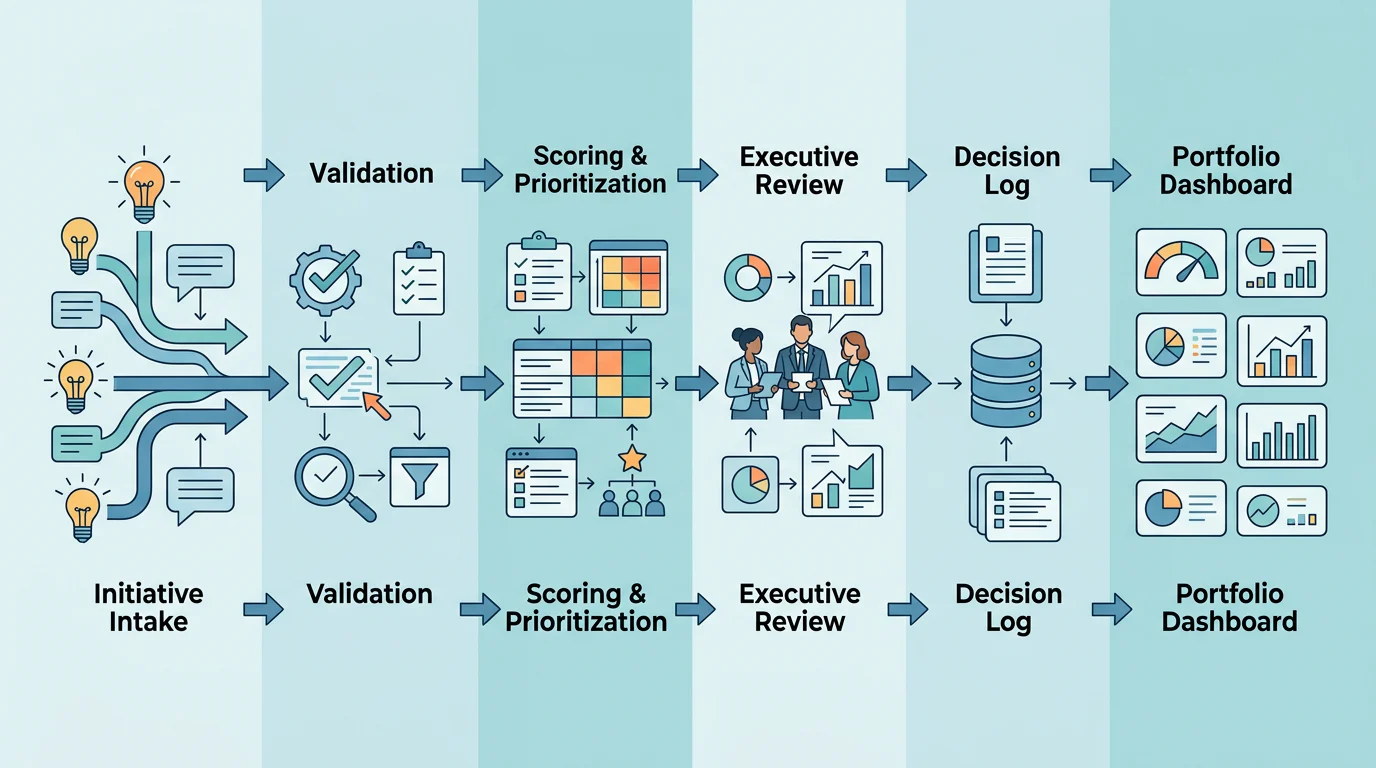
- Collect intake information and confirm that each proposal has evidence, a sponsor and a strategic rationale.
- Categorise work, identify mandatory obligations and apply agreed evaluation criteria.
- Compare scenarios against value, risk, dependencies, funding and capacity.
- Convene the decision forum to approve, defer, pause, stop or reallocate work.
- Record the decision, rationale, assumptions and action owner in a decision log.
- Review portfolio health and rebalance when strategy, risk or capacity changes.
Report Portfolio Health, Not Just Schedule Health
An executive portfolio report should show expected value, benefit forecasts, portfolio-level risk, capacity demand, material dependencies and decisions required. A collection of red, amber and green project schedules cannot show whether the whole investment mix still supports strategy.
We use portfolio guidance to keep reporting focused on value, resource management and benefits, rather than treating component delivery status as the complete picture.
How Do You Choose Practical PfMP Training?
We advise senior program leaders to choose support based on the gap they need to close. A formal portfolio title is less useful than evidence of strategic decisions, stakeholder influence, investment trade-offs and responsibility across related work.
If your current role lacks formal program or portfolio structures, start by mapping the decisions you already influence. You may have contributed to strategic prioritisation, cross-functional capacity planning, investment reviews or benefits tracking without using portfolio language. Our transition guide helps identify the capability shifts that matter when moving from program delivery to portfolio leadership.
Use the following rubric to ask for evidence before you enrol. A strong answer is specific, visible and connected to a real learning activity or deliverable.
| Evaluation Area | Weak Evidence | Strong Evidence |
|---|---|---|
| Live Instruction | Recorded material only | Scheduled live teaching with meaningful questions and discussion |
| Mentor Access | General community access | Defined individual access and feedback boundaries |
| Application Review | Generic templates | Personalised review, revision guidance and evidence checks |
| Casework | Definitions or isolated questions | Cases involving strategy, risk, capacity and sponsor conflict |
| Mock Analysis | Score only | Domain-level debriefs that explain the reasoning behind choices |
| Implementation Artifacts | Slide decks only | Usable intake, scoring, governance, reporting and decision-log tools |
The APM framework reinforces the practical standard: practitioners should compare likely value, consider finance and resource availability, and recommend whether initiatives should start, continue or close.
Choose training now when you can use the learning to improve documented decisions, sharpen certification readiness and influence a real review cycle. Wait only when there is no relevant evidence to examine and no workplace context in which to practise the capability.
How Should You Run Your First Portfolio Review Cycle?
After training, avoid trying to redesign the whole organisation. We recommend a bounded first cycle that tests the decision system with a manageable group of current and proposed initiatives, then captures what needs refinement.
The assurance workbook emphasises active governance, benefits, resources, risk, stakeholders and forward-looking performance. Those are the signals we would bring into an initial review.

Build the First-Cycle Checklist
- Confirm Decision Rights: Identify the sponsor, decision forum, escalation path and accountable owner for the review.
- Set The Portfolio Boundary: Create a current register of proposed, active, paused and completed components.
- Agree Evaluation Evidence: Define strategic fit, benefits, risk, dependencies, funding and capacity information before scoring begins.
- Create Scenarios: Compare at least two credible portfolio mixes and document assumptions behind each one.
- Make And Record Decisions: Capture approvals, deferrals, pauses, terminations and reallocations with a rationale.
- Publish A Decision-Focused Report: Show value, risk, capacity, benefits and actions required for executive attention.
- Refine The Routine: Gather feedback, fix missing data and set the trigger for the next review.
This first cycle is where implementation coaching becomes valuable. It turns a course artifact into a working management routine, while keeping the scope small enough for stakeholders to understand and adopt. Our support self-assessment can help you decide whether your next need is exam practice, evidence feedback or governance support.
Why Learn with Augment Consultancy?
At Augment Consultancy, we built our learning approach for senior practitioners who need more than recall. We connect the five PfMP domains to scenario analysis, application evidence, governance conversations and the artifacts used in a first portfolio review. You learn with PMI-certified experts with 20+ years of experience, then use that perspective to test strategic fit, funding choices, capacity constraints, risk and benefits. We help you ask sharper questions about the support you need, whether you are preparing documented experience, strengthening exam reasoning or introducing a decision routine where none exists. Our aim is simple: leave you able to explain, defend and communicate portfolio choices with executive stakeholders. Before enrolling, use our rubric to compare live instruction, individual feedback, casework, mock analysis and implementation artifacts. That keeps the decision focused on evidence. Explore our learning approach, current options and resources through Augment Consultancy.
FAQs on Practical PfMP Training
Does Practical PfMP Training Need to Teach More Than Exam Content?
Yes. We expect effective training to combine exam-domain knowledge and mock analysis with intake, prioritisation, governance, reporting and portfolio decisions leaders can apply responsibly at work.
Do I Need a Formal Portfolio Title Before I Start?
No. We focus on the strategic decisions and documented responsibilities you perform, then help you separate learning readiness from the independent certification eligibility assessment process.
What Should a Provider Prove Before I Enrol?
Ask for evidence of live instruction, mentor access, application feedback, casework, mock analysis and usable artifacts, plus a clear explanation of every included service before enrolling.
What Should an Executive Portfolio Report Show?
We would include strategic value, expected benefits, risk exposure, capacity demand, funding implications, dependencies and decisions required, rather than relying on project schedules alone in isolation.
How Soon Can I Use What I Learn?
Begin with a bounded review cycle: confirm decision rights, gather comparable data, test scenarios, record choices and report results, then refine the routine through stakeholder feedback.