How to Learn PfMP from Program Management: PfMP Fundamentals for Program Managers
Learn PfMP fundamentals for program managers through five applied modules, decision templates, a readiness test, and a legitimate certification path.

PMI’s current PfMP examination has 170 questions, which makes it tempting to begin with study materials instead of the decisions the credential is designed to test.
PfMP fundamentals for program managers begin with a shift in the unit of decision: from running one coordinated program to choosing and rebalancing the entire investment portfolio. Learn how strategy, governance, capacity, value, risk, and stakeholder communication shape those choices before you memorize terminology or take practice questions.
This learning path explains the responsibility shift, teaches five concepts through applied decisions and artifacts, and shows how to tell a knowledge gap from an experience gap.
What Changes When You Move from Program Management to PfMP?
Program management remains valuable preparation because it teaches benefits, dependencies, stakeholder tradeoffs, and coordinated delivery. Portfolio management raises the altitude. Instead of asking whether a program is progressing well, the portfolio leader asks whether the organization should continue investing in that program when compared with every other available use of funding and people.
PMI defines a portfolio as a collection of work grouped to achieve strategic objectives, and its components do not need to be related. That distinction in the portfolio standard matters. A program manager optimizes coordinated delivery. A portfolio leader optimizes the investment mix.
| Decision Level | Core Question | Primary Responsibility | Typical Evidence |
|---|---|---|---|
| Project | Can we deliver this output? | Scope, schedule, cost, quality | Charter, plan, status report |
| Program | Are related initiatives producing intended benefits? | Dependencies, benefits, coordinated delivery | Benefits map, roadmap |
| Portfolio | Is this the right investment mix for strategy? | Selection, prioritization, authorization, rebalancing | Portfolio charter, scoring model, health review |
For someone with deep delivery experience, the first practical move is to reinterpret familiar work. Benefit tracking becomes a comparison of benefits across components. A steering committee update becomes an input to authorization or reprioritization. Capacity planning becomes a portfolio-wide decision about which investment should receive scarce talent. Our transition guide helps make that capability shift explicit.
How Do You Learn Strategic Portfolio Alignment and Governance?
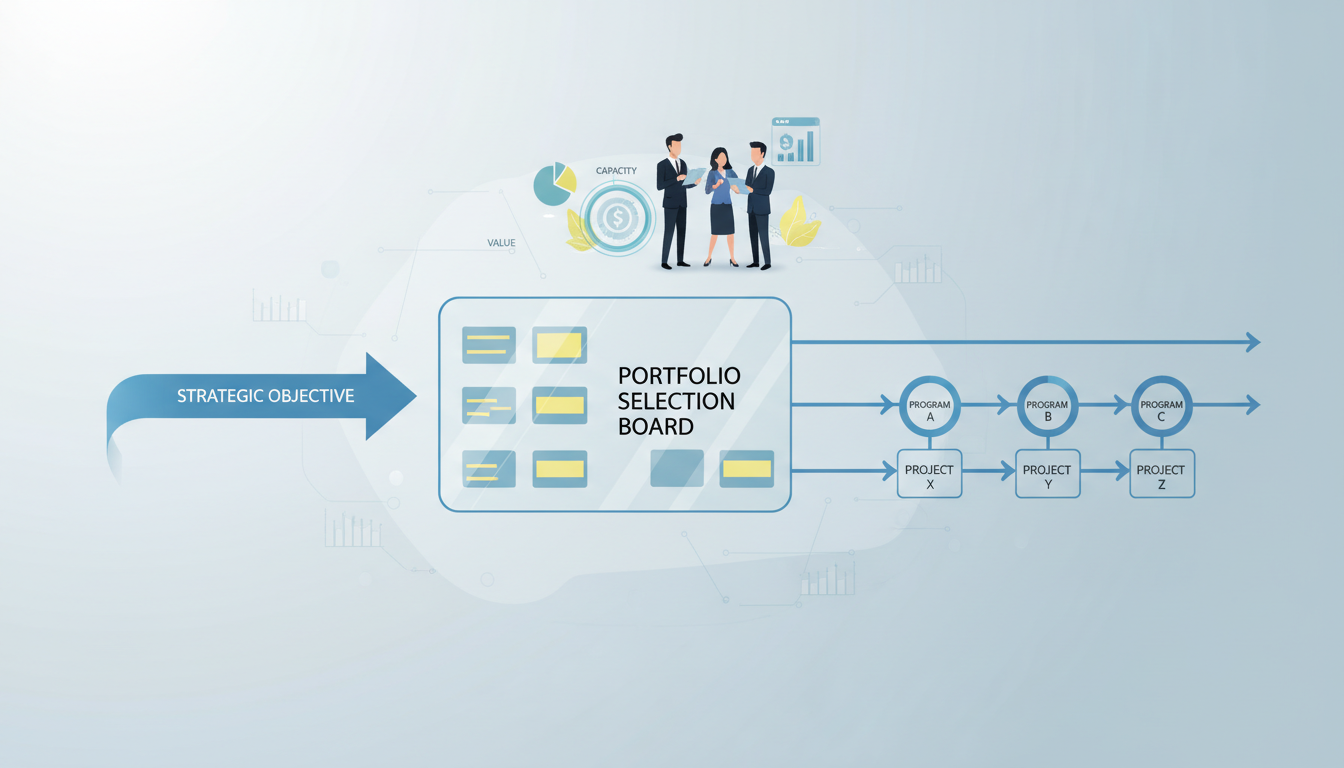
Strategic alignment and governance are where experienced program managers most often feel the unfamiliarity. They are not abstract leadership language. They are the repeatable way an organization decides what belongs in the portfolio, who may approve changes, and how it proves that resources still support strategy.
The official examination blueprint gives Strategic Alignment 25% and Governance 20% of the exam. That weighting reflects the real-world priority of deciding on the right work before pursuing flawless delivery of the wrong work. Use the official blueprint as the authoritative map, then use the modules below to make the concepts usable.
Module One: Strategic Alignment
Strategic alignment means translating organizational objectives into criteria for choosing and sequencing components. The decision example is straightforward: a company may have a technically sound internal improvement initiative, but defer it if a regulatory obligation or revenue-critical market entry has a clearer connection to strategy.
The artifact is a Strategic Alignment Canvas with six fields: objective, intended outcome, proposed component, expected benefit, assumptions, and leading indicator. For practice, take five candidate initiatives and identify which objective each one advances, what evidence supports that claim, and what would make its case weaker. Your self-check is simple: can you explain why the component belongs in the portfolio, rather than merely why it is well managed?
Module Two: Governance
Portfolio governance establishes decision rights, approval thresholds, review timing, and escalation routes. A program may be on schedule and within budget, yet still require a portfolio decision if the strategy, funding environment, or resource constraints have changed.
The artifact is a Governance Decision Log that records the decision owner, evidence reviewed, options considered, approval threshold, final decision, and next review date. For practice, assume a quarterly budget reduction and decide which components should continue, pause, or stop. Your self-check: do you know who may authorize a portfolio-level reallocation and what evidence that person needs?
Module Three: Apply Both Concepts in One Decision Memo
Bring the first two modules together in a one-page executive decision memo. State the objective, list the affected components, show the strategic evidence, summarize capacity implications, and ask for a specific governance decision. This exercise develops the judgment required for both real portfolio work and credible application examples.
Before treating any activity as qualifying experience, test whether you personally influenced component selection, prioritization, governance, or resource allocation. Our strategic-work diagnostic is built for that distinction.
How Do Portfolio Performance, Risk, and Communications Work?
The remaining three concepts teach you to look across the whole investment mix. A healthy portfolio is not a set of green project dashboards. It is a set of active, paused, and completed components that still makes sense against strategic objectives, available capacity, and risk appetite.
Module Four: Portfolio Performance
Portfolio performance asks whether the aggregate mix is delivering value, not merely whether individual components are meeting delivery targets. A delayed initiative can remain a good investment if its strategic contribution is high. A perfectly delivered initiative can become a poor investment if its expected value disappears.
Use a Portfolio Health Review template that captures strategic alignment, value trend, funding, capacity, milestone confidence, dependency exposure, and recommended decision. For practice, compare three components with different value, schedule, and resource profiles. Your self-check: can you distinguish a successful program from a component that no longer merits investment?
Module Five: Portfolio Risk Management
Portfolio risk management looks for exposure created by the mix itself. Concentration in one market, excessive dependence on a scarce skill, overlapping dependencies, or a regulatory shift can affect multiple components even when each individual risk register looks manageable.
Use a Portfolio Risk Heat Map with aggregate exposure, affected components, trigger, owner, response, and decision threshold. For practice, imagine that one specialist team supports three priority initiatives. Decide whether to sequence, reduce scope, add capacity, or defer a component. Your self-check: have you assessed the risk of the mix, rather than simply combined project risks?
Module Six: Communications Management
Communications management ensures that sponsors, delivery leaders, and stakeholders understand portfolio choices, not just status updates. The official outline assigns Communications Management 15% because stakeholder support depends on clear explanation of priorities, tradeoffs, and changes.
The artifact is a stakeholder communications plan with audience, decision needed, information need, channel, frequency, owner, and feedback loop. For practice, write a brief explaining why a funded component is being deprioritized after a strategy refresh. Your self-check: can you explain the decision without hiding behind delivery metrics? Build scenario discipline with our situational-question framework.

How Do You Map Objectives to Portfolio Components?
A prioritization worksheet turns portfolio thinking into a visible decision process. It does not replace executive judgment, and PMI does not prescribe one universal scoring formula. It makes assumptions, tradeoffs, and approval choices clear enough to challenge and revise.
Imagine a scaling company with three objectives: increase recurring revenue, improve customer retention, and maintain regulatory readiness. It has five candidate components: an enterprise pricing program, customer onboarding automation, compliance modernization, data-platform enhancement, and a brand refresh. The first task is not to rank them by enthusiasm. It is to define consistent criteria and require evidence for each score.
| Criterion | Illustrative Weight | Decision It Supports |
|---|---|---|
| Strategic Contribution | 35% | Does it directly advance a stated objective? |
| Expected Benefit And Value | 25% | Is the benefit meaningful and evidenced? |
| Capacity And Timing | 15% | Can the organization execute it now? |
| Risk And Dependencies | 15% | Does the mix create unacceptable exposure? |
| Governance And Compliance Fit | 10% | Does it meet required controls and obligations? |
In this example, compliance modernization may rank highly because it protects a mandatory objective. Onboarding automation may rank highly for both retention and scalable growth. The data-platform enhancement may deserve approval only if it enables the other components within a realistic timeframe. A brand refresh may be deferred if it lacks a direct, evidence-backed objective link.
Use four templates together: the Strategic Alignment Canvas, the Component Prioritization Worksheet, the Governance Decision Log, and the Portfolio Health Review. That sequence connects selection to authorization and later review. If you want a structured way to judge whether support will help with this work, begin with our support readiness test.
Are You Ready to Study for PfMP?
Readiness has two dimensions. You can be ready to learn portfolio concepts today while still needing more direct portfolio experience before you can make a strong application. Treating those as the same problem creates confusion, especially for directors working toward a six-month organizational deadline.
PMI currently recognizes three eligibility paths, each requiring 96 months of professional business experience within the previous 15 years. The differentiator is education level and documented portfolio-management experience. Review the current requirements before setting an exam target.
| Education | Business Experience | Portfolio-Management Experience |
|---|---|---|
| Secondary Diploma | 96 months within 15 years | 84 months within 15 years |
| Bachelor’s Degree Or Higher | 96 months within 15 years | 48 months within 15 years |
| GAC-Accredited Bachelor’s Degree Or Higher | 96 months within 15 years | 36 months within 15 years |
A useful readiness rubric scores each domain from zero to three. Zero means no direct example. One means participation or support. Two means you personally led the decision or artifact. Three means you led it, measured results, and can explain the strategic rationale. Score Strategic Alignment, Governance, Portfolio Performance, Portfolio Risk Management, and Communications Management separately.
A low score with enough qualifying months is a knowledge gap. Build the artifacts, practice decisions, and then begin focused preparation. Strong knowledge but insufficient personal examples or months is an experience gap. No course, coaching relationship, or application review can accelerate PMI’s required experience. Our flexible training formats can help busy directors plan learning around work, but they do not change eligibility.
A legitimate six-month path focuses on learning and evidence, not shortcuts. Use the first two months for alignment and governance artifacts, the next two for performance, risk, and communications practice, then map authentic examples to the five domains. Use the final two months for application organization and exam preparation if your experience is already eligible.
Learn PfMP Fundamentals with Augment Consultancy
At Augment Consultancy, we work with experienced program managers who need a practical bridge to portfolio thinking before they invest serious time in certification preparation. We teach the five domains through the decisions senior leaders actually face: choosing components, balancing resources, clarifying governance, reading portfolio health, and explaining tradeoffs to stakeholders. Our learning is led directly by certified PgMP® and PfMP® professionals with real-world program and portfolio management experience. When a candidate is already eligible, we can help them organize authentic examples, sharpen application narratives, and structure exam preparation around their real gaps. When eligibility evidence is still developing, we help them identify the portfolio responsibilities that will build credible experience. Our goal is not to make eligibility sound faster than it is. It is to make the next legitimate step obvious, practical, and worth taking. Start today with Augment Consultancy.
FAQs on PfMP Fundamentals for Program Managers
Our answers distinguish learning from eligibility.
How Should a Program Manager Start Learning PfMP?
Start by mapping organizational objectives to candidate components, then practice deciding what to fund, defer, rebalance, or stop. That creates the portfolio perspective required for PfMP.
Can Ten Years of Program Management Make Me Eligible for PfMP?
Not automatically. PMI evaluates documented portfolio-management experience within the required time window, so program tenure counts only when your personal work demonstrates portfolio-level decisions across all domains.
What Should I Learn Before Paying for PfMP Certification Support?
First identify whether your gap is conceptual knowledge, application evidence, eligibility, or exam performance. Structured help is valuable when it targets the gap you actually have.
Can a Six-Month Plan Make Me PfMP Eligible Faster?
No. Six months can accelerate learning, artifact creation, and preparation, but it cannot shorten PMI’s required portfolio-management experience or replace credible, personally led examples in applications.
What Should Legitimate Application Help Do?
It should help you organize real contributions against PMI domains, clarify evidence and outcomes, and improve writing. It should never invent, inflate, or replace experience.
When Is Self-Study Enough for PfMP Preparation?
Self-study works when you have qualifying examples and sound portfolio judgment. Use our self-study comparison to decide whether focused feedback would close your remaining preparation gaps.