Can PgMP Applications Use Industry Terminology? The PgMP Application Terminology Guide


TL;DR
We explain how PgMP applicants can retain necessary industry language while translating it into independently understandable evidence of coordinated program responsibility. Our method covers terminology, agile and hybrid delivery, sector examples, governance, and a reviewer rubric that preserves authenticity without inflating project work.
PMI currently requires candidates using the bachelor’s degree route to document 48 months of both project and program management experience within the previous 15 years under its standard pathway. Its eligibility rules make the experience record a serious part of the certification journey, not a formality.
PgMP application terminology can include necessary industry terms, provided each term lets an external reviewer understand your program responsibility. Keep accurate domain language, define unfamiliar shorthand once, and link it to related components, shared benefits, interdependencies, strategic alignment, leadership decisions, and governance evidence. Authentic clarity matters more than imitating PMI vocabulary.
We will show which terms to retain, how to translate six industry examples, and how to write evidence that remains true to your work. We will also cover agile and hybrid delivery, an annotated summary, and a reviewer-comprehension check.
What Does PMI Need a PgMP Application to Document?
A strong application does two jobs at once. It records the program’s objective, your role, benefits, and component projects, then demonstrates how you exercised program-level judgment through Strategy, Leadership, and Governance summaries.
PMI asks for tangible, measurable benefits and detailed examples that help reviewers see the applicant’s own program management actions. Its PgMP handbook does not require you to abandon the language of your field. It requires that your terminology make coordinated responsibility, common objectives, and realized benefits understandable.
This distinction matters when candidates try to make a specialized environment sound generic. A government authorization, clinical pathway, release train, or infrastructure possession can remain in the summary if the reader can understand why it mattered to the program and what you did with it. Our domain-mapping guide helps connect non-standard experience to the required perspective without rewriting the work into something else.
Do not look for a published percentage split between documenting past work and demonstrating strategic thinking. PMI does not publish one. Instead, treat your past work as the proof and your strategic, leadership, and governance decisions as the explanation of why that work qualifies as program management.
Which PgMP Application Terminology Can You Keep?
Keep terms that preserve important technical, contractual, regulatory, or operational meaning. Define terms that an experienced reviewer from another sector could misunderstand, especially acronyms, internal framework names, proprietary metrics, and local names for governance forums.
The practical test is simple: if removing the term would make the work inaccurate, retain it. If using the term alone would hide the decision, dependency, or benefit, give it a plain-language definition and continue the sentence with its program-level significance. Our documentation rubric is useful for testing this distinction before drafting summaries.
| Original Term | Plain-Language Definition | Program-Level Meaning | Evidence To Name | Weak Wording To Avoid |
|---|---|---|---|---|
| Release train | Coordinated teams delivering related increments | Sequenced product, data, security, and adoption dependencies | Integrated roadmap, dependency decision, benefit measure | “Ran sprint ceremonies” |
| North Star metric | Shared customer or value measure | Aligned several product initiatives and trade-offs | Metric baseline, steering decision, outcome trend | “Owned the product roadmap” |
| Authority to operate | Formal approval for a system to operate | Governed compliance dependencies before deployment | Approval record, risk acceptance, authorization decision | “Helped with compliance” |
| Clinical pathway | Standardized care process | Coordinated clinical, digital, training, and operational change | Quality measure, clinical approval, adoption evidence | “Implemented a pathway” |
| Possession | Approved access window for rail work | Balanced access, safety, procurement, and delivery dependencies | Access decision, milestone impact, safety controls | “Managed the construction project” |
| Deployment wave | Planned rollout cohort or sequence | Sequenced capability releases, readiness, and benefits realization | Readiness criteria, sponsor decision, adoption measure | “Led the transformation” |
The table is not a vocabulary substitution exercise. It is a way to preserve the term that accurately describes your environment while making the management meaning explicit. A reviewer should never have to infer whether you managed a project task, coordinated a program decision, or merely attended a meeting.
How Do You Translate Industry Language into Program Evidence?
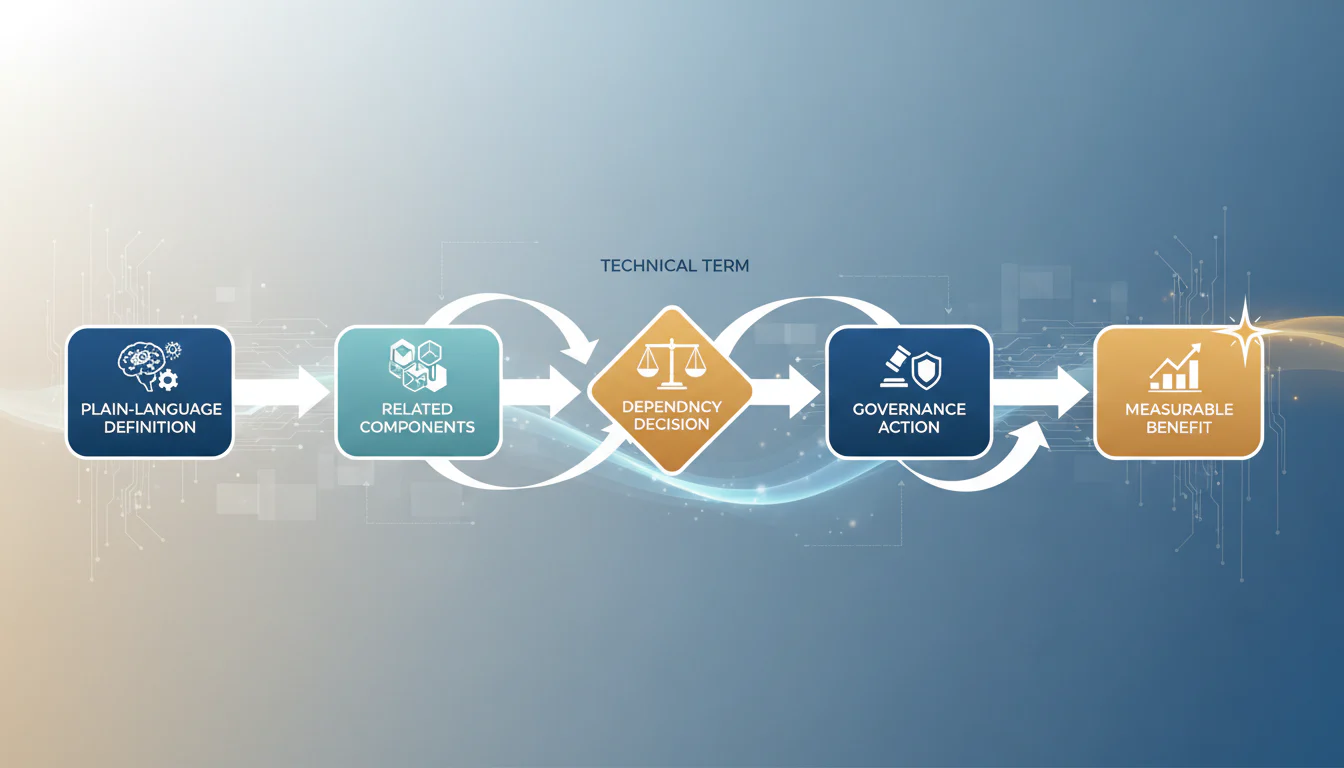
Industry terminology becomes useful when it leads the reader to evidence. We use a five-part method: retain the term, define it briefly, identify the related components, state the interdependency or decision, and show the benefit or risk affected.
PMI’s current program standard describes programs as coordinated related projects that create benefits beyond what the components could achieve separately. That program standard is the right lens for translating specialized work, regardless of the delivery method used in your organization. Our readiness scorecard can help you test whether the evidence is clear before submitting.
Connect Terms to Related Components
Name the workstreams or projects that were actually related. Then explain the relationship: one component enabled another, shared a benefit target, competed for a resource, depended on a decision, or had to be sequenced to protect the outcome.
“Coordinated the release train” is incomplete because it only identifies activity. “Coordinated the release train, a set of related delivery teams, by resequencing identity, data, and customer-onboarding components after a security decision” gives the reviewer a program relationship to assess.
Connect Components to Shared Benefits
Deliverables do not automatically demonstrate benefits. State the organizational result the related components were intended to create, then explain how you monitored or protected that result while priorities changed.
Useful evidence includes:
-
Benefit evidence: A benefits realization plan, dashboard, baseline, target, adoption measure, service outcome, cost measure, or compliance outcome.
-
Interdependency evidence: An integrated roadmap, dependency log, sequencing decision, interface risk, or coordinated milestone plan.
-
Stakeholder evidence: Acceptance criteria, stakeholder map, decision record, executive meeting outcome, or documented alignment on trade-offs.
Connect Evidence to Your Authority
Do not write as though you personally owned every decision if you did not. Be precise about whether you recommended options, coordinated an escalation, chaired a forum, obtained approval, adjusted sequencing, or made a delegated decision.
That precision protects your credibility and makes the program role easier to see. Before submission, use our panel review guide to separate evidence of genuine program responsibility from a polished description of component-level delivery.
Does PMI Accept Agile and Hybrid Programs?
Agile delivery is not automatically a problem for a PgMP application. PMI’s current program standard says it applies across diverse organizations irrespective of project delivery methods, so the method itself is not the deciding factor.
The real question is whether the application makes program-level coordination visible. An agile environment can contain multiple related components, strategic trade-offs, benefit measures, stakeholder alignment, and governance. A predictive environment can contain the same. A hybrid environment simply requires clearer explanation of how the different delivery approaches were coordinated.
| Work Type | What Makes It Credible Program Experience | What Does Not Establish Program Experience |
|---|---|---|
| Agile program | Coordinated teams, shared benefits, release dependencies, cross-team decisions, and governance | Running ceremonies for one delivery team |
| Hybrid program | Managed interfaces between iterative, regulatory, procurement, or construction components | Listing several methods without explaining coordination |
| Large project | May be strategically important, but remains one deliverable unless related components and benefits are managed together | Renaming a large project as a program |
| Portfolio work | Shows investment selection or prioritization across initiatives | Claiming portfolio oversight as direct program management |
Describe hybrid work plainly. Identify the adaptive components, the predictive or regulated components, the points where they depended on one another, and the decision cadence that kept them aligned. Our application support overview can help you test whether that explanation distinguishes projects, programs, and portfolios without forcing your experience into a template.
How Can You Show Strategy, Leadership, and Governance Without Keyword Stuffing?
The cleanest summaries use the language of your actual decisions. A reader should see strategy because you connected work to an organizational objective, leadership because you aligned people with different interests, and governance because you established or used decision rights, controls, and escalation paths.
PMI asks applicants to provide specific program details, methods, strategies, quantified goals, and results. Its summary guidance supports specific evidence, not repetitive labels such as “strategic,” “leader,” or “governed.”

Make Strategy Visible
Start with the organizational need, not the delivery artifact. Explain the benefit the program was intended to produce, the competing options or constraints you faced, and the decision you made to preserve strategic value.
For example, an applicant can describe how they resequenced adoption work after a regulatory delay because the original order would have delayed the intended customer outcome. That is stronger than saying they “ensured strategic alignment.”
Make Leadership Visible
Leadership evidence names stakeholders and shows how you handled differing priorities. Explain what expectations conflicted, how you clarified acceptance criteria, and what you did to gain agreement or escalate a decision.
Avoid claiming that you “managed stakeholders” without an action. A credible summary describes the forum, the disagreement, the information used, the decision path, and the resulting alignment.
Make Governance Visible
Governance is not a synonym for status reporting. Show the controls that shaped program decisions: a steering committee, approval threshold, risk escalation, phase gate, benefits review, delegated authority, or decision log.
Your role must stay accurate. State whether you established the mechanism, used an existing mechanism, prepared options for decision makers, or acted within formally delegated authority. Our review approach is built around preserving that distinction.
Use an Annotated Summary and Review Checklist
Here is an illustrative summary that retains authentic terminology while making its meaning clear:
I led a regional care-modernization program that used a clinical pathway, a standardized process for coordinating patient care, across digital intake, clinician training, and operating-model components. When readiness reviews showed that the digital intake component would reach sites before training and workflow redesign, I presented sequencing options to the clinical steering group. I recommended delaying rollout at unprepared sites while continuing implementation where readiness criteria were met. This protected patient-safety requirements and the program’s shared objective of improving consistent access to care. I tracked readiness, escalated unresolved staffing risks, and used governance reviews to confirm decisions with clinical and operational sponsors.
-
Term Retained: “Clinical pathway” preserves the healthcare context.
-
Plain Meaning Added: The definition lets a reviewer understand the term without sector knowledge.
-
Related Components Named: Digital intake, training, and operating-model work show coordinated scope.
-
Interdependency Explained: Training and workflow readiness affected safe rollout.
-
Authority Stated Honestly: The applicant recommended options and presented them to the steering group.
-
Governance And Benefit Evidence Included: Readiness reviews, escalation, safety, sponsors, and consistent access make the program logic visible.
Use these eight questions before submitting:
- Would an external reviewer understand every acronym on first use?
- Did we define internal framework names or metrics that change the meaning?
- Did we name multiple related components rather than one large project?
- Did we explain a genuine dependency, shared benefit, or trade-off?
- Did we state our actual decision, recommendation, escalation, or authority?
- Did we demonstrate strategy, leadership, or governance through actions?
- Can each claimed benefit be tied to a metric, target, baseline, or evidence source?
- Could a former sponsor or stakeholder confirm every material statement?
Never inflate project work into program responsibility. Do not claim authority you did not hold, invent benefit ownership, or use language written by someone else as your own, because PMI requires application responses to be unique to the applicant.
Work with Augment Consultancy
At Augment Consultancy, we help experienced program leaders turn real, complex work into applications that an independent reviewer can follow without diluting industry expertise. We do not replace your voice or create fictional responsibility. Instead, we help you identify the evidence behind your decisions, distinguish coordinated program work from component delivery, and test whether each summary shows strategy, leadership, and governance. Our review process is especially useful when your work spans agile product releases, regulated environments, infrastructure delivery, or enterprise change, where local language can hide program-level accountability. We also connect the application narrative to the way you will later prepare for the assessment, so the same authentic examples remain useful. We will give you a clear, practical way to preserve your terminology while making your responsibility legible. Explore our application-to-exam method, compare personalized feedback, or begin with Augment Consultancy.
FAQs on PgMP Application Terminology
These questions address the wording choices that most often determine whether specialized experience reads as credible program management. Each answer should be applied alongside the specific facts of your own role.
Can I Use Acronyms in My PgMP Application?
Yes. Retain a precise technical acronym when it conveys real context, but define it on first use and immediately show its program-level decision, dependency, or benefit.
Does PMI Accept Agile Programs for PgMP?
Yes, agile delivery can support a credible program entry when multiple related components, shared benefits, interdependencies, and program-level leadership are explicit. The delivery method alone proves nothing.
How Much Is Past Work Versus Strategic Thinking?
PMI requires both. The application documents what you did, while summaries must show how your program decisions advanced strategy, stakeholder alignment, governance, and measurable organizational benefits.
How Do I Distinguish a Program from a Project?
Name the related components, explain their interdependency and shared objective, then show the coordination or governance decision you made. A large delivery alone remains project work.
Where Should I Test Readiness Before Submitting?
Use a structured review before submission to check scope, evidence, terminology, and summary consistency. It can reveal gaps before you commit to a finished application.